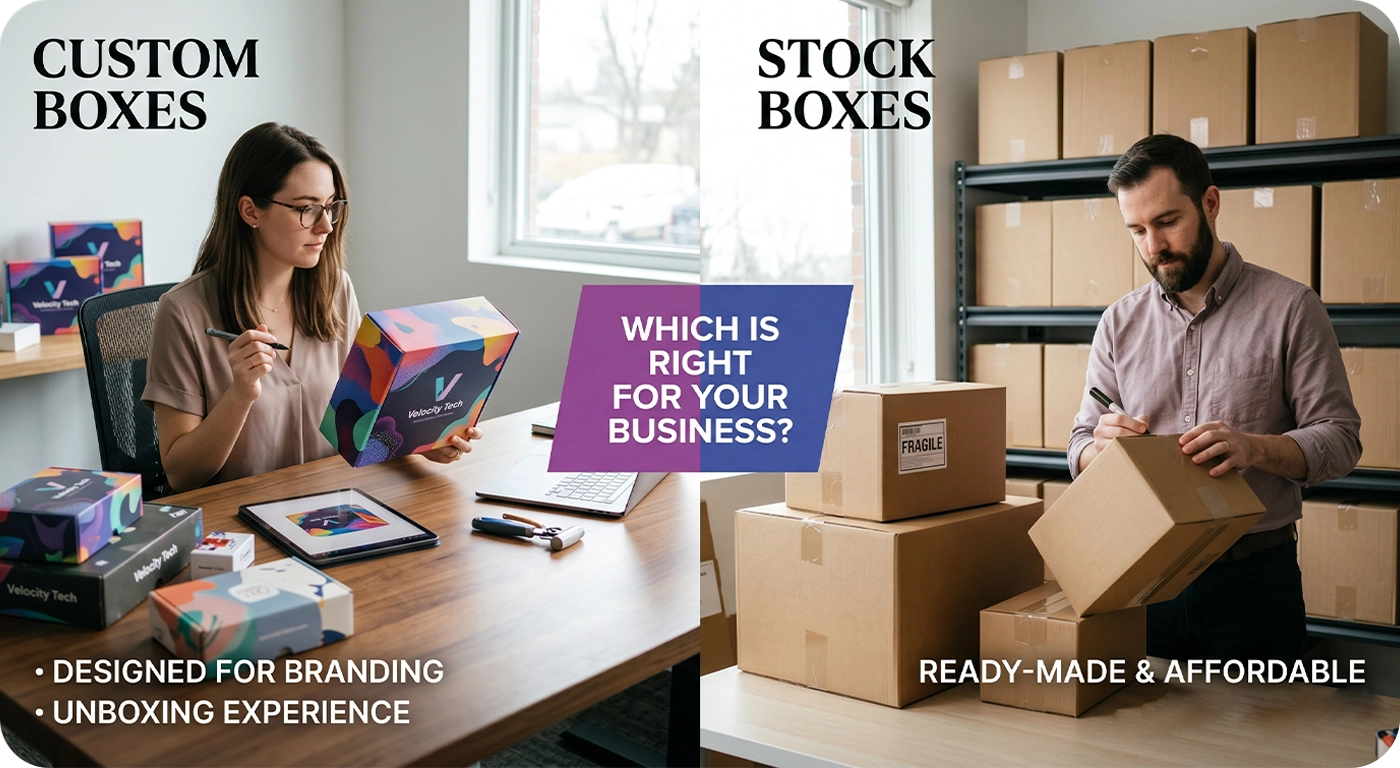
When you are launching a product or running an e-commerce store, every single penny counts. As you map out your shipping and fulfillment strategy, one critical question will inevitably pop up: “Should I just buy cheap, standard boxes in bulk, or should I invest in custom-branded packaging?”
It’s the classic battle between Stock Boxes and Custom Boxes.
While stock boxes are tempting because of their low upfront cost, custom packaging has become the secret weapon for rapidly growing brands across the US. But which one actually makes sense for your business model and bottom line?
Let’s break down the pros, cons, and real costs of both options so you can make an informed decision.
What is a Stock Box? (The One-Size-Fits-All Approach)
Stock boxes are the standard, unbranded cardboard boxes you can buy off the shelf in bulk from industrial suppliers. They usually come in plain brown (kraft) or standard white, with no logos, no custom inserts, and fixed dimensions.
The Pros:
-
Lower Initial Cost: They are cheap to buy in small quantities since there are no design or setup fees.
-
Instant Availability: Because they are pre-made, they ship out immediately. You don’t have to wait for a manufacturing queue.
-
Low Minimum Order Quantities (MOQs): You can buy 20 or 50 boxes at a time if you are just testing the waters.
The Cons:
-
The "Boring" First Impression: Your package looks exactly like an electric bill or a generic supply shipment. It does zero marketing work for your brand.
-
Wasted Space and Higher Shipping Costs: If your product doesn’t perfectly fit the pre-made dimensions, you pay to ship trapped air. Even worse, carriers like UPS and FedEx charge based on Dimensional (DIM) Weight—meaning bigger boxes cost more to ship, even if they are light.
-
Excessive Bubble Wrap: To keep products from rattling around in an oversized stock box, you have to pack it with packing peanuts, paper, or bubble wrap. This adds extra costs and creates a messy unboxing experience.
What is a Custom Box? (The Tailored Brand Experience)
Custom boxes are engineered from scratch specifically for your product and your brand. You control the exact dimensions, the material thickness, the interior structures (like custom inserts), and the printed artwork inside and out.
The Pros:
-
A Marketing Powerhouse: Every hand that touches that box—from the delivery driver to the customer's neighbors—sees your logo. It builds immediate brand recognition.
-
Optimized Shipping Costs: Because the box is tailored to your product, there is no wasted space. This keeps your DIM weight low and saves you massive amounts of money on shipping costs in the long run.
-
The Social Media "Unboxing" Effect: Customers love sharing beautiful packaging on TikTok and Instagram. A custom box turns a mundane delivery into a shareable experience, giving you free organic marketing.
-
Better Product Protection: Custom inserts hold your items firmly in place, drastically reducing product damage and expensive return rates during transit.
The Cons:
-
Higher Upfront Investment: There is usually a setup or tooling fee for the initial run, and the cost per unit can be higher for small orders.
-
Lead Times: They aren’t sitting on a shelf. Custom boxes take time to design, print, cut, and manufacture.
Head-to-Head Comparison: At a Glance
| Feature | Stock Boxes | Custom Boxes |
| Upfront Price | Very Low | Moderate to High |
| Long-Term Shipping Efficiency | Poor (Wasted space adds to DIM weight) | High (Perfect fit saves shipping costs) |
| Brand Recognition | None | Maximum Impact |
| Product Protection | Requires extra void-fill (bubble wrap) | Superior (Custom inserts available) |
| Turnaround Time | Immediate | Requires manufacturing lead time |