Understanding Antimicrobial Packaging
Antimicrobial packaging uses materials or coatings infused with agents that prevent microbial growth on products or inside the package. It’s a game-changer for industries like food, where 600 million annual foodborne illness cases demand better safety measures, and healthcare, where sterility is non-negotiable. The technology works through mechanisms like direct contact inhibition (e.g., silver nanoparticles breaking down microbial cell walls) or controlled release of agents (e.g., bacteriocins targeting specific bacteria). These methods keep products clean, reducing spoilage and infection risks.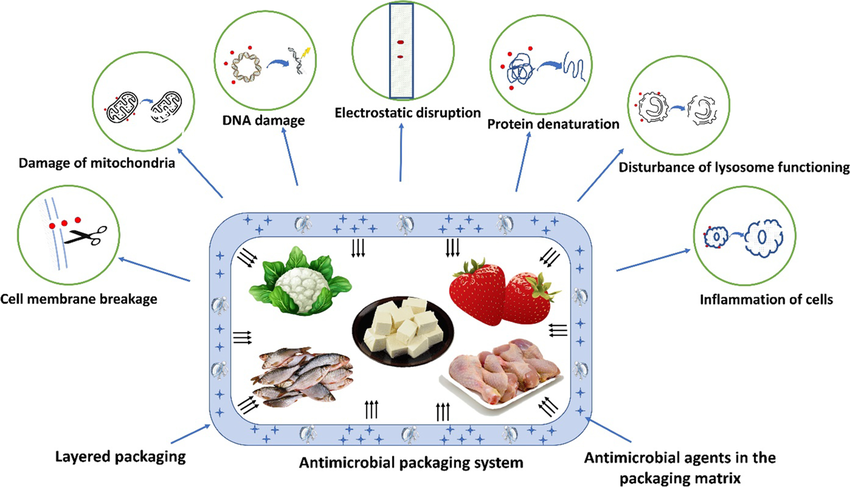 Its value lies in addressing modern needs. In food, it cuts waste by extending shelf life, while in healthcare, it ensures sterile conditions for medical devices and drugs. Regulatory bodies like the FDA and European Commission set tough standards, pushing companies to innovate for efficacy, safety, and eco-friendliness. With consumers increasingly focused on hygiene and sustainability, antimicrobial packaging is becoming a must-have for safe product delivery.
Materials Used in Antimicrobial Packaging
The success of antimicrobial packaging hinges on choosing the right materials and agents, balancing functionality, cost, compliance, and sustainability.
Base Materials
Plastics dominate with a 59.7% market share in 2023 due to their durability and ability to incorporate antimicrobial agents. Polypropylene (PP) is popular for food containers because it resists moisture, while polyethylene (PE/HDPE/LDPE) shines in flexible films and bags. Polyvinyl chloride (PVC) is a go-to for medical packaging due to its clarity and strength. But with 8 million metric tons of plastic waste hitting oceans yearly, biopolymers are gaining ground. Poly (butylene succinate) offers compostable food packaging, cellulose derivatives work for films, and starch-based materials are cost-effective for single-use items. Paper and paperboard, prized for recyclability, are used in cartons and e-commerce, with innovations like DS Smith’s antimicrobial cardboard. Emerging materials, like bacterial cellulose from IIT Hyderabad, kept tomatoes fresh for 30 days, showing the power of bio-based composites.
Antimicrobial Agents
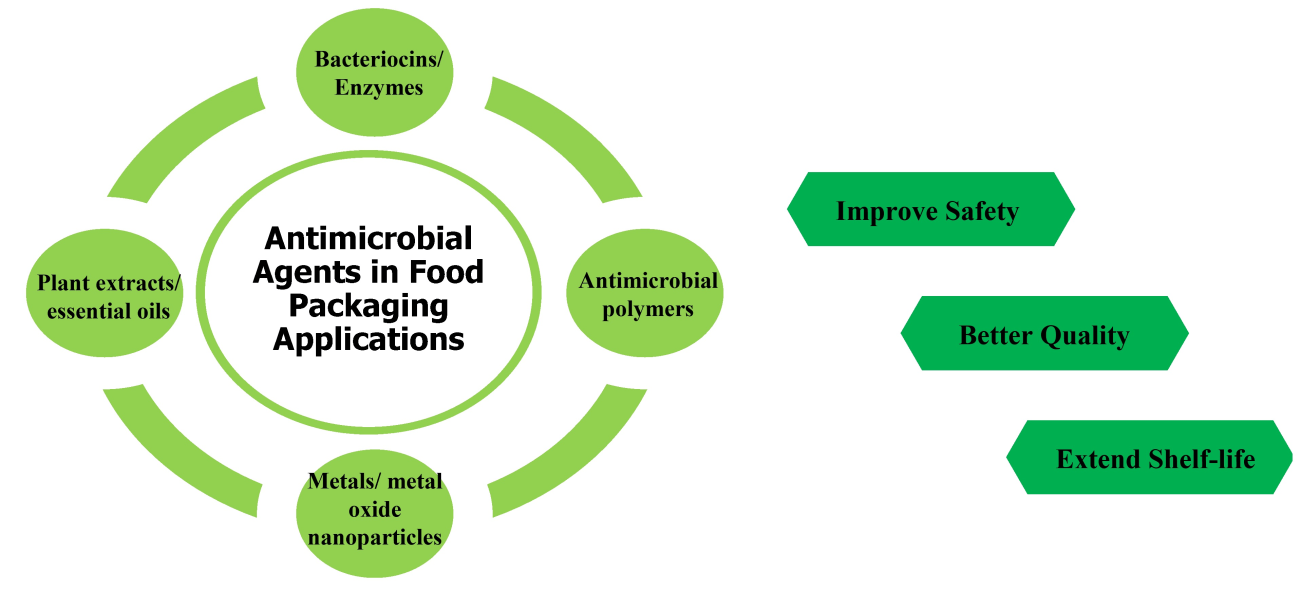 Silver nanoparticles (AgNP) deliver broad-spectrum protection, disrupting microbial cell membranes in food and medical uses. Bacteriocins, natural peptides, led the market in 2024 for their safety and precision in food preservation. Organic acids like sorbic acid offer affordable microbial control, while plant extracts, such as essential oils, provide eco-friendly options. Other agents, like quaternary ammonium compounds and enzymes, cater to niche needs. Combining these materials and agents allows for customized solutions, with research focused on cutting costs and boosting sustainability.
Types of Antimicrobial Packaging
Antimicrobial packaging is categorized into two primary types—migratory and non-migratory—based on how antimicrobial agents interact with the packaged product. Each type is tailored to specific industry needs, offering distinct mechanisms to ensure product safety, extend shelf life, and comply with regulatory standards.
Migratory Antimicrobial Packaging
Mechanism and Functionality
Migratory antimicrobial packaging involves agents that diffuse from the packaging material into the product or the package’s internal environment to inhibit microbial growth. These agents, such as bacteriocins or organic acids, migrate to the product surface, creating a protective barrier against pathogens like Salmonella or E. coli. This active release mechanism ensures antimicrobial action extends beyond the packaging surface, making it highly effective in high-moisture environments where microbes thrive. The diffusion process is carefully controlled to maintain consistent antimicrobial activity, ensuring long-term protection for perishable products.
Key Applications
Migratory packaging is a cornerstone in the food industry, particularly for perishable goods like meat, dairy, and fresh produce. For example, nisin-coated films used in poultry packaging reduce Listeria growth by 99%, extending shelf life by up to 30%. These films are applied to products like chicken breasts or cheese, where the antimicrobial agent migrates to the surface to prevent spoilage during storage and transport. In bakery products, organic acids like sorbic acid migrate to inhibit mold growth, maintaining freshness for weeks. This type is also explored in beverage packaging to prevent microbial contamination in liquid products like juices.
Advantages
Migratory systems are highly effective in high-moisture environments, where microbes proliferate rapidly. Their ability to actively suppress microbial growth makes them versatile for food preservation, especially for products with short shelf lives like fresh meat or dairy. In 2021, migratory packaging led the market due to its effectiveness in combating spoilage, contributing to reducing the 33% of global food production lost annually. The use of natural agents like bacteriocins aligns with consumer demand for minimally processed, safe foods, enhancing market appeal. Additionally, migratory systems can be tailored to specific pathogens, offering targeted protection.
Regulatory and Safety Considerations
Migratory agents face stringent regulatory oversight due to their interaction with the product. The FDA’s Food Safety Modernization Act mandates extensive safety testing to ensure migrated agents are safe for consumption, particularly in food packaging. For instance, bacteriocins undergo toxicity and migration studies, costing up to USD 500,000 per agent and taking 12-18 months to gain approval. European Commission standards further require detailed documentation to confirm compliance, complicating global market entry. These regulations ensure consumer safety but increase development timelines and costs.
Challenges
The high cost of developing and testing migratory agents, which can increase production expenses by 20-30%, limits adoption, particularly for small and medium-sized enterprises (SMEs). The potential for migrated agents to alter the product’s taste, texture, or nutritional profile raises concerns, especially in sensitive applications like dairy or beverages. Research is ongoing to optimize migration rates and develop natural agents, such as plant-based essential oils, which could reduce costs by 15% by 2027 while maintaining efficacy and consumer acceptance.
Non-Migratory Antimicrobial Packaging
Mechanism and Functionality
Non-migratory antimicrobial packaging uses agents that remain fixed within or on the surface of the packaging material, acting only upon direct contact with microorganisms. Agents like silver nanoparticles or antimicrobial coatings are embedded in the material, providing a stable barrier that neutralizes microbes without releasing chemicals into the product or environment. This contact-based mechanism ensures consistent, long-term protection, making it ideal for applications where chemical migration could pose safety or regulatory concerns.
Key Applications
Non-migratory packaging is widely used in healthcare for sterile packaging of medical devices and pharmaceuticals. For example, silver nanoparticle-coated films in medical device trays prevent microbial contamination without leaving residue, ensuring sterility for items like surgical tools or implants. In e-commerce, DS Smith’s antimicrobial cardboard maintains hygiene during shipping, critical for the 20% rise in e-commerce packaging demand since 2020. In food packaging, non-migratory systems are applied to dry goods like snacks or cereals, where agent migration could affect product quality, ensuring safety without altering composition.
Advantages
Non-migratory systems provide reliable, maintenance-free protection, making them ideal for sensitive applications like pharmaceuticals, where unintended chemical transfer is unacceptable. Their fixed nature ensures compliance with stringent standards from the FDA and European Commission, which prohibit chemical migration in medical and certain food applications. They reduce infection risks by up to 40% in hospital settings, making them critical for sterile environments. Additionally, non-migratory packaging offers consistent antimicrobial action over extended periods, reducing the need for reapplication and enhancing durability.
Regulatory and Safety Considerations
Non-migratory packaging faces fewer regulatory hurdles than migratory systems since agents do not transfer to the product. However, developing embedded agents like silver nanoparticles requires significant investment in material engineering, with testing costs reaching USD 500,000. Regulatory bodies mandate stability and efficacy tests to ensure fixed agents remain effective throughout the product’s shelf life. Compliance with standards like the FDA’s Food Safety Modernization Act ensures safety, particularly for medical applications, but adds to development costs.
Challenges
The higher upfront cost of embedding antimicrobial agents, which can exceed migratory systems, poses a barrier, especially for budget-conscious manufacturers. Non-migratory packaging may also be less effective in high-moisture environments, where microbes thrive beyond the packaging surface, limiting its use in some food applications. Research is advancing to improve efficacy in diverse conditions, with nanotechnology innovations like silver nanoparticle optimization enhancing performance in challenging settings.
Antimicrobial Packaging Market Size and Growth
The antimicrobial packaging market is booming, driven by demand for safe, sustainable solutions. Key projections include:- Market Research Future (2023): USD 7.36 billion in 2023, set to hit USD 15 billion by 2035 (CAGR 6.12%).
- Towards Packaging (2025): USD 12.73 billion in 2025, growing to USD 20.96 billion by 2034 (CAGR 5.7%).
- Grand View Research (2023): USD 11.11 billion in 2023, reaching USD 21.46 billion by 2030 (CAGR 7.6%).
- Research Nester (2025): USD 11.54 billion in 2025, soaring to USD 33.67 billion by 2037 (CAGR 9.1%).
- Fortune Business Insights (2023): USD 11.69 billion in 2023, hitting USD 21.46 billion by 2032 (CAGR 7.1%).
- Polaris Market Research (2024): USD 13.84 billion in 2025, reaching USD 28.57 billion by 2034 (CAGR 7.5%).
- Verified Market Research (2024): USD 11.24 billion in 2024, growing to USD 16.57 billion by 2032 (CAGR 5.49%).
- TechSci Research (2024): USD 11.62 billion in 2024, reaching USD 16.72 billion by 2030 (CAGR 6.09%).
Market Trends Shaping Antimicrobial Packaging in 2025
The antimicrobial packaging market in 2025 is driven by trends reflecting tech advancements, consumer needs, and regulations.Sustainability and Eco-Friendly Solutions
Environmental concerns are pushing biodegradable and recyclable materials. Biopolymers like starch and cellulose cut reliance on plastics, tackling the 8 million metric tons of plastic waste entering oceans yearly. Mondi’s recyclable paper packaging for pasta, developed with Fiorini, blends antimicrobial properties with sustainability. Europe’s 67% packaging waste recycling rate in 2018 shows regulatory support, with the EU’s Circular Economy Action Plan pushing for sustainable packaging by 2030. Companies are pouring USD 1.5 billion into sustainable packaging R&D in 2024, meeting consumer demand, with 74% willing to pay more for eco-friendly options.Advanced Technologies
Smart packaging is changing the game. Coatings with sensors detect microbial activity and release antimicrobials on demand, cutting food waste by 15-20% in perishables like dairy. Nanotechnology, especially silver nanoparticles and bacterial cellulose, boosts efficacy at the molecular level. IIT Hyderabad’s bacterial cellulose films extend shelf life, with scalable applications. Nanotechnology investment for packaging is set to hit USD 2 billion by 2030, driven by precision and cost savings.Food Safety and Healthcare Demands
With 600 million annual foodborne illness cases, demand for antimicrobial packaging for perishables like meat and dairy is soaring. Bacteriocin-coated films cut Listeria in poultry by [99%, extending shelf life by 30%]. In healthcare, the global medical packaging market is projected to grow at a CAGR of 6.3% through 2030, with antimicrobial packaging ensuring sterility and reducing infection risks by up to 40% in hospital settings.E-Commerce and Regional Growth
The e-commerce surge, with a global market projected at USD 7.4 trillion by 2025, demands hygienic packaging for shipping. DS Smith’s antimicrobial cardboard, developed with Touchguard, reduces contamination risks during transit, addressing a 20% rise in e-commerce packaging demand since 2020. Asia Pacific’s urbanization (1.2 billion urban population growth from 2000-2020) and population growth drive market leadership, while North America and Europe benefit from innovation and regulations like the FDA’s Food Safety Modernization Act.Examples of Antimicrobial Packaging in Action
Antimicrobial packaging shines in real-world applications:- Bacteriocin-Coated Food Films: Used in meat and dairy, these films with bacteriocins like nisin cut spoilage bacteria, extending shelf life by 30%. Poultry packaged with nisin-coated films shows a 99% reduction in Listeria.
- Silver Nanoparticle Films: These films, used in food and medical packaging, leverage silver’s broad-spectrum power. IIT Hyderabad’s bacterial cellulose films preserved tomatoes for 30 days, preventing fungal and bacterial growth.
- Antimicrobial Cardboard for E-Commerce: DS Smith and Touchguard’s solution ensures hygiene during shipping, vital for e-commerce’s growth.
- Ophthalmic Droppers: Berry Global and Pylote’s multidose dropper maintains sterility, cutting infection risks by 50%.
- Recyclable Paper Packaging: Mondi and Fiorini’s pasta packaging combines sustainability with 25% spoilage reduction.
- Medical Device Trays: Antimicrobial trays reduce contamination risks by 40% during storage and transport.
Key Companies Driving the Market
Leading companies are shaping the antimicrobial packaging market through innovation and partnerships:| Company | Key Contribution | Focus Area | Notable Innovation | Market Impact |
|---|---|---|---|---|
| BASF SE | Develops compliant antimicrobial solutions | Food, healthcare, consumer goods | Antimicrobial defoamers | Global chemical leader |
| Mondi PLC | Pioneers sustainable antimicrobial packaging | Food, e-commerce | Recyclable pasta packaging | Sustainability leader |
| BioCote Limited | Specializes in antimicrobial additives | Food, medical, consumer goods | Additives for plastics | Strong in additives |
| Dunmore Corporation | Provides specialized antimicrobial coatings | Food, medical | Durable antimicrobial films | Niche coating leader |
| Avient Corporation | Launched antimicrobial thermoplastic elastomers | Consumer goods, healthcare | GLS Thermoplastic Elastomers | Growing in healthcare |
| The Dow Chemical Company | Scalable antimicrobial solutions for plastics and biopolymers | Food, healthcare | Antimicrobial polymers | Polymer innovation leader |
| Microban International | Leads in antimicrobial technology across sectors | Food, healthcare, consumer goods | Broad-spectrum coatings | Wide market reach |
| Klöckner Pentaplast | Focuses on antimicrobial food packaging | Food | Antimicrobial trays | Key food packaging player |
| Oplon Pure Sciences Ltd. | Specializes in medical and food packaging coatings | Healthcare, food | High-efficacy coatings | Emerging innovator |
| Takex Labo Co. Ltd. | Develops advanced antimicrobial agents | Food, medical | Novel compounds | Specialized focus |
| Berry Global | Partnered for antimicrobial ophthalmic droppers | Healthcare | Multidose dropper | Medical packaging leader |
| DS Smith | Introduced antimicrobial cardboard for e-commerce | E-commerce | Antimicrobial cardboard | E-commerce innovator |
Challenges Facing the Industry
The antimicrobial packaging market faces hurdles that need smart solutions:- High Production Costs: Adding agents like silver nanoparticles bumps up costs by 20-30%, limiting SME adoption. Antimicrobial films cost USD 0.50 more per square meter than standard ones. Research into plant-based extracts could cut costs by 15% by 2027, but scaling needs heavy investment.
- Regulatory Complexity: FDA and EU regulations require extensive testing, costing USD 500,000 per agent and taking 12-18 months. Food contact approvals involve multi-stage trials, delaying market entry. Global standard harmonization could help, but regional differences complicate compliance.
- Consumer Awareness Gaps: In regions like Africa and South Asia, only 15% of food packaging uses advanced tech. In rural India, just 10% of food manufacturers use antimicrobial solutions. Education campaigns, like those boosting adoption by 5% in India in 2024, are key.
- Safety and Toxicity Concerns: Synthetic agents like quaternary ammonium compounds raise toxicity concerns, requiring USD 500,000 safety assessments. Bacteriocins, with 95% efficacy against pathogens, are safer but need more research for scalability.
Opportunities for Growth
The market is brimming with potential:- Rising Packaged Food Demand: Urbanization (1.2 billion urban growth in Asia Pacific, 2000-2020) and rising incomes fuel demand for safe food packaging. Antimicrobial solutions for dairy and meat are set to grow at a CAGR of 7.8% through 2030, with 60% of consumers prioritizing shelf-life extension.
- Healthcare Sector Expansion: The healthcare packaging market will hit USD 180 billion by 2030, with antimicrobial packaging ensuring sterility. India’s 10% annual healthcare spending growth offers big opportunities.
- Sustainability Innovations: With 74% of consumers willing to pay more for eco-friendly packaging, biopolymers are projected to grow at a CAGR of 8.5% through 2035. Bio-based composites cut environmental impact by 20%.
- Technological Advancements: Smart coatings reduce food waste by 15-20%, and nanotechnology investments will hit USD 2 billion by 2030, cutting costs by 10% in trials.