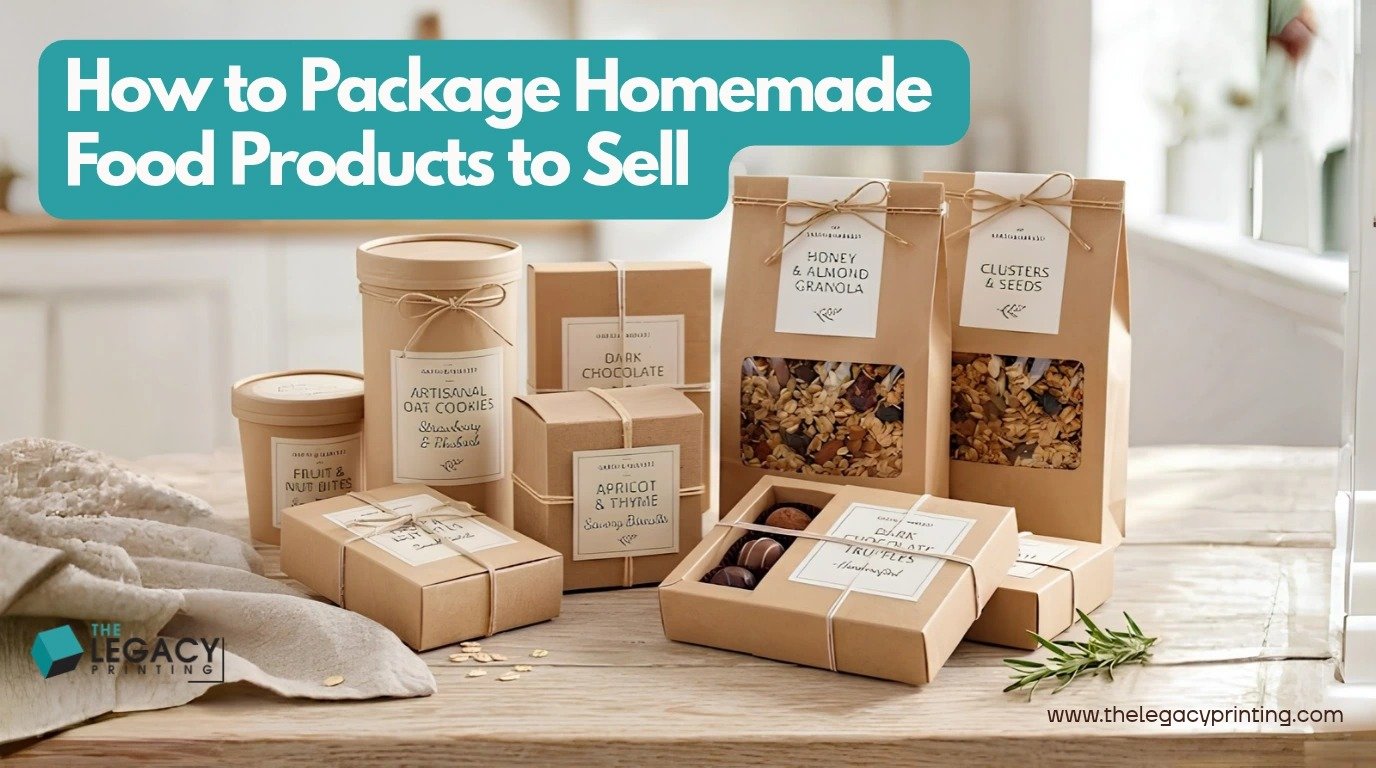
Wondering how to package homemade food products for sale? Start with your state's cottage food rules. Next, put the food in a food-grade box or liner. Then add a label with the food's name, net weight, ingredients, allergens and your business details. Get those parts right, and your treats arrive whole, look professional and follow the law.
The steps are below, in order. After them, you'll find the most common first-timer mistakes and a checklist to use before you print.
| Step | What you need | Time | Result |
|---|---|---|---|
| Check the rules | Your state agency's cottage food page | Short, but don't skip it | You know what you can sell and where |
| Pick the packaging | Food type, product size, food-grade box and liner | Depends on how many products you sell | Food stays clean, fresh and in one piece |
| Write the label | Final recipe, scale, allergen list, state disclaimer | Plan it before the box art is final | A label buyers and inspectors can trust |
| Test before bulk | Sample kit or a small run | Kits ship within days | No costly surprises on a big order |
How Do You Package Homemade Food Products to Sell?
Follow nine steps in order: rules, food match, materials, box, label, allergens, shipping, branding and testing. Each step builds on the one before it. So hold off on the fun design part until the rules and the label are clear.
Step 1: Check Your State's Cottage Food Rules
A cottage food law is a state rule that lets you sell some low-risk foods made in your home kitchen. People who sell this way are often called cottage food operators. Every state has its own rules, and requirements vary significantly.
A Harvard Food Law and Policy Clinic cottage food report found label rules ranging from a full label to a short disclaimer. The report is from 2018. Use it to see how much states differ, not as a guide to today's rules.
Open your state's Department of Agriculture or Department of Health website. Look up these points:
- Allowed foods. Cottage laws cover low-risk foods. That usually leaves out TCS foods (Time/Temperature Control for Safety), which must stay cold or hot to be safe. Cream fillings are a common example.
- Sales cap. Some states limit how much you can sell each year. Some adjust that cap for inflation, so read the current number on the state site.
- Where you can sell. In person, online, by local delivery, or by shipping.
- Registration. Whether you need a permit, a license or a food handler course.
- Label wording. The exact disclaimer sentence and the type size it must use.
- Address rule. Some states may accept a registration ID or business address instead of your home address. Others may want a street address and won't take a P.O. box.
Step 2: Match the Packaging to the Food
Every food has its own weak spot. Cookies break. Brownies leak grease, and candy melts in the heat. Use this table as a starting point for your cottage food packaging.
| Food | Box style that fits | Inner layer or barrier | Window? | Watch out for |
|---|---|---|---|---|
| Dry cookies | Tuck end or window box; mailer box to ship | Parchment or liner if buttery | Yes, cookies sell on looks | Breakage, so use an insert |
| Brownies and bars | Bottom lock or window box | Grease-resistant liner | Optional | Grease stains on the board |
| Iced cupcakes and cakes | Window box with insert, bottom lock base | Insert holds each piece apart | Yes | Smudged icing; check if your state allows cream fillings |
| Donuts | Window box | Grease-resistant liner | Yes | Sticky glaze and oil |
| Bread | Sleeve or tuck end box | Food-grade paper bag | Optional | Crushed crust |
| Candy and fudge | Pillow, sleeve or small tuck end box | Paper cups or wrapped pieces | Optional | Melting in summer heat |
| Coffee and tea | Printed outer box | A sealed inner bag to keep it fresh | No | Air and moisture |
| Jam and sauce | Gift box as an outer pack | New food-grade glass jar and lid | No | Glass breaking in transit |
An insert is a cardboard piece inside the box with slots that hold each item in place. Not sure your food is allowed at all? Go back to Step 1 before you order anything.
Step 3: Use Food-Grade Materials With an Inner Layer Where Needed
Food-grade means a material is allowed to touch food. The FDA (U.S. Food and Drug Administration) regulates the paper, board, coatings, inks and glue that touch food. It calls them food contact substances, and each one has to be cleared for the way it's used.
There are two kinds of contact. Direct contact means the food touches the box. Indirect contact means a liner, bag or paper cup sits in between. For example, a greasy brownie resting straight on printed board is the riskiest setup, for safety and for looks.
That's why most home bakers use two layers. The outer box carries your brand, and the inner layer touches the food. Ask your box maker these questions before you order food grade packaging boxes:
- Is this board food-grade for direct contact, or only for an outer pack?
- Can you add a grease-resistant coating or liner?
- Will the inside be printed or left plain?
- Do you offer kraft or recycled cardboard?
At The Legacy Printing, our custom food boxes use food-grade materials made for food packaging. Kraft paper and recycled cardboard come in almost every category with no extra premium. You can also browse our eco-friendly boxes.
Step 4: Choose the Box Style and Size
Pick the style by how you sell, then size it to the product. Here's how the common styles work as packaging for a home bakery:
- Window box: a die-cut opening (a hole cut to shape) shows the food. Great at markets and on shelves.
- Bottom lock (auto-bottom): the base snaps into place and holds weight. Good for cakes, jars and heavy loads.
- Pillow box: a curved, light box for candy and small favors.
- Sleeve box: a tray that slides into an outer band. It feels like a gift.
- Mailer box: made from corrugated board, which has a wavy middle layer for strength. Use it for shipping.
For more ideas, see our post on custom bakery boxes that make your baked goods stand out.
Sizing. Measure the length, width and height of your product at its widest point. Add room for the liner or insert, and no more. A box that's too big lets cookies slide and crack. If you sell sets of four or six, measure the full set, not one piece.
Kraft or white, matte or gloss? These choices shape your brand look. A coating is a thin clear layer on top of the print. Here's the honest trade-off:
| Choice | Good for | Trade-off |
|---|---|---|
| Kraft (brown) | Natural, handmade, eco feel | Colors print darker and softer |
| White | Bright colors and clean photos | Shows grease marks and scuffs more |
| Matte coating | Calm, modern, premium look | Colors look a little less bold |
| Gloss coating | Shiny, bright, eye-catching on shelves | Glare under strong lights |
| Spot UV (shiny coat on one area only) | A shiny logo on a matte box | Adds a step to the design |
Our opinion? Kraft with one or two ink colors suits most home bakers. It looks handmade on purpose, not cheap.
Plan your label space now, too. A dieline is the flat template of your box that shows every fold and cut. Learn what a dieline is and how it works, then keep one flat panel clear for the label.
Step 5: Write a Label That Follows the Rules
Packaged food needs six basic items under the FDA Food Code, according to this health department labeling guidance based on the FDA Food Code:
- Statement of identity: the plain name, like "Chocolate Chip Cookies."
- Ingredients: listed from most to least by weight.
- Net quantity: how much food is inside, not counting the box.
- Name and place of business.
- Major allergens, if the food has any.
- Nutrition Facts, unless you're exempt.
Cottage food sellers usually add a home-kitchen disclaimer too. It's a sentence saying the food was made at home and wasn't inspected. Your state sets the wording and type size.
Nutrition Facts. This is the standard panel of calories and nutrients. Some small sellers don't need it, but the exemption has conditions.
Dates and batch codes. A best-by or production date tells buyers how fresh the food is. A batch code lets you trace a problem back to one bake day. Check whether your state asks for a date. Even if it doesn't, adding one builds trust.
Where each item goes:
| Panel | What goes there |
|---|---|
| Principal display panel (the front) | Product name and net weight |
| Information panel (side or back) | Ingredients, allergens, name and address, disclaimer, date and batch code |
Step 6: Get Allergens Right
The FDA food allergies page lists nine major food allergens: milk, eggs, fish, crustacean shellfish, tree nuts, peanuts, wheat, soybeans and sesame. Sesame was added by the FASTER Act, signed on April 23, 2021. It became a major allergen on January 1, 2023. The FDA allergen labeling Q&A explains how these terms are defined in the law.
You can show allergens inside the ingredient list or in a "Contains" line, like "Contains: milk, eggs, wheat." Use the specific common name. For example, write "pecans," not "nuts."
A "may contain" line is voluntary. It warns about cross-contact, when a trace of an allergen gets into food by accident. It never replaces listing the allergens you actually use.
Check every sub-ingredient, too. Sprinkles, chocolate chips, flavor extracts and store-bought frosting can hide milk, soy or wheat.
Step 7: Seal, Protect and Ship
A tamper-evident seal is a sticker or band that tears when the box is opened. It looks neat, costs little, and gives buyers peace of mind.
Shipping takes more care. Use a corrugated mailer box with an insert or padding. Before you sell online, pack one order exactly as a customer would get it. Shake it, then drop it from table height. If something breaks, fix the insert before launch.
Heat is the other problem. Chocolate, fudge and buttercream soften in hot delivery trucks. Your state may not allow cream-filled items at all, and some states only allow in-person sales. Confirm that shipping is legal for you first.
Step 8: Add Brand Touches on a Small Budget
Your box is the first thing a customer touches, so let it do some selling. Small extras go a long way:
- A logo sticker that also seals the box
- A ribbon hang tag with the flavor name
- A handwritten-style thank-you card
- A QR code linking to a recipe, your reorder page or your social account
- One color and one font used on every product
That last point matters most. When your cookie box and candy box look like family, people remember your name.
Step 9: Test With a Sample or Small Run First
Never place your first big order blind. Request a sample kit, or print a small batch. We follow up on sample kit requests within 2 hours, and kits ship within days.
Our minimum order is as low as 50 pieces, with no die or plate charges. Read more about starting with just 50 custom boxes.
How It Works, in Plain Words
Good food packaging for a small business does three jobs at once. Each job belongs to a different part.
The inner layer keeps the food clean and stops grease from soaking through. The outer box protects the food and sells it. The label tells buyers and inspectors exactly what's inside.
If one part fails, the others can't cover for it. A beautiful box with a missing allergen is still a problem. A perfect label on a soggy box still looks bad.
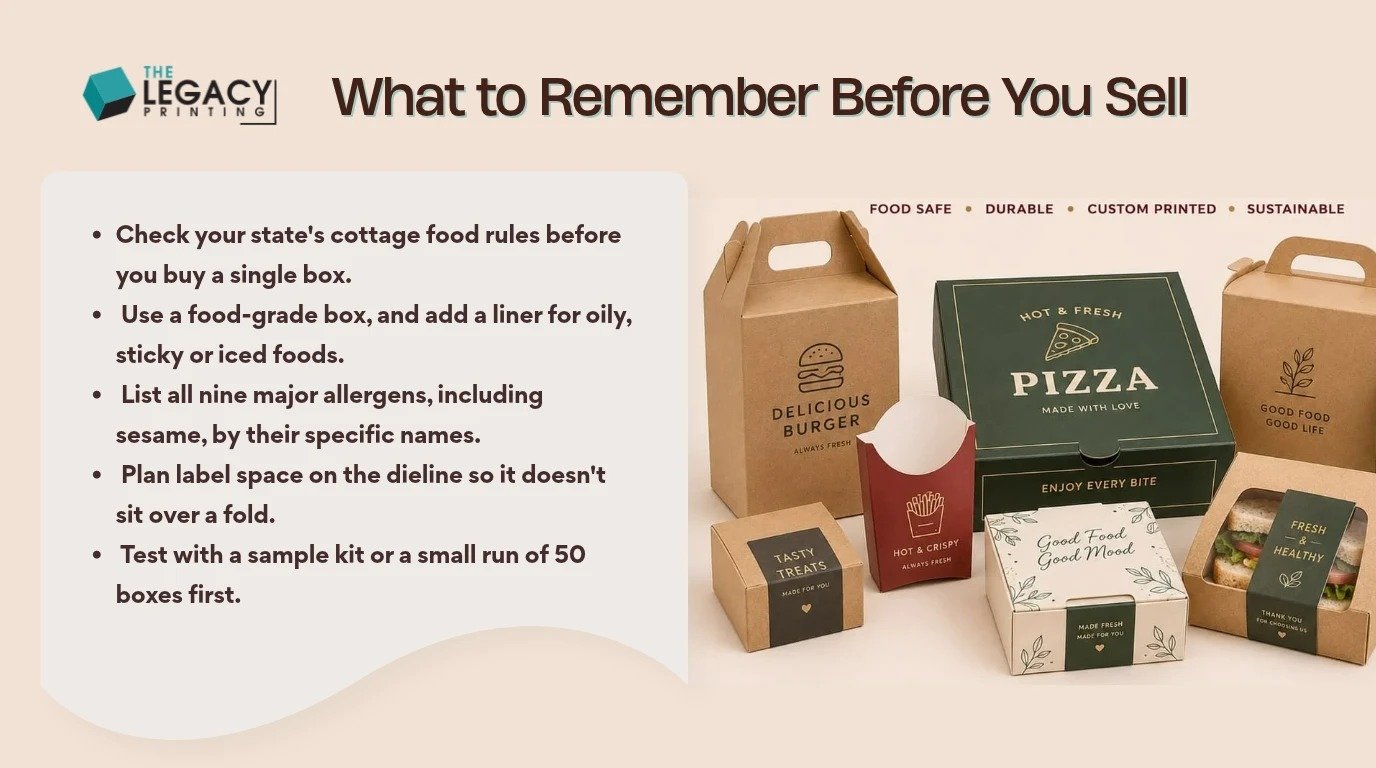
What to Remember Before You Sell
Which Mistakes Do First-Time Home Food Sellers Make Most?
Most mistakes come from rushing the label or guessing the box size. All of them are easy to fix before you print.
| Mistake | Fix |
|---|---|
| Forgetting sesame | Check all nine allergens on every product |
| Writing "nuts" | Name the exact tree nut, like almonds or walnuts |
| Using "may contain" instead of real allergens | List the allergens you use; "may contain" is extra |
| Hand-written labels that smudge | Print labels, or print the info panel right on the box |
| Label stuck over a seam or fold | Mark a flat label area on the dieline |
| Grease stains on the board | Add a grease-resistant liner or coating |
| Box too big, so items slide | Measure the product and add an insert |
| No date on the label | Add a best-by or production date and a batch code |
| Shipping iced or cream items | Sell those locally only, if your state allows them |
| Copying another state's label | Use your own state's exact wording |
Pro Tips From the Packaging Side
These tips come from how custom boxes are made and printed. They aren't legal advice.
- Finish the recipe before the label. A new brand of chocolate chips can change your allergen list.
- Print the fixed info, sticker the changing info. Put your logo and name on the box. Use a small sticker for flavor, date and batch code. That way, one box design works for many products.
- Ask for a 3D rendering. A free digital 3D preview shows where the label lands before anything prints.
- Weigh, don't guess. Weigh several finished packs to set your net weight.
Pre-Order Checklist Before You Print
Tick every line before you approve a print proof. If one is blank, wait.
- State rules checked: allowed foods, sales channels, registration, disclaimer wording
- Ingredient list final and sorted by weight
- All nine allergens checked, including sub-ingredients
- Net weight measured
- Label space marked on the dieline
- Box style chosen: window, bottom lock, pillow, sleeve or mailer
- Material picked: kraft or white board
- Finish picked: matte, gloss or spot UV
- Window yes or no; insert yes or no
- Liner and seal sticker ready
- 3D rendering approved
- Sample kit or a small run tested
Frequently Asked Questions
Do I need a license to sell homemade food?
It depends on your state. Some states ask cottage food sellers to register or get a permit, and others don't. Your state's Department of Agriculture or Department of Health site has the current answer.
Can I reuse jars or containers?
New food-grade jars and new lids are the safer choice. Old jars may have chips or worn seals. Some states also have their own rules on this, so check yours.
Do I need a barcode to sell homemade food?
A barcode isn't one of the six basic label items in the FDA Food Code guidance above. Some stores still ask for one before they stock your product, so check with each store first.
Do I need a Nutrition Facts panel for home-baked goods?
Often not, but it depends. Some small sellers are exempt, and the exemption comes with conditions. Check the FDA's small business exemption rules and your state's cottage food page before you print.
Can I ship homemade food to other states?
Only if your state allows it. Selling channels change from state to state, and some states only allow in-person sales. Confirm on your state agency's site before you set up online orders.
How many custom food boxes do I have to order?
At The Legacy Printing, you can start with as few as 50 boxes. There are no die or plate charges, design support is free, and shipping is free anywhere in the USA. Kraft and recycled cardboard come at no extra premium in almost every category.
Get Your Food Boxes Started
Tell us what you bake and how many boxes you need. We'll suggest the right box, material and finish, and our team will prepare print-ready artwork for free. You'll approve a 3D rendering before anything goes to print. First order? Save 20% on your first purchase!
Call 800 719 2780, email sales@thelegacyprinting.com, or request a sample kit. Ready to go? Get a Free Quote and a free design proof today.