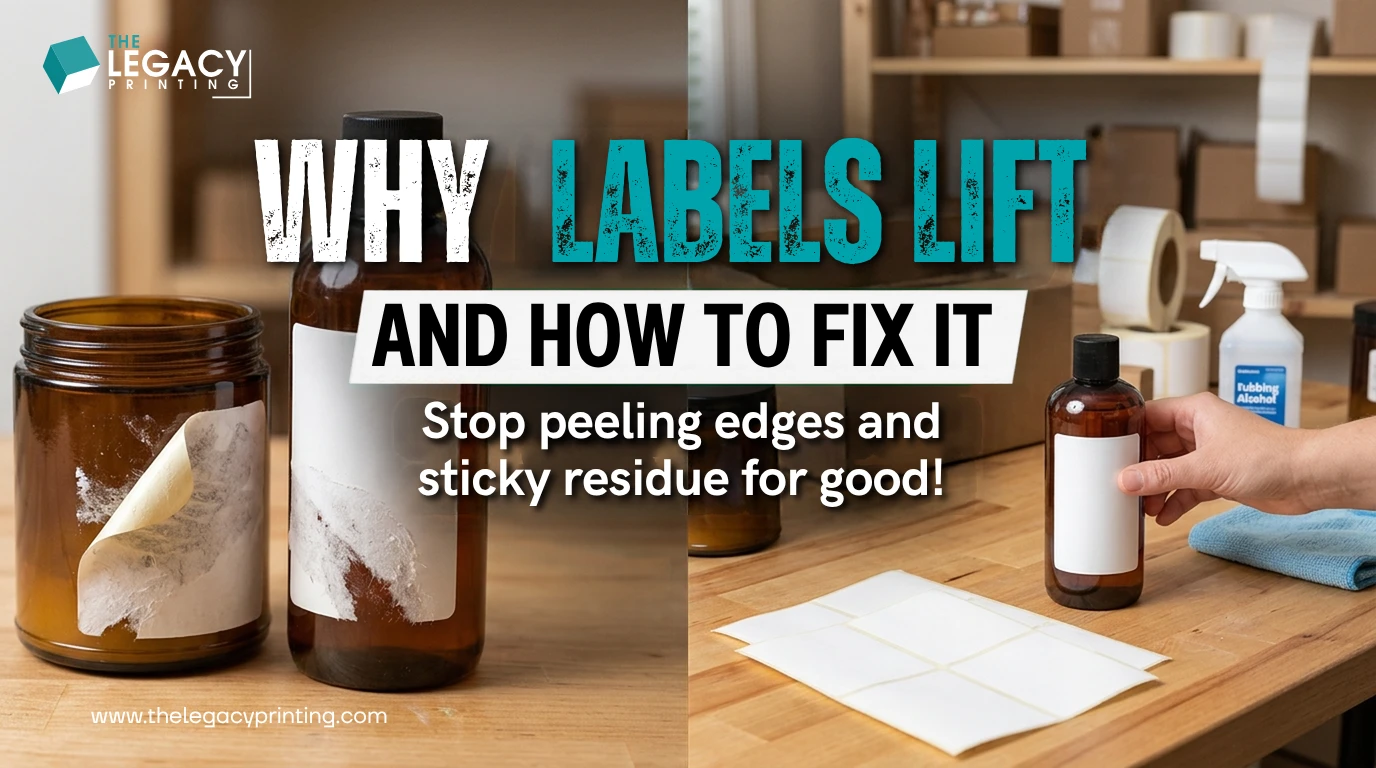
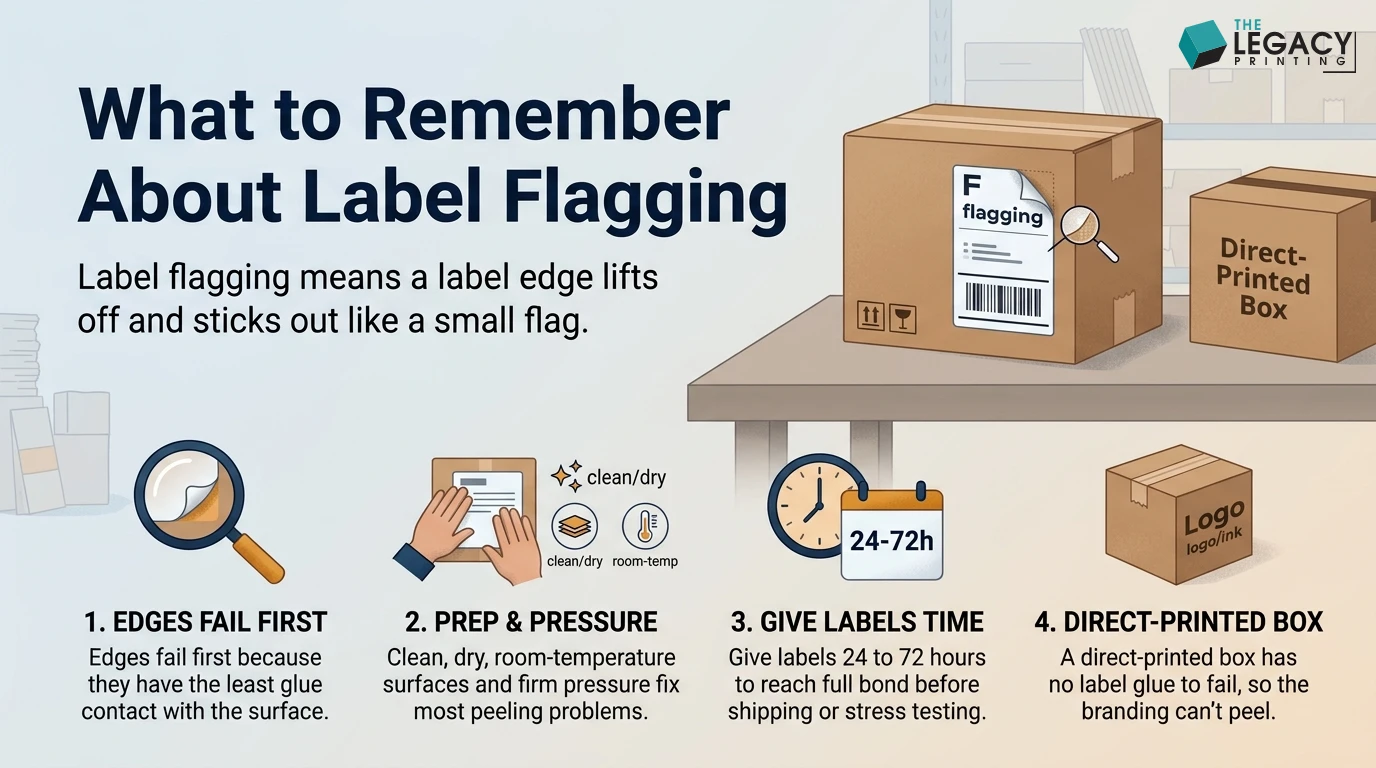
Label flagging happens when the edge of a label lifts and sticks out like a small flag. Adhesive transfer happens when the glue ends up in the wrong place. Both problems usually come from the surface, the temperature or the way the label went on. A peeling label makes a good product look cheap, and it can hide details your customer needs to read.
Most advice on label flagging and adhesive transfer is written for factory label machines. This article is for small brands that label candle jars, cosmetic tubes, bakery boxes or mailers by hand.
What Is Label Flagging? (And What "Adhesive Transfer" Means)
Label flagging is when one edge or corner of a label lifts off the product and won't stay down. It often starts at the trailing edge, which is the last part of the label to touch the surface.
Flagging in plain words
Picture a round label on a small jar. The middle sticks fine, but one end slowly curls up. That curled end is the "flag." Dust and lint get under it, and the lift spreads.
Three meanings of adhesive transfer
People use "adhesive transfer" in three different ways, and that causes confusion:
- Glue moving to the liner. The release liner is the paper backing you peel the label from. If glue stays on the liner instead of the label, the label goes on weak.
- Glue left on the container. You peel a label off, and a sticky film stays behind. This is adhesive residue.
- Transfer tape. This is a glue-only tape with no backing layer. Here, the phrase describes a product, not a problem.
Most stick-on labels use a pressure-sensitive adhesive (PSA). That's glue that sticks when you press it on, with no water or heat needed.
Why edges and corners lift first
Edges have less glue contact than the center. So any weak spot, like a speck of dust, a tiny air bubble or a surface that shrinks in the cold, shows up there first. Once an edge lets go, the lift works its way inward.
Why Do Labels Peel at the Edges? 12 Label Flagging and Adhesive Transfer Causes
Labels peel at the edges when the glue can't fully touch and grip the surface, or when something pulls the label back off. Here are 12 common causes, each with a fix.
1. The surface pushes glue away (surface energy)
Surface energy is how strongly a surface attracts glue. It's measured in dynes per centimeter (dyn/cm). This surface energy and labels guide treats anything above 40 dyn/cm as high energy, which is easier to stick to. Below 40 is low energy.
Glass and metal are usually easy. Slippery plastics like polyethylene (PE) and polypropylene (PP) are low energy, so glue beads up instead of spreading. Good spreading is called wet-out, and more wet-out means a stronger hold.
For example: a lotion brand switches from glass to a PP squeeze bottle but keeps the same label. Soon the corners start lifting. Fix: ask your label printer for an adhesive made for low-energy plastics.
2. Dust, oil or moisture on the surface
A thin film of dust, hand oil or condensation sits between the glue and the surface. Hand labeling makes it worse, because fingers touch the label edges. For example: a candle maker labels jars right after wiping them with a damp cloth, and the labels never fully grab. Fix: clean the surface, let it dry completely, and hold labels by the face, not the sticky edge.
3. Tight curves and stiff label stock
A stiff label wants to go back to flat. On a small bottle or tube, it keeps pulling its own edges off the curve. Rigid brown kraft paper is known for lifting on tight curves. Glue with good "mandrel hold" stays down on a curve, so edges are harder to lift.
For example: a thick kraft label on a lip balm tube lifts at both ends. Fix: use a thinner, flexible film, round the label corners, and choose an adhesive rated for curves. If the label wraps all the way around, a bigger overlap gives the end more glue to hold.
4. Labeling in the cold
Cold glue gets stiff and can't flow into the surface. Every adhesive has a minimum application temperature, the lowest temperature at which it still bonds. This label adhesion failure checklist says most PSAs need surfaces above 50°F.
For example: a shop labels mailers straight off a cold winter dock, and the labels pop off in transit. Fix: let products and labels warm to room temperature first. For freezers or cold rooms, ask about special cold-temperature adhesives.
5. Heat and temperature swings after labeling
Each label also has a service temperature range, the conditions it can handle after it fully bonds. Heat softens glue. Hot-cold cycles make the label and container grow and shrink at different rates. For example: a sauce jar moves from a hot car to a cold fridge again and again. Fix: tell your label supplier where the product will live, not just where it's sold.
6. Not enough pressure
PSA glue needs pressure to spread out and make contact. A light tap leaves gaps. The same checklist recommends at least 15 to 30 psi. By hand, that means a firm swipe from the center out with a squeegee or flat card. For example: someone presses only the middle of a bakery box seal label, and both ends lift by lunchtime.
7. Stretching the label as you apply it
Pull a label tight while you stick it down, and it tries to shrink back later. That pull lifts the edges over time. Fix: use light, even tension. Let the label lie down naturally, then press.
8. Moving or shipping the product too soon
Glue works in two stages. Initial tack is how sticky it feels on first touch. Ultimate adhesion is its strongest hold after it settles. The wait between them is dwell time. The Avery Dennison adhesive overview puts it at 2 to 24 hours, depending on the adhesive, surface and temperature. The Butler checklist says full strength can take 24 to 72 hours.
That's why labels often peel off after 24 to 48 hours. They got bumped, packed tight or chilled before the bond finished. Fix: label first, then let products rest at room temperature before packing.
9. Rough, dusty or recycled board
Corrugated board is cardboard with a wavy layer inside. Its outside soaks up and releases moisture from the air. As this piece on why tape and labels don't stick to corrugated explains, humid air can leave it damp and dry air can leave it dusty. Recycled board has tightly packed fibers, so glue sinks in less. Read more on why adhesives struggle on recycled boxes.
For example: shipping labels slide off brown mailers on humid summer days. Fix: wipe the box with a clean, dry cloth, press the label firmly, and test on the exact board you'll use.
10. Varnish, UV coating or lamination on the box
Shiny top layers look great, but they're smooth and sealed. Glue grips them badly. This article on varnish and label adhesion on cartons says the simplest fix is to leave the label area uncoated, because glue bonds better to paper fibers. For example: a lot-code sticker on a glossy cosmetics carton peels before the box reaches the shelf.
11. Label rolls stored badly
Labels can fail before they touch the product. High heat makes glue flow onto the liner. Crushed rolls cause adhesive transfer, and very humid or hot rooms can make labels curl. Fix: keep rolls in a cool, dry place and use them soon after delivery.
12. Label machine settings (for automated lines)
Hot melt labelers hold labels well only when glue temperature, glue film and label timing stay within range. Label stock with high friction can feed unevenly. If flagging starts right after you switch label suppliers, check the new stock first.
What to Remember About Label Flagging
Quick Diagnosis Table: Symptom, Likely Cause, Fix
Match what you see to the likely cause. Try the easy fixes before you buy new labels.
| Symptom | Likely cause (tip #) | Quick fix | Effort |
|---|---|---|---|
| Edges lift on a small bottle or tube | Stiff stock, tight curve (3), stretching (7) | Flexible film, rounded corners, light tension | Medium |
| Labels won't grab a plastic bottle | Low surface energy (1) | Adhesive made for PE/PP plastics | Medium |
| Labels pop off a kraft or recycled box | Rough or dusty board, humidity (9) | Wipe dry, press hard, test on real board | Low |
| Labels slide off a glossy carton | Coating blocks glue (10) | Uncoated label panel on the box | Low at design stage |
| Labels peel after 24 to 48 hours | Moved too soon (8), cold (4), low pressure (6) | Warm up, press firmly, wait before packing | Low |
| Labels curl on the roll | Heat or humidity in storage (11) | Cool, dry storage; use rolls soon | Low |
| Sticky residue left behind | Adhesive transfer to the surface | Slow, low-angle peel; removable glue | Low |
| Flagging after a new supplier | Label stock or machine setup (12) | Check stock friction and glue settings | High |
How to Choose the Right Fix for Your Surface
The right fix depends on what the label sticks to. Find your surface, then test before a big label order.
| Surface | Main risk | Best approach |
|---|---|---|
| Glass jars and bottles | Condensation, cold, curves | Clean and dry fully, label at room temperature, flexible stock on small jars |
| PE or PP plastic | Glue beads up (low surface energy) | Low-energy plastic adhesive, flexible film for squeezable bottles |
| Kraft or recycled board | Less porous fibers, dust | Wipe, press firmly, longer dwell before shipping |
| Coated or laminated carton | Smooth coating blocks glue | Leave an uncoated label patch in the design |
| Rough corrugated | Uneven surface, humidity | Firm squeegee pressure, larger labels, store boxes dry |
How to stop labels lifting on bottles
On bottles, four things work together: a flexible label, rounded corners, an adhesive matched to glass or plastic, and a rest of 24 to 72 hours before packing. Your label printer can help you match the adhesive to your bottle.
Labels not sticking to your box?
Fix it at the design stage. Plan an uncoated label panel on the dieline, the flat outline of your box that shows folds, cuts and artwork areas. New to them? Read what a dieline is and how it works.
Love a gloss finish? Our guide to matte vs gloss lamination helps you choose, and our team can explain how each finish affects label areas.
Kraft paper and recycled cardboard are available in almost every category at The Legacy Printing, with no extra premium. They're rougher, though, so test labels on the real box. Still deciding? See kraft vs white boxes.
Label Adhesive Residue Fix: Prevent It and Remove It
Residue happens when glue holds the surface more strongly than it holds the label. The right adhesive and a careful peel prevent most of it.
Why residue happens
Permanent glue keeps building its bond after you apply it. Heat can soften it so it splits when you peel. A fast, steep peel also tears the glue layer and leaves part of it behind.
Safe removal steps
- Lift a corner and peel slowly at a shallow angle, close to the surface.
- Test any cleaner on a hidden spot first, especially on printed or coated areas.
- Use a mild cleaner that suits the material. Skip harsh solvents on printed surfaces.
- Wipe gently with a soft cloth until the film is gone, then let it dry.
For anything that touches food, follow the cleaner's own instructions and use only products made for that use.
When to choose removable adhesive
If labels need to come off cleanly, like price stickers or gift tags, ask for a removable or repositionable adhesive. Save permanent glue for labels that should stay put.
Printed Box vs Label Packaging: Which Is Better for You?
A printed box can't flag, because there's no label glue to fail. Labels still win when your information changes often or your runs are tiny.
| Factor | Direct-printed box | Labels on plain boxes |
|---|---|---|
| Brand look | Artwork on every panel, inside and out | Limited to the label area |
| Risk of peeling | None for the printed artwork | Depends on surface, weather and application |
| Small-run flexibility | Digital printing suits short runs | Very flexible |
| Changing info | Needs a reprint | Easy to update |
| Size and shape | Custom size and shape to fit the product | Limited to stock sizes |
When labels still make sense
Labels are the right tool for lot codes, expiry dates, ingredient updates, flavor variations and shipping addresses. Many brands use both. They print the brand on the box and add a small label for details that change.
When a printed box saves the headache
If your main brand label keeps peeling, print it straight on the box and the problem is gone. Digital printing needs no plate setup and suits low quantities. Offset printing suits large runs with CMYK color. Our comparison of custom boxes vs stock boxes covers the trade-offs.
Industry examples
- Bakery in a humid summer: seal labels lift on damp boxes. Printed Custom Food Boxes carry the logo, and a small label shows the flavor.
- Candle jar with a kraft label: the stiff kraft label flags on the curve. A printed custom candle box shows the brand, and a flexible label goes on the jar.
- Cosmetic tube: tight curves fight labels. Printed Custom Cosmetic Boxes keep the shelf look clean.
- E-commerce mailers from a cold dock: warm them up before labeling. Print your brand on custom mailer boxes so only the ship-to label is stuck on.
Before You Order: A Label Test Checklist
Test a small batch on your real product before you buy in bulk. It's the cheapest way to catch flagging early.
Test on the real product
- Use the exact bottle, jar or box, with its real finish.
- Label at the temperature of your actual work area.
- Apply labels the way your team will, by hand or by machine.
Wait, flex, chill, rub
- Wait 24 to 72 hours for full bond.
- Squeeze soft bottles and flex the label area.
- Put a few in the fridge or a warm room if the product will live there.
- Rub the edges with your thumb and watch for lifting.
Privacy note for shipping labels
Loose or peeled shipping labels can show names, addresses and order numbers. Cover or remove old labels before you reuse boxes. When you design mailers, put the ship-to area on a flat, uncoated panel so the label stays put.
Frequently Asked Questions
What is label flagging?
Label flagging is when a label's edge lifts off the product and sticks out like a small flag. It usually starts at the trailing edge or a corner, where glue contact is weakest.
What causes adhesive transfer on labels?
Heat, crushed label rolls and fast peeling are the usual causes. Heat can make glue flow onto the liner, and a fast, steep peel can leave glue on the surface.
How do I stop labels lifting on bottles?
Use a flexible label with rounded corners and an adhesive matched to your bottle material. Apply it to a clean, dry, room-temperature bottle with light tension and firm pressure. Then let it rest before packing.
Why are my labels not sticking to my box?
Your box is probably dusty, damp, rough or coated. Wipe it dry and press firmly. If the box has a gloss or UV coating, plan an uncoated label area on your next order.
Why do labels peel off after 24 to 48 hours?
The glue never reached full bond. Common reasons are stretching during application, low pressure, cold surfaces or packing the product too soon.
How long does a label adhesive take to fully bond?
Many label adhesives need 24 to 72 hours to reach full strength. The exact time depends on the glue, the surface and the temperature.
Will a stronger adhesive fix flagging?
Not always. Flagging is often a surface or application problem. If the label is stiff, the surface is coated or the product is cold, stronger glue may still fail. Fix those first, then test.
Skip the Peeling: Get Printed Boxes From The Legacy Printing
The surest way to stop your brand label from peeling? Print it straight on the box. Your packaging is the first thing customers touch, so it should look right every time they open it!
We're a BBB accredited business, rated 4.9/5 from 1,159+ orders and reviews. Here's what you get:
- Free design support. Our in-house team prepares the dieline and print-ready artwork, including a flat label panel if you need one.
- A digital 3D rendering to approve before production.
- Minimums as low as 50 pieces, with no die and plate charges.
- Free shipping to any address in the USA, with no hidden freight costs.
- Greener options like kraft paper and recycled cardboard. See our Eco-Friendly Boxes.
- Sample kits so you can test labels on the real box. We follow up on kit requests within 2 hours.
Not sure which structure or finish fits your product? Call 800 719 2780 or email sales@thelegacyprinting.com. Our team is available 24/7, and first-time customers save 20% on their first purchase.
Ready to end peeling labels for good? Get a free quote and free design proof today.