A true soap doesn't need an ingredient list, according to the CPSC soap FAQ. That surprises a lot of soap makers. But add an ingredient meant for a cosmetic effect, and the same bar can fall under cosmetic rules instead. So when you work out how to package soap for retail sale, start with the label. The box comes second.
Here's the quick version. Use a printed belly band or paper wrap for markets and starter lines. Use a full box for boutique shelves, gift sets and premium bars. Whatever you choose needs room for the required label details, and it should still show off your soap's best feature.
Box, Band or Wrap? The Short Answer
Pick by where you sell. Bands and wraps are quick, low cost and let people smell the soap. Boxes protect the bar, hold more information and look finished on a store shelf.
Quick pick by sales channel
- Farmers market or craft fair: a belly band. Shoppers can pick up the bar and sniff it.
- Boutique or gift shop shelf: a tuck end or window box. It stacks neatly and stays clean.
- Online orders: a box or sleeve inside a mailer, so the bar arrives looking new.
- Gift sets: a rigid box, or a sleeve over a tray with an insert.
Comparison table: box vs belly band vs paper wrap vs sleeve
A belly band (also called a cigar band) is a paper strip that wraps around the middle of the bar. A sleeve is a printed paper tube that slides over the bar or a tray. Some makers use shrink wrap, a heated plastic film, but this guide sticks to paper options.
| Feature | Full box | Belly band | Paper wrap | Sleeve |
|---|---|---|---|---|
| Shelf impact | High | Medium | Low to medium | High |
| Scent comes through | Low | High | Medium | Medium |
| Protection | High | Low | Medium | Medium |
| Label space | Lots (six panels) | Small | Medium | Good |
| Speed to pack | Fast once folded | Very fast | Slow by hand | Fast |
| Eco fit (kraft, recycled board) | Good | Very good (least material) | Good | Good |
| Best for | Boutiques, online, premium | Markets, starter lines | Rustic brands, small batches | Shelves and gift sets |
Before You Pick Packaging: Cure and Measure the Bar
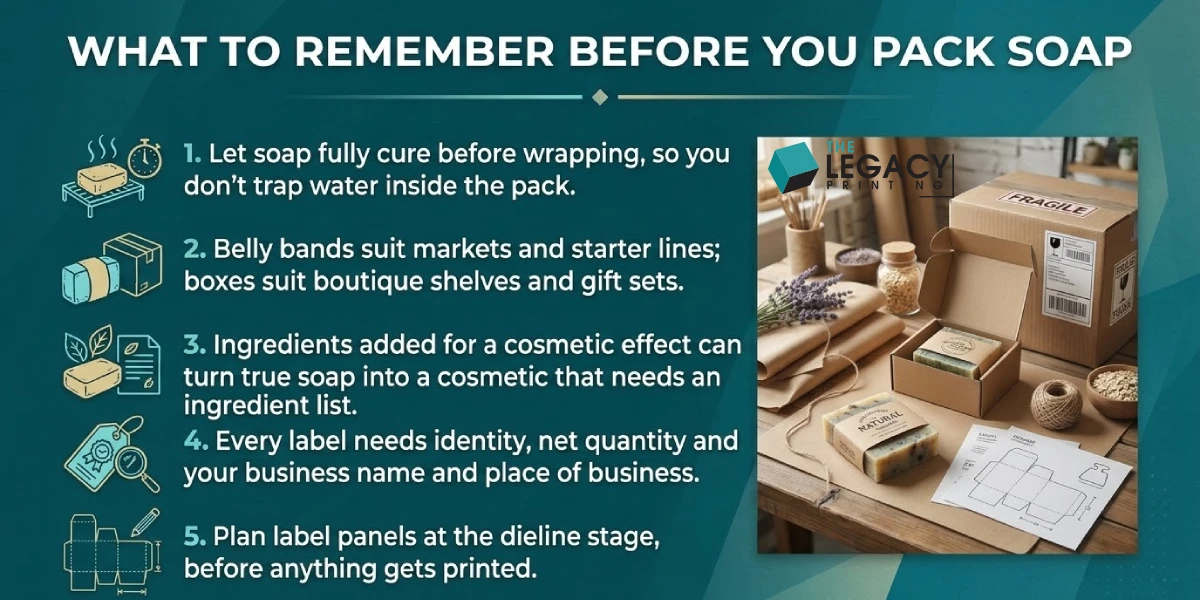
Pack only fully cured soap, and measure it after the cure. A bar changes shape slightly as it rests. Packaging sized for fresh soap can fit badly a few weeks later.
Why wrapping too early makes soap sweat
Curing means letting cold-process soap rest so extra water leaves and the bar hardens. Wrap it too soon, and that water has nowhere to go. It's like putting a lid on a pot of hot soup: the steam turns into drops on the inside.
Soap makers call those little beads of moisture sweating. Humid storage can cause them too. Either way, the drops can wet paper bands, smudge ink and stain boxes. Follow your recipe's full cure time, keep bars somewhere dry, then pack.
How to measure for a box or band
Measure the length, width and height of a cured bar with a ruler or calipers. Handmade bars vary a little, so measure several and use the largest. For a band, also measure around the bar to get the strip length. Our guide on how to measure a product for a custom box walks through each step.
Leave room for bar shrinkage and inserts
A box that's too tight is hard to fill and can crush the bar's edges. One that's too loose lets the bar slide around and scuff. Leave a small gap, plus space for any inner wrap or insert. Send us your bar measurements, and our team will suggest exact inside sizes.
What to remember before you pack soap
Three Soap Shops, Three Choices: Soap Packaging Ideas in Action
The right pick depends on your goal, your budget and what goes in your soap. The three situations below are made-up examples. Still, they match questions small soap makers ask all the time.
Scenario 1: The farmers market seller
Say you sell cold-process bars at a weekend market. You want a cleaner look, and you hope to land your first local shop.
- Options: plain bars with a sticker, paper wraps or printed belly bands.
- Best choice: a printed belly band on kraft paper.
- Why: shoppers can still see and smell the soap. Bands go on fast, and there's room for the scent name, net weight and business details. When a shop owner asks to see your line, it already looks store-ready.
Scenario 2: The holiday gift set
Now say a gift shop wants a three-bar holiday set. It has to look like a present without any extra wrapping paper.
- Options: three banded bars in a bag, a sleeve over a tray, or a rigid box.
- Best choice: a two-piece rigid box with an insert. For a smaller budget, go with a sleeve and tray.
- Why: a rigid box is made of thick, firm board, so it feels like a gift before anyone opens it. An insert works like an egg carton, keeping each bar in its own spot so they don't knock together. And because the box holds scent in, the first whiff on opening becomes part of the gift.
Scenario 3: The "moisturizing" spa bar
Last, say you make a goat milk bar with added ingredients meant to soften skin. You want to sell it as a "moisturizing" bar on a spa shelf.
- Options: a band, a tuck end box or a window box.
- Best choice: a tuck end box, with a die-cut window if the bar's color helps it sell.
- Why: ingredients added for a cosmetic effect can make the bar a cosmetic. Cosmetics need an ingredient list on the outer pack, and a small band rarely has room. A box gives you a clean front and a full back panel for the details.
Decision table: match your situation to a choice
| Your situation | Best pick | Main reason |
|---|---|---|
| Market stall, testing scents | Kraft belly band | Low cost, scent comes through |
| First boutique account | Tuck end or sleeve box | Stacks well, looks finished |
| Bright or swirled soap | Window box | Shoppers see the color |
| Holiday or multi-bar gift set | Rigid box or sleeve and tray | Gift feel, insert holds bars |
| Soap counts as a cosmetic | Full box | Room for ingredient list |
| Online orders | Box or sleeve inside a mailer | Bar arrives clean and unscuffed |
Soap Boxes for Retail Shelves
Soap boxes for retail work best when the style matches how shoppers look at your bar. Folding styles cover most needs. Rigid boxes are for premium sets.
Tuck end, sleeve, window and drawer styles
- Tuck end box: a folding box with a flap that tucks in to close. It's light and stacks well.
- Sleeve box: a printed sleeve over a bar or tray. It shows part of the soap and still gives you lots of branding space.
- Window box: a box with a die-cut opening, so shoppers can see the soap's color.
- Drawer box: a tray that slides out of an outer sleeve, like a matchbox. Opening it feels like a small reveal.
You can browse more shapes on our custom retail boxes page, or see bath and beauty options under custom cosmetic boxes.
Kraft, recycled cardboard or rigid: how to choose
Kraft paper is brown and natural looking, which suits earthy, handmade brands. Recycled cardboard tells a similar story with a smoother surface for printing. Rigid board costs more but feels like a keepsake. The good news is that kraft and recycled cardboard are available in almost every category with no extra premium. See our eco-friendly boxes for kraft and recycled options.
Soap oils can stain paper over time. A glassine or greaseproof inner wrap (thin paper that resists oil) helps a lot, and a coated box interior can help too. Ask our team which board suits your recipe.
Finishes that help shelf impact
Matte coating looks soft and calm, while gloss makes colors pop. Spot UV adds shiny patches to chosen areas, embossing raises a logo, and gold or silver foil adds a metal shine. One finish used well beats three fighting each other. For example, a raised logo on plain kraft looks handcrafted and keeps the design simple.
Soap boxes for gift sets and multi-bar packs
For sets, plan the insert first, then the box around it. Our custom gift boxes can include structural inserts that hold each bar in place. On a multi-bar pack, the label should show how many bars are inside plus the total net weight. 16 CFR Part 500 gives soap examples, such as "6 Bars, Net Wt." followed by the total weight.
Belly Bands and Paper Wraps: When Are They Enough?
Bands and wraps are enough when shoppers handle the soap in person and you don't need much label space. They're the easiest way to look professional on a small budget.
Best for markets and starter lines
A band uses the least material of any option. It's quick to put on, so a busy weekend of packing goes faster. When you're still testing new scents, that low risk matters.
Scent and visibility trade-offs
Bands leave the ends open, so scent drifts out. That helps at a stall where people sniff before they buy. Boxes and sleeves hold scent in, which keeps gift bars fresh. The catch with bands is less protection, so bars can pick up dust or dents on a shelf.
Moving up to boxes as you grow
A sensible path is to start with printed bands or sleeves on kraft, then move to full boxes once a shop orders regularly. Keep the same colors and logo so customers recognize you in both. With a minimum order as low as 50 pieces, you can test a boxed scent before committing to a big run. Our post on starting with small order custom boxes explains how.
What Must Be on a Soap Label in the US?
At minimum, a soap label shows what the product is, who made or sells it, and how much is inside. If your soap counts as a cosmetic, more rules apply, including an ingredient list.
Please note: this is general information, not legal advice. Check the agencies below for your product.
True soap vs cosmetic: why your claims matter
The CPSC (Consumer Product Safety Commission) oversees "true soap." That's soap that meets the FDA's definition of true soap and is made mainly from fats or oils and lye. The CPSC soap FAQ says adding synthetic detergents, or ingredients known for cosmetic effects, can make it a cosmetic. That's true even if you still call it soap.
Cosmetics fall under the FDA (Food and Drug Administration). So before you add that extra oil or describe the bar on your label, decide which category it belongs in. Do this before any design work starts.
What every soap label needs
The Fair Packaging and Labeling Act (FPLA) is a US law about package labels. Under the FTC Fair Packaging and Labeling Act rules, labels need:
- Statement of identity: a line saying what it is, such as "soap."
- Name and place of business of the maker, packer or distributor.
- Net quantity of contents: how much soap is inside, not counting the wrapper. It must appear in both metric and US units, such as grams and ounces.
The FTC (Federal Trade Commission) enforces FPLA for household products, and the FDA enforces it for cosmetics. Weigh your bars after curing, since they lose water while they rest.
Extra items if your soap counts as a cosmetic
Cosmetics need an ingredient list. Under MoCRA, the Modernization of Cosmetics Regulation Act of 2022, cosmetic labels also need a US contact, so customers can report bad reactions. That can be a US address, a US phone number or an online contact such as a website. Use business details, not personal ones, and check FDA's current guidance for the exact wording.
Fragrance allergen labeling is still moving. As of September 2026, industry updates said there was no final rule under MoCRA yet. Check FDA before you finalize a cosmetic label.
Where each item goes on a box
The front of the package is the principal display panel, or PDP. Put your brand, the product identity and net weight there. The ingredient list and business details usually go on the back or side panels.
The FDA summary of cosmetic labeling requirements says ingredients and net quantity belong on the outer container. If your bar sits in a box, they go on the box itself, not on a loose card. The FDA allows off-package ingredient lists only in narrow cases: the product isn't in a folding carton, it's held in trays or racks, and the package surface is under 12 square inches. That's why we plan label panels on the dieline (a flat map of the box showing every fold and cut) before printing.
Check FDA and CPSC before you print
The CPSC says each product is assessed on its own. If you're unsure, you can contact FDA and ask whether your product falls under its rules. A quick question now costs far less than reprinting a whole run.
Soap Packaging for Shelves: Design That Sells
Good soap packaging for shelves is easy to read from a few steps away. Shoppers should spot the scent fast and see your whole range as one brand.
Color code scents across your range
Use one box size for the whole line and one color per scent. Lavender gets purple, citrus gets orange, and so on. On a shelf, the bars form a neat block of color, like a row of paint swatches. Sharing one dieline across scents also keeps reprints simpler.
Barcode and scent name placement
Some shops will ask for a UPC barcode, the striped code scanned at checkout. Leave a clear space for it on a side or back panel. Print the scent name large on the front, because that's what people read first.
Make unboxing feel special on a small budget
Small touches go a long way. Try a printed message inside the lid, a kraft box with a single foil logo, or a glassine wrap with a sticker seal. Each one turns opening the box into part of the product.
How to Package Soap for Retail Sale Without Common Mistakes
Most soap packaging problems come from rushing the label or the fit. Watch for these:
- Wrapping before the soap has cured, which traps moisture.
- A box sized so tight that bars won't slide in easily.
- No net weight, or a weight taken before curing.
- Ingredients printed too small to read.
- No barcode space for shops that want one.
- Hiding the soap completely with no scent cue on the front.
- Uncoated paper that soap oil can soak into.
- Changing a recipe without updating the label.
Quick prevention checklist before you print
- Soap category decided: true soap or cosmetic.
- Ingredients and label wording reviewed against that category.
- Net weight checked after the cure, in grams and ounces.
- Business name and place of business on the label.
- Barcode space planned.
- Scent name clear on the front panel.
- Dieline proof approved.
How The Legacy Printing Helps
We make custom soap boxes and sleeve boxes in-house, with no subcontracting. We're BBB accredited and rated 4.9/5 from more than 1,159 orders and reviews. Tell us what you're packing, and we'll help you get the fit, label space and shelf look right.
Free design support, dieline and 3D rendering
Our design team prepares your dieline and print-ready artwork for free. Before production, you'll see a digital 3D rendering, so you can check the label panels and shelf look first.
Minimum order as low as 50 pieces, no die and plate charges, free USA shipping
Start small without setup fees. Digital printing needs no plate setup, so it suits short runs and new scents. Offset printing suits larger runs where exact CMYK color (the four standard printing inks) matters. Shipping is free to any address in the USA, with no hidden freight costs.
Request a sample kit
Want to feel the kraft before you order? Request a sample kit. We follow up within 2 hours, and kits ship within days. Color options include 1 color, 2 colors, 4 colors (CMYK) and custom Pantone.
Get a free quote and free design proof
Send us your bar size and the look you want. Our team is available 24/7 to help you choose the box structure and material. First-time customers save 20% on their first purchase!
Frequently Asked Questions
How do you package handmade soap?
Cure it fully, measure the cured bar, then choose a band, wrap or box based on where you sell. Add an oil-resistant inner wrap if the bar is oily, and put all required label details on the outer pack.
What is the best packaging for handmade soap?
It depends on your sales channel. Belly bands work well at markets, tuck end or window boxes suit store shelves, and rigid boxes suit gift sets.
What is the cheapest way to package soap?
A printed paper belly band is usually the lowest-cost option, because it uses the least material. It still gives you space for your brand, scent name and basic label details.
Do I need to list ingredients on handmade soap?
Not if it's a true soap, but yes if it counts as a cosmetic. The CPSC doesn't require ingredient lists on true soap, while cosmetics need one on the outer container.
Does the FDA regulate handmade soap?
The FDA covers soap that counts as a cosmetic. True soap falls under the CPSC, but synthetic detergents or ingredients known for cosmetic effects can bring a bar under FDA rules.
Can I print inside the box?
Yes, many box styles can be printed inside. Ask our team whether your chosen style and board allow it. It's a nice spot for a thank-you note.
Are kraft soap boxes recyclable?
Plain kraft paperboard is often accepted in paper recycling, but local rules vary. Heavy finishes can change that, so ask our team which options suit your eco goals.
Ready to Put Your Soap on the Shelf?
Cure first, label right, then pick the pack that fits where you sell. Start with bands while you're testing, and move to boxes as stores come calling. Get a free quote and free design proof at thelegacyprinting.com/request-quote. You can also call 800 719 2780 or email sales@thelegacyprinting.com. We'd love to help your soap look as good as it smells!