
Most broken cookies aren't the carrier's fault. They break because they slide around inside a box that's too big and crash into each other. So if you want to know how to ship cookies and baked goods without breaking them, the answer is to stop that movement. Pack them snugly in an inner box, set that box inside a sturdy shipping box, and fill every gap with soft padding.
The usual mistake looks like care. Someone wraps each cookie by hand, then drops the bundle into a roomy box with a little tissue on top. By the time it arrives, the cookies have rattled into crumbs. The good news? The fix is simple, and it starts with the box.
Short answer: the 5 rules that stop cookies from breaking
Cool, wrap, box, cushion, test. Follow these five steps in order, and most sturdy cookies will arrive whole.
- Cool completely. Warm cookies give off moisture, which softens crisp edges and makes cookies stick together.
- Wrap in pairs or small stacks. Fewer cookies per bundle means less weight on the bottom one.
- Use a snug inner box or tin. The cookies shouldn't be able to shift inside it.
- Put that box inside a stronger shipping box. FedEx's guide to shipping cookies suggests 2 to 3 inches (5 to 8 cm) of cushioning on all sides.
- Shake test, then ship early in the week. If you hear sliding, add more filler before you seal.
Quick checklist before you seal the box
- Cookies are fully cool and any icing is fully dry.
- Soft and crisp cookies are packed in separate containers.
- Layers are separated with parchment paper or a paper divider.
- The inner box has no empty space at the top.
- Padding fills the outer box on every side.
- No ribbon or string is tied to the outside of the shipping box.
Which cookies and baked goods ship best?
Dense, sturdy bakes travel best. Domino Sugar's shipping tips name drop cookies, bar cookies, pound cakes, unfrosted cakes, muffins and fudge as durable choices. Thin, crisp, cream-filled or heavily frosted treats are much harder to get there in one piece.
Domino also suggests leaving brownies, loaf breads and pound cakes in disposable aluminum pans. The pan acts like a built-in tray, so the bake can't bend or crack.
Two words come up a lot when shipping baked goods. Shelf-stable means the food stays good at room temperature for a while, like most cookies. Perishable means it spoils fast and often needs cold storage, like cheesecake or cream fillings.
Table: baked good vs. risk vs. packing tip
| Baked good | Breakage risk | Packing tip |
|---|---|---|
| Drop cookies (chocolate chip, oatmeal) | Low | Wrap back to back in pairs and stack snugly in a box or tin. |
| Shortbread and biscotti | Low to medium (edges can chip) | Pack tightly with parchment between layers. |
| Brownies and bar cookies | Low | Ship in the pan, or cut and fit pieces tightly in a tin or box. |
| Muffins and quick breads | Low to medium | Wrap each one and use a box with an insert so they don't roll. |
| Decorated sugar cookies | High (icing can crack or smear) | Let icing dry fully, give each cookie its own slot, and consider freezing first. |
| Thin, lacy or crisp cookies | High | Ship only in a rigid box with dividers, or pick a sturdier recipe. |
| Gluten-free bakes | Medium (often more crumbly) | Wrap individually and leave no room for them to shift. |
| Cream-filled or cheesecake | Perishable | Needs cold shipping. Most small sellers leave these off mail orders. |
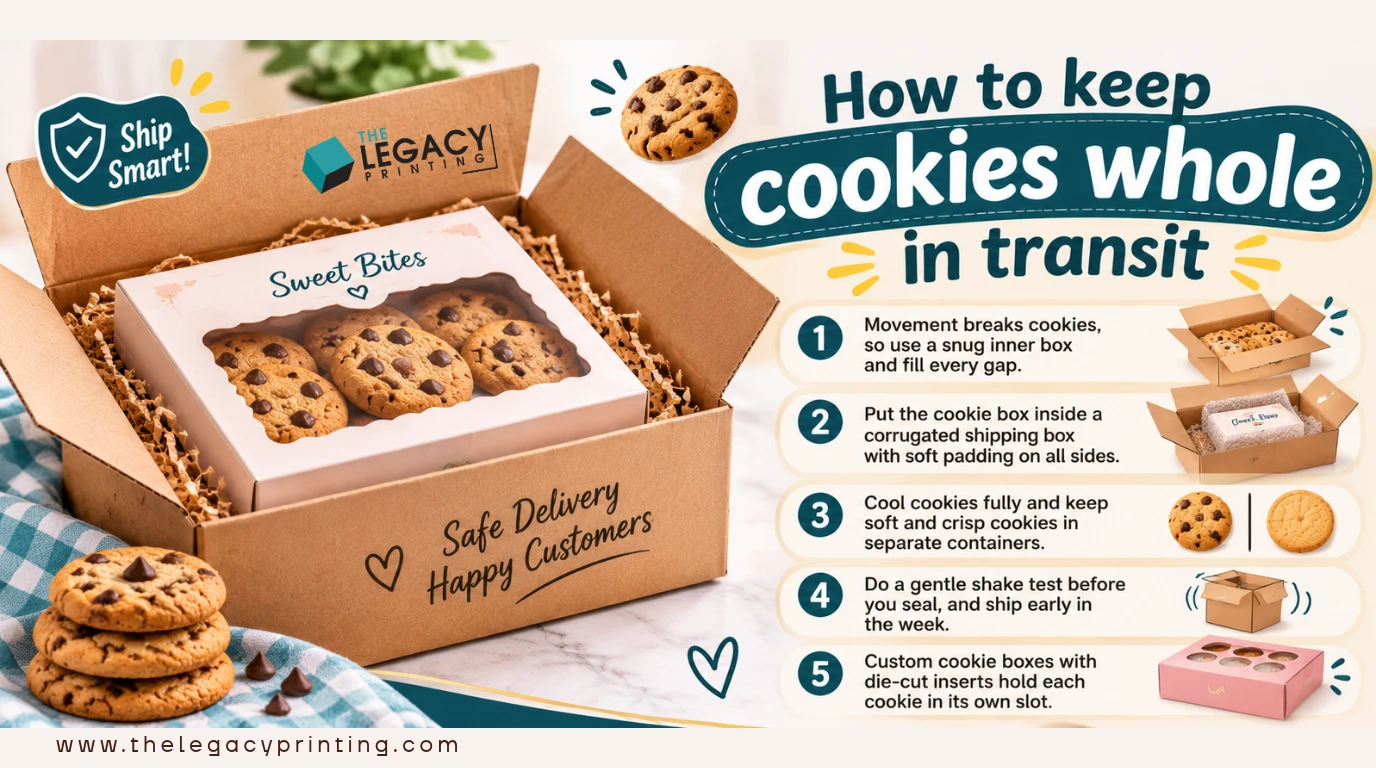
How to keep cookies whole in transit
How to ship cookies and baked goods without breaking them, step by step
How to package cookies for shipping comes down to layers: cookie, wrap, inner box, padding, outer box. Each layer protects the one inside it.
Step 1: Cool completely
Let cookies cool all the way before you wrap them. Trapped moisture softens crisp cookies and can make frosting sweat. For decorated cookies, wait until the icing is hard to the touch. FedEx also recommends freezing frosted or decorated cookies before shipping to help prevent damage.
Step 2: Wrap in pairs or small stacks
Place two cookies back to back, with the flat bottoms touching, and wrap them together. Domino Sugar recommends this method, and FedEx notes that wrapping cookies one by one also helps prevent breakage. Small stacks work too. Just keep them short, so the bottom cookie isn't crushed.
Step 3: Layer with parchment and dividers
Put parchment paper between each layer. Parchment is a thin non-stick paper, so cookies won't stick or rub together. A paperboard divider (also called an insert or partition) is even better, because it holds each cookie or stack in its own spot.
Keep soft and crisp cookies apart. America's Test Kitchen explains that moisture and flavors move between cookies. For example, pack chewy molasses cookies next to crisp gingersnaps, and the gingersnaps will turn soft.
Step 4: Put the cookies into an inner box or tin
Choose a tin or cookie box that fits the cookies closely. Fill any space at the top with crumpled parchment or wax paper, so nothing can bounce. The goal is no "headroom," which simply means no empty space above the food.
Step 5: Use the box-in-a-box method
Now set the inner box inside a bigger corrugated shipping box. Corrugated board is cardboard with a wavy paper layer, called the flute, glued between two flat sheets. That wavy layer soaks up bumps.
Fill the space around the inner box with cushioning, the soft material that takes the hit when a box is dropped. FedEx suggests 2 to 3 inches on all sides, while America's Test Kitchen goes a bit further, with 3 to 4 inches (8 to 10 cm) of lightweight filler. Either works, as long as the inner box can't move. Paper filler, like crumpled kraft paper, keeps the whole package paper-based and simpler for your customer to recycle.
Step 6: Shake test and seal
Close the box and give it a gentle shake. If you hear or feel anything slide, add more filler. You can also turn the closed inner box upside down to check for shifting. Then tape every seam, not just the middle.
Step 7: Label and ship
Write the address clearly and add a "fragile" note if you like. A label helps, but it won't save a badly packed box. Skip ribbon or string on the outside, since it can catch in sorting machines. And ship early in the week, so your box doesn't sit in a warehouse over the weekend.
What is the best box for shipping cookies?
The best box for shipping cookies is really two boxes: a snug cookie box or tin inside a corrugated shipping box. The cookie box holds the cookies still and shows off your brand. The shipping box takes the bumps.
If you sell cookies, the inner box is where you have the most choice. Check these points before you order.
A snug size
Size matters more than anything else. A box that's too big lets cookies slide, and carriers charge by box size as well as weight, so an oversized box costs you twice. Measure your cookies, wrapped and stacked, before you order. Our guide on what size box you need for your product walks you through it.
An insert that holds each cookie
A die-cut insert is a paperboard piece cut into slots, so each cookie sits in its own spot. For decorated cookies, it's the most useful upgrade you can make. We make structural inserts to fit your cookie size and shape.
A strong outer box
For the shipping box, choose corrugated board. Thin paperboard is fine for the inner box, but it isn't strong enough to go through the mail on its own.
Material that suits food
Food-grade packaging is made to touch food. If your cookies will sit directly against the box, ask our team which materials suit your product. Many bakers wrap cookies first, so the box never touches the food. Kraft paper and recycled cardboard are available in almost every category with no extra premium.
Minimum order and timing
Testing a new cookie line? You don't want a garage full of boxes. Our minimum order starts as low as 50 pieces. Read more in small order custom boxes: start with just 50 pieces.
Table: cookie box options compared
| Box option | Protection | Look | Cost level (general) | Best for |
|---|---|---|---|---|
| Metal tin | High | Classic, but hard to brand in small runs | Medium | Home bakers and one-off gifts |
| Kraft tuck end box | Medium (needs an outer box) | Natural, earthy | Lower | Small bakeries and eco-minded brands |
| Window box | Medium (needs an outer box) | Shows the cookies inside | Lower to medium | Decorated cookies, shop shelves and markets |
| Two-piece rigid box | High | Premium, gift-like | Higher | Holiday and corporate cookie gifts |
| Printed mailer box | Medium to high | Branded unboxing | Medium | Online orders and subscription boxes |
| Corrugated shipping box | High | Plain or printed | Lower | The outer box for every shipment |
A tuck end box closes with flaps that tuck in at the top and bottom. A two-piece rigid box has a thick, firm base and a separate lid. Not sure which suits you? Our post on kraft vs. rigid boxes compares them side by side. You can also browse our custom food boxes, including Custom Cookie Boxes and Custom Bakery Boxes.
Cookie gift box packaging that looks great when opened
Good cookie gift box packaging protects the cookies first and delights the person opening it second. The box is the first thing your customer sees and touches, so it's a real part of your brand.
Unboxing touches that work
- Matte or gloss coating: matte feels soft and modern, while gloss makes colors pop.
- Gold, silver or holographic foil: great for holiday logos and names.
- Spot UV: a shiny coating on just one part, like your logo.
- Embossing: a raised logo you can feel with your fingers.
- A die-cut window: lets people see your decorated cookies before they lift the lid.
Ribbon and hang tags go inside the shipping box
Love a ribbon? Tie it on the gift box, then put the gift box inside the shipping box. The ribbon stays neat, and nothing hangs outside to snag in a machine. A ribbon hang tag with a short thank-you note adds a personal touch. See more ideas on our custom gift boxes page.
Eco-friendly option: kraft and recycled cardboard
Kraft boxes have a warm, handmade look that suits bakeries. Pair them with paper filler instead of plastic, and the package is easier for your customer to recycle. Browse our eco-friendly boxes for options.
Holiday bakery packaging: when should you ship?
Ship early, and plan your holiday bakery packaging even earlier. Carriers get busy in December, and your boxes need time to be designed, made and delivered before you pack a single cookie.
USPS 2026 send-by dates
Here are the USPS 2026 holiday shipping deadlines for the lower 48 states:
| USPS service | What it is | Send by |
|---|---|---|
| Ground Advantage | Lower cost, slower ground service | Thursday, December 17 |
| Priority Mail | Faster service | Friday, December 18 |
| Priority Mail Express | The fastest USPS service | Saturday, December 19 |
Packages to Alaska, Hawaii, Puerto Rico and other U.S. territories take longer, so check the USPS page for those. FedEx and other carriers also ship baked goods, so compare services if you need a specific delivery day.
Ship early in the week
Monday or Tuesday is a safe choice. A box sent on Friday may sit in a hot or cold warehouse over the weekend, and that's hard on cookies.
Hot and cold weather
Chocolate can melt in summer heat. In warm months, choose cookies without chocolate coatings, or pick a faster service. FedEx notes that gel packs are usually preferred for cooling, though most shelf-stable cookies won't need them. In any season, a snug box and good padding do most of the work.
Order your boxes before the rush
Leave time for design, your proof, production and delivery to your door. A sample kit lets you test the fit before you order in bulk. We follow up on sample kit requests within 2 hours, and kits ship within days.
Common mistakes that cause broken or stale cookies
Almost every broken or stale cookie comes from one of a few simple mistakes. Each one is easy to fix.
| Mistake | What happens | Fix |
|---|---|---|
| Packing warm cookies | Moisture softens cookies and makes them stick | Cool fully before wrapping |
| Box too big | Cookies slide and break; postage can cost more | Use a snug inner box and fill gaps |
| No inner box | One layer takes every bump | Use the box-in-a-box method |
| Mixing soft and crisp cookies | Crisp cookies go soft and flavors mix | Pack each type separately |
| Wet or fresh icing | Designs smear or crack | Let icing dry fully; consider freezing |
| Ribbon on the outside | Can catch in sorting machines | Keep ribbon inside the shipping box |
| Shipping on Friday | Box sits over the weekend | Ship early in the week |
| Chocolate in hot weather | Melting and messy cookies | Choose other cookies or a faster service |
Red flags and questions to ask your box supplier
The safest box order is one with no surprises. Watch for these red flags, and ask these questions before you pay.
Red flags
- No proof or preview before printing starts.
- Die and plate charges that show up late in the quote.
- Freight costs added at checkout.
- High minimums that force you to buy far more than you need.
- Vague answers when you ask which materials suit food.
- No way to get a sample before a big order.
Questions to ask
- Can you make an insert sized for my cookies?
- What is your minimum order?
- Are there die or plate charges?
- Is shipping included?
- Will I see a proof or 3D rendering before production?
- Which materials suit food that touches the box?
- Should I use digital or offset printing for my quantity?
Here's how we answer those. There are no die and plate charges, and orders start as low as 50 pieces. Shipping is free to any address in the USA, with no hidden freight costs. You'll approve a digital 3D rendering before production, and our team prepares print-ready artwork for free.
On printing, digital printing needs no plate setup, so it suits small runs and first orders. Offset printing suits large runs and uses CMYK color, the four standard inks (cyan, magenta, yellow and black) that mix to make full-color prints.
FAQ: shipping cookies and baked goods
How do you ship cookies so they don't break?
Stop them from moving. Wrap cookies in pairs, pack them snugly in a tin or cookie box, and set that box inside a corrugated shipping box with padding on every side. Shake it gently before sealing to check for sliding.
What is the best box for shipping cookies?
Use two boxes: a snug inner cookie box with a die-cut insert, and a corrugated outer box. The inner box keeps cookies still, and the outer box absorbs the bumps.
How much padding do cookies need?
FedEx suggests 2 to 3 inches of cushioning on all sides of the inner box. America's Test Kitchen suggests 3 to 4 inches of lightweight filler. The real test is simple: the inner box shouldn't move when you shake the package.
Should I freeze cookies before shipping?
For frosted or decorated cookies, FedEx recommends it to help prevent damage. Plain drop cookies and bar cookies usually travel fine without freezing.
Can I ship homemade cookies to another state?
It depends on where you live. Cottage food laws are state laws, and they generally don't cover sales across state lines. Selling to other states often brings in federal rules and may require a licensed commercial kitchen. Check with your state agriculture or health department before you take out-of-state orders.
When should I ship holiday cookies?
For the lower 48 states in 2026, USPS send-by dates are December 17 for Ground Advantage, December 18 for Priority Mail and December 19 for Priority Mail Express. Earlier is safer, and order your boxes well before then.
Get cookie boxes that keep every cookie whole
Tell us what you bake and how many boxes you need. We'll suggest the right box, insert and material, then send a free 3D rendering before anything goes to print. There are no die and plate charges, shipping is free anywhere in the USA, and first-time customers save 20% on their first purchase.
Questions? Our team is available 24/7 at 800 719 2780 or sales@thelegacyprinting.com. Ready to start? Get a Free Quote today!