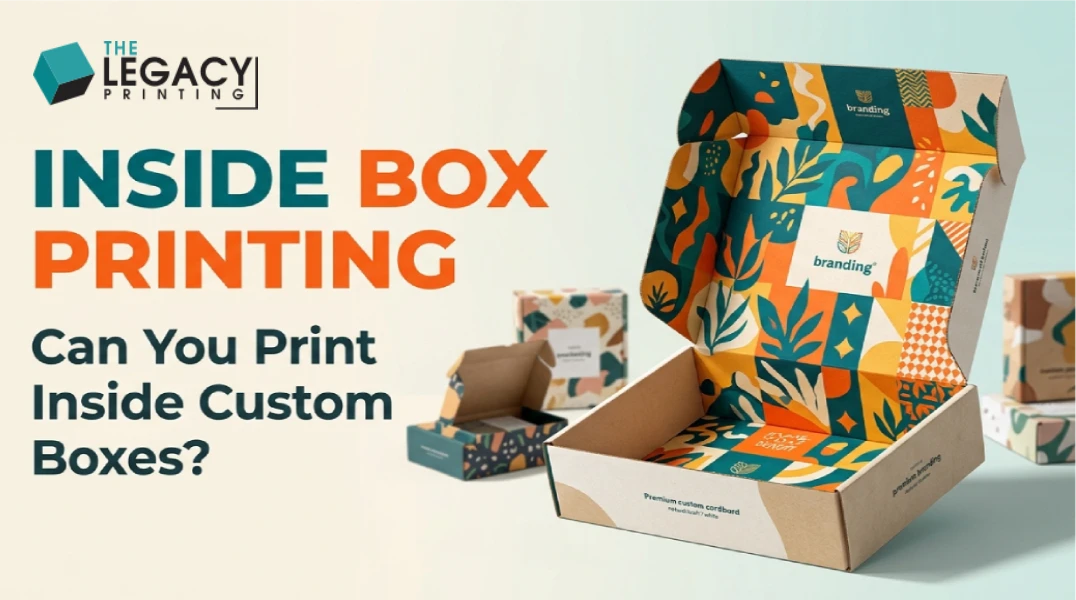
A lot of brand owners assume the inside of a box has to stay plain brown or white. It doesn't. So, can you print inside custom boxes? Yes. Mailer boxes, shipping boxes, folding cartons and rigid boxes can all carry art on the inside, the outside, or both.
The hard part is getting it right the first time. Most inside printing problems start in the design file, not on the press. That's good news, because file problems are easy to fix once you know what to look for.
Can You Print Inside Custom Boxes? The Short Answer
Yes, and you have three choices: inside only, outside only, or both sides. The right pick depends on how your box opens and what you want customers to feel when it does.
Inside only, outside only, or both
- Outside only: The classic choice. Your brand shows on the shelf or the doorstep, and the inside stays plain.
- Inside only: A plain or kraft outside with a bright surprise inside. It works well for shipping, because the box stays low-key in transit.
- Both sides: Custom boxes printed inside and out carry your brand from the porch to the last fold.
Which box styles take inside printing well
Boxes that open with a lid give inside art the most attention. Mailer boxes, two-piece boxes, drawer boxes and magnetic closure boxes all show their insides the moment they open. Custom two piece boxes are a good example, since the whole underside of the lid faces the customer.
Other styles hide the inside. A small tuck end carton for a mascara tube, or custom printed pillow boxes and gable boxes, show very little interior once opened. Inside print still works there, but it pays off less. If you're unsure, tell us your idea and we'll suggest a style that shows it off.
The Problem: Signs Your Box Interior Isn't Working
A box interior isn't working when it's blank or printed badly. Either way, you waste the one moment your customer is fully paying attention.
Here are the signs brand owners usually spot:
- Customers open the box, see plain board and toss it aside.
- The inside print came out backward or on the wrong panel.
- A logo or line of text got cut in half at a fold.
- A dark background cracked or showed white lines along the edges.
- Bright colors looked muddy on brown kraft board.
- The product or insert sits right on top of your message.
- The QR code won't scan, or it opens the wrong page.
Sound familiar? The causes below explain why it happens.
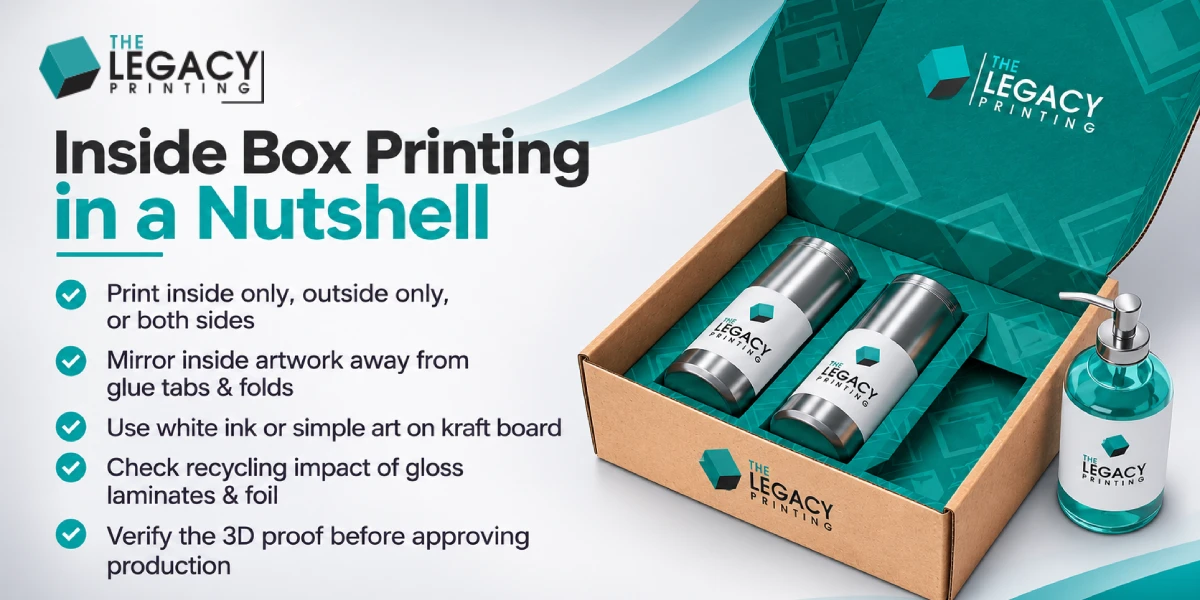
Inside Box Printing in a Nutshell
Why Inside Box Printing Goes Wrong: 6 Real Causes
Nearly every inside printing problem comes from file setup, color choices or box layout. The box itself is rarely the issue.
1. The inside file wasn't mirrored
Inside art prints on the back of the flat sheet. So the inside template is mirrored, or flipped, to make the art land in the right spot after folding. Design it like the outside, and your lid message can end up on the wrong panel or read backward.
2. Art sits on the glue tab or across a fold
A dieline is the flat map of your box, showing every cut, fold and glue spot. The glue tab is the small flap that gets glued down to build the box, so any art there gets covered. Text placed right on a fold line also bends and breaks up when the box closes.
3. Heavy dark ink covers every inch
A solid black or navy interior looks great on screen. On real board, heavy dark ink can crack at the folds and show the board underneath. It can also rub off where the product slides in and out.
4. Colors were planned for white board but printed on kraft
Kraft board is brown paperboard, and ink sits on top of that brown. Colors come out warmer and darker than they look on a white screen. For example, a soft pink can turn into something close to dusty brown.
5. The product or insert hides the message
This one catches a lot of people out. You print a lovely thank-you note on the inside base, then a paper insert or the product itself covers it. The inside lid is usually the safer spot.
6. The QR code is too small, too light or points to the wrong page
A blurry, low-resolution QR code won't scan. Light codes on kraft often fail too, because phones need strong contrast. And a code that leads to an old sale page makes your box look out of date.
Cause and Fix at a Glance
Each problem has a simple fix. Here they are side by side.
| What you notice | Real cause | Fix |
|---|---|---|
| Art is backward or on the wrong panel | Inside file not mirrored | Use the mirrored inside template and label the file "Box Interior" |
| Logo cut off or hidden | Art on the glue tab or outside the safe area | Keep logos and text inside the safe area, off the glue tab |
| White edges after cutting | No bleed | Run background color past the cut line |
| Cracks or white lines at folds | Heavy dark ink across folds | Use lighter colors or patterns near folds; ask about a protective finish |
| Muddy colors on brown board | Art planned for white board | Use white ink under key art, or simple one- or two-color designs |
| Message covered when opened | Insert or product sits on top | Move the message to the inside lid |
| QR code won't scan | Low resolution or weak contrast | Use a vector QR code in a dark color and test it on more than one phone |
Inside Printing by Box Type
Inside printing works on most box types, but each handles it a little differently.
Printing inside mailer boxes
Mailer boxes are the most popular choice for inside print. They're made of corrugated board: cardboard with a wavy layer, called the flute, between two flat sheets. E-flute is thinner and gives a smoother print surface. B-flute is thicker and better for heavier items.
When the lid lifts, the whole inside panel faces your customer. That's prime space for a pattern, a note or your social handle. Still picking a style? Our guide on mailer boxes vs shipping boxes explains which one fits your shop.
Kraft boxes
Yes, you can print inside kraft boxes, but plan for the brown base. A layer of white ink printed first helps logos and colors stand out. Without it, simple one- or two-color art in dark shades looks cleanest. Our post on kraft vs white boxes helps you decide which suits your brand.
Custom printed rigid boxes
Rigid boxes are thick, stiff boxes made from heavy board. The art isn't printed on the board itself. It's printed in full color on a paper wrap glued over the board, and a paper liner inside can carry a brand color, a pattern or a lid message.
Custom rigid boxes are a favorite for jewelry, gifts and launch kits. Many brands choose custom gold foil boxes or custom silver foil boxes for the outside, then keep the inside to one printed line. Browse our custom gift boxes to see rigid styles that suit this look.
Sleeve, drawer, tray and folding cartons
Drawer boxes have a tray that slides out of a sleeve, so the tray floor is a great spot for a message. Tray styles such as custom six corner boxes also open wide and show their insides. Folding cartons, like tuck end boxes for lipstick or serum, have less room inside. A short line on the inside flap is often enough.
Which inside print fits your box?
| Box type | Common use | Best print choice | Inside idea |
|---|---|---|---|
| Custom mailer boxes | Apparel, e-commerce, subscriptions | Both sides, or inside only | Pattern, thank-you note, social handle |
| Bakery and custom made cookie boxes | Cookies, pastries, treats | Outside, plus inside lid only | Short brand story; keep print away from where food sits |
| Cosmetic cartons | Lipstick, serum, cream | Mostly outside; small inside flap | One how-to-use tip |
| Rigid gift boxes | Jewelry, gifts, launch kits | Printed outer wrap and inner liner | Lid message or solid brand color |
| Custom tie boxes | Ties and accessories | Outside plus inside lid | Care tips |
| Custom game boxes | Board and card games | Both sides | Quick rules or a QR code to a how-to-play video |
For food boxes, keep inside print on the lid and away from direct food contact. Ask our team which materials and coatings suit your product before you order.
Does Printing Inside a Box Cost More?
Printing both sides usually costs more, because the sheet needs more print work. Inside-only printing is a different story. Many printers count it as one-sided printing, since only one side gets ink.
A few things move the cost up or down:
- Ink coverage. A small logo costs less than a full-color pattern on every panel.
- Print method. Digital printing prints straight from your file with no plates, so it suits small runs. Offset printing uses plates and suits big runs in CMYK color.
- Quantity. Larger runs spread the setup work across more boxes.
- Finishes. Foil, spot UV or lamination each add a step.
If you've been searching for custom digitally printed boxes in LA or another city, digital printing is the easiest way to test inside art on a small run. We don't list fixed prices, because every box is different. Ask for a free quote and you'll get the real number for your size, style and print choice.
How to Design Box Interior Artwork, Step by Step
Start with the dieline, build a separate inside file, and check a 3D proof before you approve. These steps keep you clear of every mistake above.
- Get the dieline for your exact box. Every size has its own map. New to the term? Read what a dieline is and how it works.
- Make two files. Build one for the outside and one for the inside, labeled "Box Exterior" and "Box Interior."
- Use the mirrored inside template. Place inside art on the flipped template so it lands right after folding.
- Add bleed. Bleed is extra color that runs past the cut line, so no white edge shows if the cut shifts slightly.
- Respect the safe area. This is the zone inside the edges where text and logos won't get cut or folded.
- Keep art off the glue tab and folds. Give key text some breathing room from every fold line.
- Pick colors for your board. CMYK is four inks (cyan, magenta, yellow and black) that mix into full color. Pantone colors are exact named inks for matching a brand color. On kraft, ask about white ink.
- Send a print-ready file. PDF is the format most printers prefer. Use high-resolution images and vector logos and QR codes.
- Check the 3D proof. A proof is a preview of your box before printing. Open each panel and confirm the inside art really sits inside.
Box Interior Printing Ideas for a Small Budget
You don't have to fill the whole inside with color. One well-placed message on the lid often does more than a busy full-coverage design.
Inside lid printing: the first thing customers see
Inside lid printing turns unboxing into a small moment. Your customer reads your words before they even touch the product. So put whatever matters most right there.
Simple ideas that work
- A short thank-you message in your brand voice
- Two or three how-to-use steps for a cosmetic or candle
- Care tips for clothing, ties or jewelry
- A QR code to a setup video or your brand story
- Your social handle, with a nudge to share an unboxing photo
- A discount code for the next order
- A repeating logo pattern or one solid brand color
One privacy note: pre-printed boxes go to many people, so never print customer names or personal details on them. Use a general link, and check where the QR code leads before you approve the file.
Cosmetic brands get a lot out of short how-to steps on the lid. See our custom cosmetic boxes for styles with room for inside messages.
Is a Box With Inside Printing Still Recyclable?
A paper or cardboard box with plain printing can usually go in the recycling bin. The bigger question is the finish you add on top.
Inks and coatings
Packaging printers often advise skipping glossy laminates, foils and soft-touch coatings if easy recycling is your goal. Want some shine and a greener box at the same time? Ask our team which finishes fit. You can also explore our eco-friendly boxes in kraft paper and recycled cardboard, which we offer in almost every category at no extra premium.
What the recycling numbers say
Used cardboard boxes collected for recycling are called OCC, or old corrugated containers. The recycling rate for OCC was 69 to 74 percent in 2024, as reported by Recycling Today. The industry group AF&PA now reports ranges instead of a single number. According to Packaging Dive, older figures of 88 to 94 percent were seen as too high.
Be careful with the word "recyclable"
The FTC Green Guides (16 CFR Part 260) set US rules for green marketing words. A plain "recyclable" claim needs recycling access for a "substantial majority" of people where the item is sold, which means at least 60 percent. Below that, you have to qualify the claim. So check before you print "recyclable" inside your lid.
How to Get It Right Next Time With The Legacy Printing
The easiest way to avoid inside printing mistakes is to have the dieline, file and proof checked by people who do this every day. That's how we handle every order.
Free design support and dielines
Send us your logo and your idea, and our team prepares print-ready artwork for free, including the mirrored inside file. Everything is made in-house, with no subcontracting, so the people checking your art are the same people printing it.
Small runs, no die or plate charges
You can start with as few as 50 boxes, which makes it easy to test an inside design before a bigger run. There are no die and plate charges. We use digital printing for short runs and offset printing for large CMYK runs, and you can customize size and shape on every order.
3D rendering, sample kits and free USA shipping
Before production, you get a digital 3D rendering to confirm the inside art sits where it should. Want to feel the board first? Sample kit requests are followed up within 2 hours, and kits ship within days. Shipping is free to any address in the USA, with no hidden freight costs. Our customer service team is available 24/7, and we're rated 4.9/5 from 1,159+ orders and reviews.
Frequently Asked Questions
Can you print inside mailer boxes?
Yes. Mailer boxes are one of the best styles for inside printing. The whole inside lid faces the customer on opening, so it's a great spot for a pattern, a note or a QR code.
Does printing inside a box cost more?
Printing both sides usually costs more than one side. Inside-only printing is often treated as one-sided printing. Ink coverage, quantity and finishes also change the price, so a quote gives you the real figure.
Can you print inside rigid boxes?
Yes, though it works differently than on cardboard. Rigid boxes use a printed paper wrap over thick board, and an inside liner can carry color or a message. Ask our team which rigid styles suit your design.
Can you print inside kraft boxes?
Yes. Colors look warmer and darker on brown board, so use white ink under key art or stick to simple one- or two-color designs.
Do I need a separate file for the inside of the box?
Yes, you need one file for the outside and one for the inside. The inside file uses a mirrored template, and clear labels like "Box Interior" prevent mix-ups.
What is the best way to design the inside of a box?
Start with the dieline, put key text on the inside lid, and stay off glue tabs and folds. Then check the 3D proof panel by panel before you approve.
Can I add a QR code inside the box?
Yes. A QR code inside the lid is a low-cost way to share a video or your brand story. Use a vector file in a dark color, test it on more than one phone, and link to a page that won't go out of date.
Ready to Print Inside Your Boxes?
Inside printing turns a plain box into part of your unboxing experience, and it doesn't take a big budget. Tell us what you're shipping and how many, and we'll handle the dieline, the mirrored file and the 3D proof. With a 50-box minimum, free design support, no die and plate charges and free shipping across the USA, it's an easy test to run. New customers also save 20% on their first purchase!
Get a free quote today, or call us at 800 719 2780 or email sales@thelegacyprinting.com to request a sample kit.