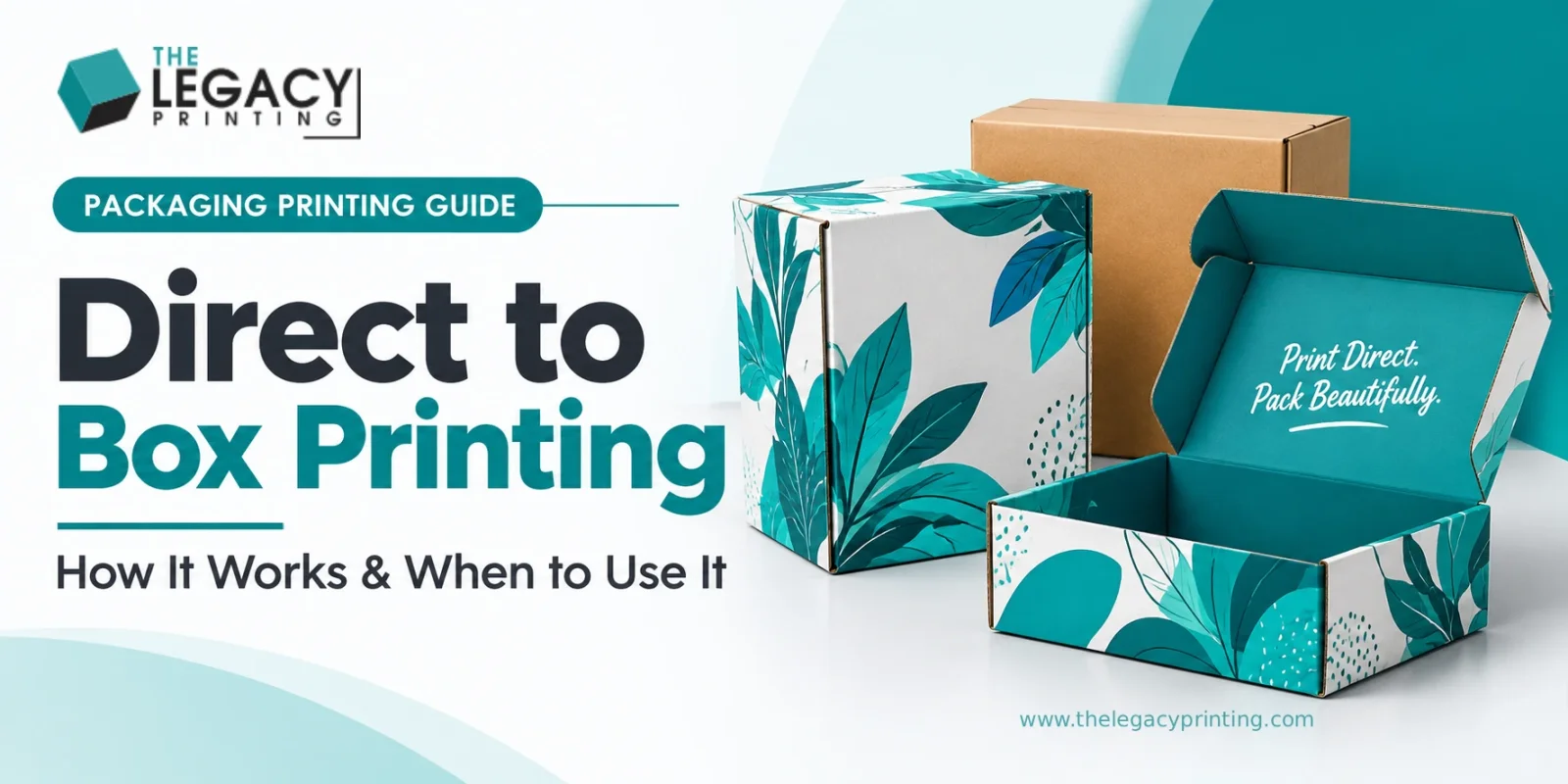
Direct to box printing means the ink goes straight onto the cardboard box or flat board, with no extra printed sheet glued on top. Your print method affects your price per box, your minimum order, how sharp your art looks and how long your boxes take to make.
Choose the wrong method and you could pay for printing plates on a tiny order. Or you could open your first carton and find a blurry logo on brown board. Choose well, and your box starts selling your brand the moment it lands on a doorstep. You only need a few basics to make a safe choice, and they're all below.
What Is Direct to Box Printing?
Direct to box printing puts your design right onto corrugated board or a flat box blank. The other main route is pre-printing. With pre-printing, the design goes on a separate sheet first, and that sheet is then applied to the box.
Corrugated board is cardboard with a wavy paper layer between two flat paper layers. It's strong and light, so most shipping boxes and mailer boxes use it. Two methods print on it directly:
- Flexo (flexography): flexible plates stamp ink onto the board. It works best for big runs with simple art.
- Digital (inkjet): a machine sprays ink straight from a computer file. There are no plates, so it suits small orders.
Direct Print vs Pre-Print vs Litho-Lamination
Litho-lamination is a type of pre-printing. A paper sheet is printed with offset (litho) printing, then laminated, or glued, onto corrugated board. Offset printing transfers ink from a plate to a rubber roller and then onto paper. It gives sharp, photo-like graphics.
| Method | How it works | Best for | Main limits |
|---|---|---|---|
| Direct digital | Ink is sprayed from a file onto the board | Short runs, full-color art, many designs | Fewer finishes can be added inline |
| Direct flexo | Plates on rollers stamp ink onto the board | Large runs, simple logos, 1 to 2 colors | Plate setup; weak on tiny text and soft fades |
| Litho-lamination (pre-print) | Offset-printed sheet is laminated onto corrugated board | Retail displays and premium shelf boxes | Extra steps, more time and higher cost |
Rigid boxes work differently. In rigid box printing, the design goes on paper that's then wrapped around thick board. Most paper packaging box printing, such as folding cartons for cosmetics or custom vial box printing, also prints flat paperboard sheets first. So direct printing is mainly a corrugated topic.
Not the Same as a Direct to Box Printer on a Factory Line
If you searched "direct to box printer," you may have found industrial inkjet machines. Warehouses use them to print barcodes, batch numbers and GS1 codes on shipping cases instead of adding labels. GS1 codes are the standard barcodes that stores and warehouses scan to track products. These machines are made for tracking, not brand artwork. This article covers boxes that carry your logo, colors and story.
How Does Direct to Box Printing Work?
Digital direct printing sprays ink from your file onto the board. Then the board is cut and folded into boxes. Flexo uses one plate per color on rollers, so it needs setup before the first box prints.
Digital Box Printing, Step by Step
- Pick the box style and size. Measure your product first, then leave room for any insert.
- Get the dieline. A dieline is a flat map of the box that shows every cut and fold. Our guide on what a dieline is and how to use it covers this in more detail.
- Place your art on the dieline. Add bleed, which is extra art past the cut line, so no white edge shows. Crop marks tell the printer where to cut.
- Check a proof. Look at the text, the colors and how the panels line up when folded.
- Print. The printer mixes CMYK inks (cyan, magenta, yellow and black) to make most colors.
- Cut, crease and fold. The printed sheets are die-cut to shape and scored, which means fold lines are pressed in. Then they're glued or packed flat.
Flexo: Plates, Rollers and a Few Colors
A flexo corrugated box printing machine uses rubber-like plates, one for each color. Each plate picks up ink and presses it onto the board. On long runs, the setup cost gets spread thin, which makes flexo a sensible pick for bold, simple logos.
The weak spot is detail. Flexo on corrugated can't hold very small text, thin lines or soft color fades well. If your art has those, you'll need to simplify it or choose a different method.
Why Plates Matter on Small Orders
Plates cost money to make. On a big order, that cost is shared by many boxes, so you barely notice it. On a small order, each box carries a bigger share, and your price per box jumps.
Digital printing skips plates completely. And at The Legacy Printing, you pay no die and plate charges at all!
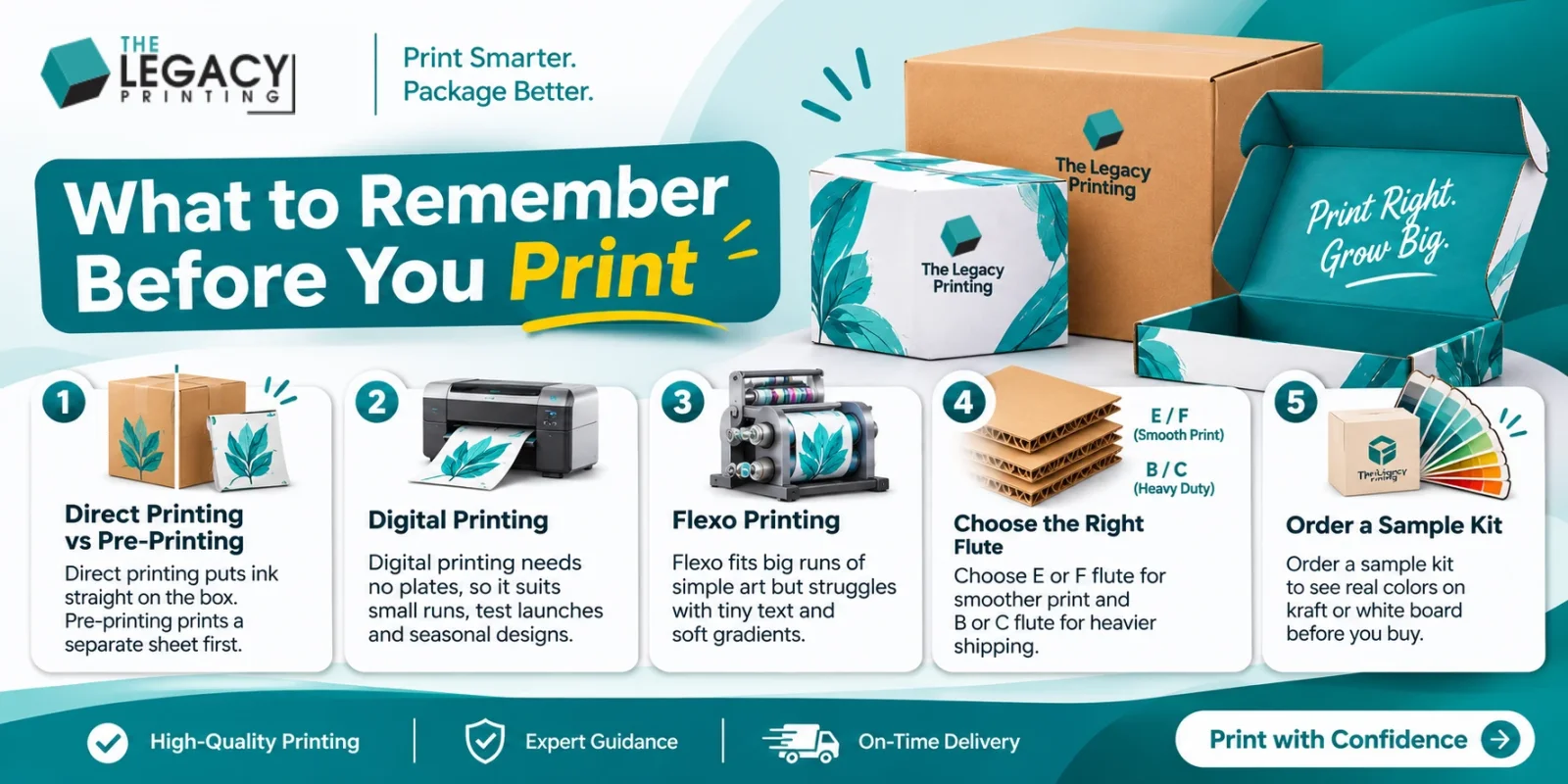
What to Remember Before You Print
What to Look For When Choosing a Custom Box Printing Method
Start with your order size and how detailed your art is. Then check the board, the liner color, the finishes and the box strength. Each one changes how the final box looks and how well it holds up.
Order Size and How Often Your Art Changes
Answer this first, because it narrows your choices fast. Small runs, test launches and seasonal designs favor digital, since there's no setup. Large repeat orders of one design favor flexo or offset.
For example, say you sell three candle scents. Digital lets you print all three designs in one order without paying for extra plates.
How Detailed Your Artwork Is
Photos, small text and soft color fades need a sharp method. Digital handles them well on most boards. A bold logo in one or two colors looks clean in flexo and costs less on big runs. If you need flexo but your art is detailed, simplify it before you print.
The Finishes You Want
Finishes add shine, texture or a metal look. Spot UV is a shiny coat on chosen areas, and foil adds a metallic layer. Embossing presses a raised shape into the board.
Standard direct-print corrugated equipment can't add high-gloss UV, soft-touch coating or foil inline. If finishes matter to you, ask our team which ones fit your box and board. Our post on spot UV printing on boxes shows when this finish is worth adding.
Board and Flute
The flute is the wavy middle layer of corrugated board. Its size changes both how your print looks and how well the box protects your product. Here are typical thicknesses from this corrugated flute thickness chart:
- F flute: about 1/32 in (0.8 mm)
- E flute: about 1/16 in (1.6 mm)
- B flute: about 1/8 in (3.2 mm)
- C flute: about 5/32 in (4 mm)
Thin E and F flutes have a flatter surface, so print looks smoother. That makes them a good match for printed mailer boxes. Thicker B and C flutes give more cushioning and stacking strength, so they suit heavier shipping cartons.
Kraft or White Liner
The liner is the top paper layer you print on. Kraft is natural brown paper, and white liner is bright and clean. Both take ink, but the same colors look very different on each.
On kraft, light colors blend into the brown, so bold, dark art works best. Read our comparison of kraft vs white boxes before you decide.
Box Strength (ECT)
ECT stands for Edge Crush Test. It measures how much force a board can take on its edge before it crushes. A 32 ECT board, for example, holds 32 pounds of force per inch of edge.
You can get the same rating on B or C flute. The flute changes thickness, cushioning and print quality, not the rating. Box style codes, like FEFCO codes, only describe the shape, not the strength.
Box Printing Options by Budget and Use
For small orders or changing art, digital is usually the safest pick. For big runs of simple art, flexo or offset makes more sense. Premium shelf boxes call for litho-lamination or rigid boxes.
| Your situation | Good fit | Why | Watch out for |
|---|---|---|---|
| First test run of a new product | Digital on E flute | No plates and a low minimum | Ask which finishes are possible |
| Seasonal or limited edition | Digital | New art costs no new plates | Order early before busy holiday weeks |
| Many scents, flavors or sizes | Digital | Several versions in one order | Keep text readable on each version |
| Big repeat order, simple logo | Flexo or offset | Lower cost per box on long runs | Fine detail and fades may blur on flexo |
| Heavy shipping carton | Simple print on B or C flute | Strength and cushioning come first | Thick flutes print less smoothly |
| Retail display or shelf box | Litho-lamination or offset | Sharp, photo-like graphics | More steps, more time, higher cost |
| Subscription or e-commerce mailer | Digital mailer with inside print | Strong unboxing moment | Plan inside art on the dieline |
| Luxury gift or high-end product | Rigid box with printed wrap | Thick, premium feel and full finishes | Rigid boxes are bulkier to ship and store |
Red Flags and Costly Mistakes to Avoid
Most print problems start in the file, not on the press. Run through this list before you approve anything:
- Low-resolution art. An image that looks fine on a phone can print blurry on a box panel.
- No bleed. Thin white lines can show at the edges after cutting.
- Tiny text or thin lines on flexo. They can fill in or break up, so make them bigger and bolder.
- Art across folds or glue flaps. Logos can split in odd places, and ink can crack along fold lines.
- Light colors on kraft. Pale pinks and yellows can almost disappear on brown board.
- Forgetting the inside. Inside print has to be planned on the dieline from the start.
- Wrong flute for fine print. Detailed art on thick B or C flute can look uneven.
- No proof before production. Always check one, even on a rush order.
- Surprise fees. Look out for plate charges, die charges or freight added after the quote.
Questions to Ask Your Box Printer Before You Order
A few simple questions protect you from most surprises. Ask these before you pay:
- Which print method do you suggest for my order size, and why?
- Are there plate, die or setup fees?
- What's the minimum order for my box style?
- Will I see a proof or 3D rendering before production?
- Can you print inside the box?
- Which flutes and liners work best for my art?
- Which finishes can I add to this box?
- Is shipping included, or is freight extra?
- Can I get a sample kit to check real colors?
Searching "box printing near me" can feel safer, and that's understandable. Still, clear answers matter more than distance. With free shipping to any US address, a printer in another state can be just as easy to work with as one nearby.
Is Direct Printed Cardboard Recyclable?
Plain corrugated cardboard is widely recycled in the US. Coatings and some finishes can change how easily a box gets recycled, so ask before you add them.
According to AF&PA's 2024 paper and cardboard recycling rates, 69% to 74% of US cardboard available for recovery was recycled in 2024. You may also come across the EPA containers and packaging data, which estimated a 96.5% corrugated box recycling rate for 2018. The two figures use different methods, years and scope, so they don't show a trend when placed side by side.
At The Legacy Printing, kraft paper and recycled cardboard are available in almost every category with no extra premium. Browse our eco-friendly boxes to see your options. Planning a coating or finish? Ask our team how it affects recycling for your box.
Our Recommendation by Situation
For most small US brands, digital printing on a corrugated mailer is the safest first step. It keeps the order small, the art flexible and the risk low.
- Bakery shipping cookies or brownies: a digitally printed corrugated mailer with a simple logo works well. Keep the branding bold and the design uncluttered.
- Candle shop selling online: E flute mailers with a printed inside lid make opening feel like a gift. For heavy jars, add an insert or pick a sturdier flute.
- Cosmetics subscription box: digital printing lets you change the theme each month with no plate costs. Add a short thank-you note on the inside.
- Apparel brand: a kraft mailer with dark, bold art looks clean and natural. Avoid pale colors on brown board.
- Retail brand going into stores: this is where litho-lamination or offset is worth the higher cost. Shoppers judge shelf boxes from a short distance, so sharp graphics matter.
Not sure which box fits your shipping needs? Our guide on mailer box vs shipping box walks you through the choice.
How The Legacy Printing Makes Box Printing Easy
We keep the process short and clear, so you know exactly what you're getting before anything prints. It takes four steps:
- Choose your style and size. Pick a box style and set custom dimensions and shapes to fit your product.
- Send your artwork or get it designed free. Our team prepares print-ready artwork for you.
- Approve a 3D rendering. You see your box in 3D before production starts.
- Get free, fast shipping. We ship free to any US address, with no hidden freight costs.
Here's what else you get:
- No die and plate charges
- Minimum order as low as 50 pieces
- Digital printing for short runs and offset printing for large runs
- In-house manufacturing with no subcontracting
- Finishes like matte and gloss coating, spot UV, foil, embossing and debossing
- Customer service reps available 24/7
- Rated 4.9/5 from 1,159+ orders and reviews, and a BBB accredited business
- Save 20% on your first purchase
Frequently Asked Questions
What is the minimum order for direct printed boxes?
At The Legacy Printing, you can start with as few as 50 pieces. Digital printing makes small runs practical because no plates are needed. That makes it easy to test a new product before you order more.
Is digital or flexo printing better for corrugated boxes?
Digital is better for small runs, detailed art and changing designs. Flexo is better for large runs of simple art. If you're printing a few hundred mailers with photos, go digital. For a very large order of a one-color logo, flexo can cost less per box.
Can you print directly on cardboard boxes in full color?
Yes. Digital printing can print full CMYK color directly on cardboard. Colors look brightest on white liner. On brown kraft they look darker and more muted, so choose bold shades.
Can you print inside a mailer box?
Yes, many mailer styles can be printed inside as well as outside. Mention it when you request a quote, so our team plans the inside art on your dieline from the start.
Can I get a sample before ordering in bulk?
Yes. You can request a sample kit to see real print and materials first. We follow up on sample kit requests within 2 hours, and kits ship within days. Kits come in 1 color, 2 colors, 4 colors (CMYK) or custom Pantone. Pantone is a numbered color system used to match one exact brand color.
Are direct printed corrugated boxes recyclable?
Plain printed corrugated is widely recycled in the US, but some coatings and finishes can affect that. Kraft and recycled cardboard are our simplest greener options. Ask our team how any finish you choose affects recycling.
Ready to Print Your Boxes?
Direct to box printing is a low-risk way to put your brand on every box, especially on small runs. Match the method to your order size, the flute to your art and the liner to your colors. Then check a proof before anything prints.
Want help choosing? Get a free quote and free design proof, call 800 719 2780 or email sales@thelegacyprinting.com. Tell us what you're shipping, and we'll suggest the right box, board and print method for your product!