How do you switch to eco-friendly packaging without hurting your brand or your budget? Check what you use now, shrink your boxes to fit, and then move to kraft or recycled cardboard one product at a time. Test a small run first, and print only claims you can prove. That's how to switch to eco-friendly packaging with low risk.
Our short answer on materials is simple. For most small brands, kraft or recycled cardboard is the right pick for product boxes. Corrugated mailers win for shipping. Rigid boxes make sense when a premium unboxing that customers keep matters more than low weight.
How to switch to eco-friendly packaging: the 6-step plan
The whole switch comes down to six steps: audit, right-size, pick a material, print smart, test, and make honest claims. Here's how they fit together.
| Step | What to do | Effort (general) |
|---|---|---|
| 1. Audit | List every box, tape, filler, insert and label you use now | Low |
| 2. Right-size | Match each box closely to the product inside it | Low to medium |
| 3. Pick a material | Compare kraft, recycled cardboard, corrugated and rigid | Medium |
| 4. Print smart | Choose a simple design and finishes that suit your goal | Low |
| 5. Sample and pilot | Test with one product before changing everything | Medium |
| 6. Claims and customers | Print specific, provable words and tell buyers about the change | Low |
Why packaging is part of your brand, not just a cost
Your box is the first thing a customer touches. A clean kraft box with a simple logo says something about you before anyone reads a word. So treat this switch as a brand decision, not just a line on your budget. Done well, it helps your planet story and your unboxing experience at the same time!
What does "eco-friendly packaging" really mean?
Good eco-friendly packaging has a specific benefit you can prove, like recycled content or easy recycling. On its own, the phrase is vague. That's exactly where many brands get into trouble.
Recyclable vs recycled content vs reusable vs compostable
- Recyclable: the box can be collected and turned into new material. Paper is one of the most recycled packaging materials in the US. In 2018, paper and paperboard packaging had a recycling rate of 80.9%, according to EPA containers and packaging data (2018).
- Recycled content: the box is made partly or fully from recovered paper. Post-consumer means paper people used and threw away. Pre-consumer means scrap left over from making products.
- Reusable: the box is sturdy enough to use again, like a rigid gift box that becomes storage.
- Compostable: the material breaks down into compost. Only claim this with solid evidence, and say so if it can't be composted at home.
If these terms still blur together, our guide to compostable vs biodegradable vs recyclable packaging explains each one in more detail.
Why "eco-friendly" alone is a risky claim
The Federal Trade Commission (FTC) publishes the Green Guides, which are US rules of thumb for honest environmental claims. The FTC first issued them in 1992 and revised them in 2012. Its advice is clear: don't make broad, unqualified claims like "green" or "eco-friendly." Name the specific benefit instead.
You also need proof. Per the FTC environmental marketing guidance, eco claims about a product or its packaging need competent and reliable scientific evidence. The FTC summary of the Green Guides takes a few minutes to read. Your state may have extra rules, so check before you print.
Step 1: Audit what you use now
A packaging audit is a simple list of every part in your package, with its size, material and cost. It shows you where the waste is before you spend money on new boxes.
List every part
- Shipping boxes and mailers
- Product boxes that sit on a shelf
- Tape and stickers
- Void fill, which is the paper or air pillows that fill empty space in a box
- Inserts that hold the product in place
- Labels, hang tags and thank-you cards
- Coatings and window film
Check weight, size and damage
Weigh a packed order and write down the box size. Then read through your damage complaints and customer messages. If products arrive broken, a greener box that breaks more often isn't a win.
Spot what you can cut
Look for parts that do the same job twice. For example, a product box inside an oversized shipper, plus filler, often protects the item three times over. A sticker label you could print straight onto the box is another easy cut.
Step 2: Right-size before you change materials
The greenest material is the material you never use. A box that fits snugly needs less board and less filler, and it can cost less to ship.
Many carriers charge by dimensional (DIM) weight. That means they price a package by its size, not only by how heavy it is. A smaller box may move you into a lower rate, so ask your carrier how they measure it.
You can customize the size and shape of every box we make, so it can follow your product closely. Not sure where to start? Our guide on what size box you need for your product walks you through measuring.
Step 3: Kraft vs recycled cardboard vs corrugated vs rigid: which eco-friendly packaging box fits you?
Kraft and recycled cardboard suit most product boxes. Corrugated is best for shipping, and rigid fits premium gifts. Here's how they compare side by side.
| Material | What it is | Look | Protection | Cost level (general) | Best for |
|---|---|---|---|---|---|
| Kraft paper board | Strong brown paperboard with a natural look | Natural and earthy | Good for light items | Low to medium | Bakery, soap, candles, natural cosmetics |
| Recycled cardboard | Board made from used paper that was reprocessed | Clean surface that takes color well | Good for shelf boxes | Low to medium | Cosmetics, retail, food boxes |
| Corrugated board | A wavy paper layer (called the flute) between two flat layers | Plain or fully printed | Strong; built for shipping | Medium | Mailers, subscription and e-commerce orders |
| Rigid board | Thick, firm board, usually wrapped in printed paper | Premium | Very sturdy | Higher | Gifts, jewelry, premium sets |
| Paper inserts and molded pulp | Cardboard inserts, or trays of pressed paper fiber | Plain | Holds and cushions items | Varies | Replacing foam inserts |
Good news on cost: at The Legacy Printing, kraft paper and recycled cardboard are available in almost every category with no extra premium. See the full range on our eco-friendly boxes page.
Kraft packaging boxes
Kraft is brown because it's usually left unbleached. That gives it an honest, handmade feel that suits natural products.
Pros: natural look, recyclable where paper is collected, great with one or two ink colors. Cons: bright colors print darker on brown, and it isn't the strongest choice for heavy items.
Recycled cardboard boxes
Recycled paperboard is the everyday material behind many folding cartons, like tuck end and sleeve boxes.
Pros: prints full color well, lightweight, recyclable where paper is collected. Cons: it's a shelf box, so online orders usually need a shipping box around it.
Corrugated mailers and shipping boxes
The wavy middle layer gives corrugated its strength. It's also a material the US recycling system handles at scale. In 2018, the US generated 33.3 million tons of corrugated boxes and recycled about 32.1 million tons, per the EPA data linked above.
Pros: protects in transit, and one box can be both the shipper and the branded box. Cons: bulkier and heavier than paperboard, so right-sizing matters even more.
Rigid boxes
A rigid box is thick and firm. Unlike a folding carton, it doesn't fold flat.
Pros: premium feel, and customers often keep and reuse it. Cons: uses more material, costs more, and takes up more space in storage and shipping.
Which should you choose?
- Baked goods: a kraft bakery box sized to the treat works well. Ask our team which materials suit direct food contact, and browse our custom food boxes.
- Cosmetics or serums: recycled cardboard tuck end boxes with a fitted insert keep bottles still. See our custom cosmetic boxes.
- Candles or soap: start with a kraft product box. For online orders, add a right-sized corrugated shipper.
- Apparel or subscription boxes: a printed corrugated mailer does two jobs. It's the shipper and the unboxing moment in one.
- Premium gifts or jewelry: choose a rigid box that customers will want to keep.
- CBD or personal items: a plain outer mailer adds privacy. Our cannabis packaging includes child-resistant closures and areas for state-specific labels, but check your state's rules too.
Easy eco swaps for every part of the package
The box isn't the only thing you can change. If you want to make packaging more sustainable, work through it part by part. These swaps are a good starting list.
| Part you use now | Eco swap to consider |
|---|---|
| Oversized box plus lots of filler | A right-sized custom box with little or no filler |
| Plastic air pillows | Crinkle paper or a fitted cardboard insert |
| Foam insert | A cardboard or paper-based structural insert |
| Plastic window film | An open die-cut window, or no window at all |
| Heavy full-coverage coating | A lighter finish; ask our team about options |
| Full-color flood printing | One or two colors on natural kraft |
| Separate sticker labels | Printing the details right onto the box |
Step 4: Choose printing and finishes that suit your goal
Keep the design simple, and pick the print method that matches your order size. On kraft, one or two strong colors often look better than a busy full-color design.
Digital printing prints straight from your file, with no plate setup. That makes it a good fit for small runs. Offset printing uses printing plates and CMYK color, the four standard inks (cyan, magenta, yellow and black). It suits large runs. Our sample kits show 1 color, 2 colors, 4 colors (CMYK) and custom Pantone options. Pantone is a color-matching system for exact brand shades, and the kit lets you compare them on real board.
Finishes add polish. Matte or gloss lamination is a thin protective layer, spot UV adds shine to chosen areas, and foil stamping presses on a metallic layer. Some heavy coatings and mixed materials can make a box harder to recycle, though. Tell us your eco goal, and we'll suggest finishes that fit it.
Step 5: Order a sample and run a small pilot
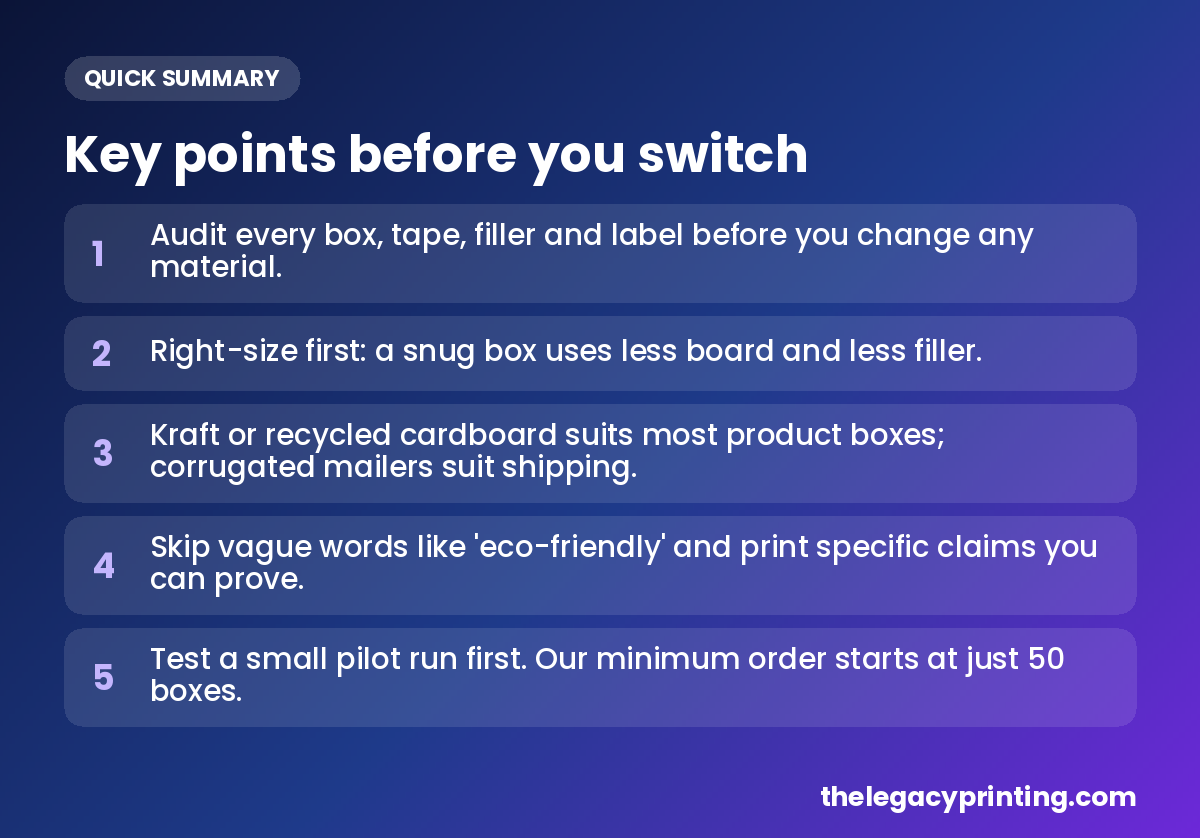
Test the new box with one product before you switch everything. A pilot run is a small first order that shows you real problems while they're still cheap to fix.
- Fit: does the product sit snugly without rattling?
- Strength: drop and stack a few packed boxes, then send some through your normal carrier.
- Look: check the color and finish in daylight and in your product photos.
- Packing speed: time your team. A box that's slow to fold costs you every day.
Our minimum order is as low as 50 pieces, and there are no die and plate charges. So a pilot won't lock you into thousands of boxes. Before production, you'll approve a digital 3D rendering of your box. Want to touch the material first? Request a sample kit. We follow up on requests within 2 hours, and kits ship within days.
One more tip: use up your old stock first. Phase in the new box as the old one runs out, so good packaging doesn't go to waste.
Step 6: How do you make honest eco claims on your box?
Print specific facts you can prove, not general green words. Keep the material details from your supplier on file, so you can back up every claim if anyone asks.
| Avoid | Use instead (only if true) | Why |
|---|---|---|
| "Eco-friendly box" | "Made from recycled paperboard" | The FTC warns against broad, unqualified claims |
| "Made from recycled material" (when it's only part) | "Made from 30% recycled material" (your real percentage) | The FTC says partial recycled content should be qualified |
| "Recyclable" everywhere | "Recyclable where paper is collected. Check locally." | The FTC says to qualify it if facilities reach fewer than 60% of consumers or communities where it's sold |
| "Biodegradable" | Skip it | Items sent to landfills won't break down within one year, per the FTC |
| "Compostable" | Only with solid evidence, plus a clear note if it can't be composted at home | The FTC says to qualify home composting limits |
Once your claims are right, tell your customers about the change. A short line in an email or on a thank-you card works well. Use the same specific words you printed on the box.
What FSC certified means on a box
FSC stands for the Forest Stewardship Council, a group that sets rules for responsibly managed forests. An FSC label tells you where the fiber came from. It doesn't tell you whether the box is recyclable.
The rules are strict. Under the percentage system, the 2020 FSC packaging guide says a product needs at least 70% FSC-certified and/or recycled input. A box can only carry the label under a valid chain of custody certificate. Chain of custody is the paper trail showing the material was tracked at every step. Since that guide is a 2020 edition, check FSC's current rules before you print the logo.
How to write recycling instructions on the box
Keep it short and clear, like "Please flatten and recycle this box." If one part goes in a different bin, such as a plastic seal, say what to do with it. And if you use a recycling label from an outside program, follow that program's rules exactly.
FAQ: switching to eco-friendly packaging
What is the best sustainable packaging for small business owners?
For most small businesses, kraft or recycled cardboard works best for product boxes. For shipping, a right-sized corrugated mailer is the safer pick. The right choice depends on your product's weight and how you sell it.
Are kraft packaging boxes recyclable?
Plain kraft boxes are recyclable where paper is collected. Heavy coatings, plastic windows or mixed materials can make recycling harder. So keep finishes light if recycling matters to you.
Do recycled cardboard boxes cost more?
Not with us. Kraft paper and recycled cardboard are available in almost every category with no extra premium. Ask for an instant quote to see your exact price.
Can I print "eco-friendly" on my packaging?
The FTC advises against broad claims like "eco-friendly" on their own. Print a specific, provable fact instead, such as "Made from recycled paperboard."
How do I test new packaging before switching fully?
Order a sample kit, then run a small pilot with one product. Our minimum order starts at 50 pieces, with no die and plate charges.
Does FSC packaging mean the box is recycled?
Not always. FSC labels are about where the fiber comes from. A box needs a valid FSC chain of custody certificate to carry the label.
Ready to make the switch?
Tell us what you ship and how many boxes you need. We'll suggest the right box, material and finish, then send a free 3D rendering before anything goes to print. Design support is free, shipping is free anywhere in the USA, and you'll never pay die or plate charges.
Plus, new customers save 20% on their first purchase! Call us at 800 719 2780, email sales@thelegacyprinting.com, or Get a Free Quote today.