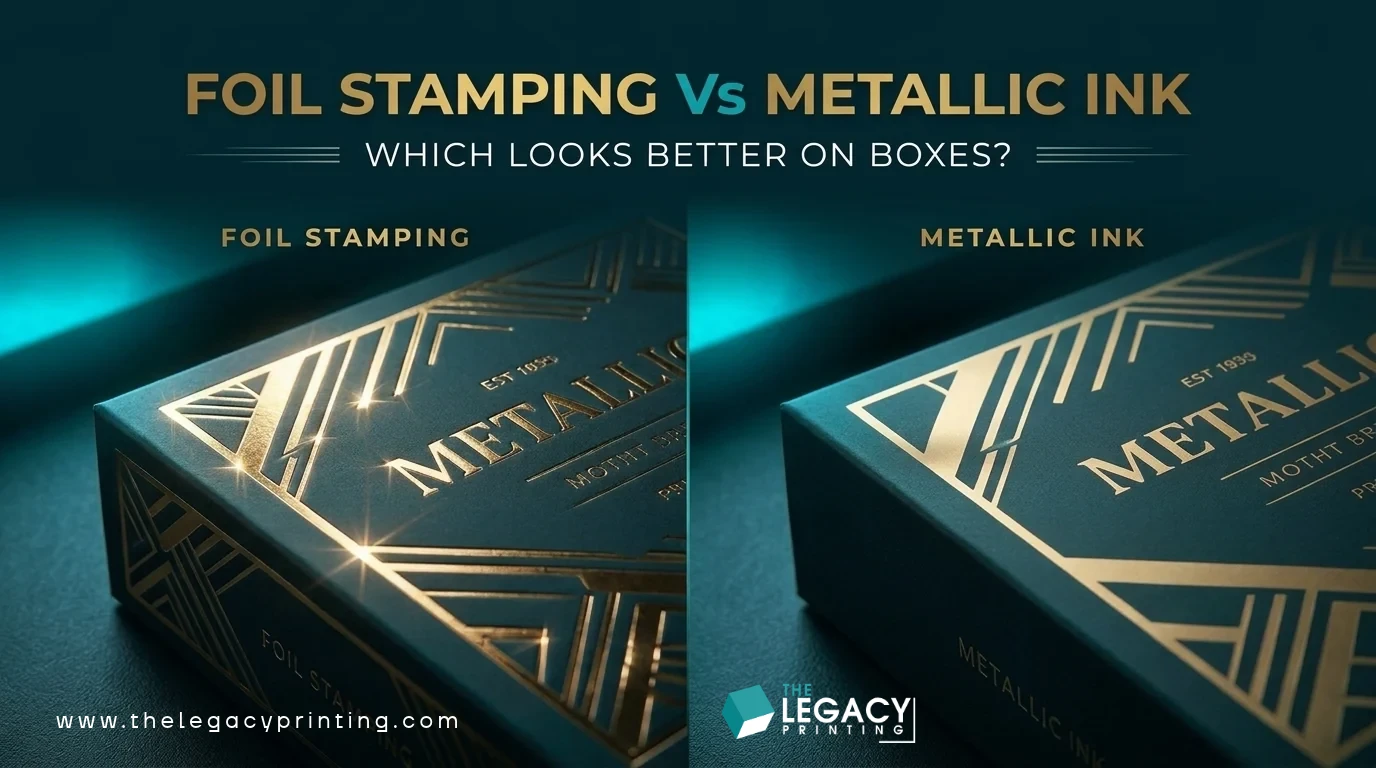
Gold foil and gold ink are not the same look at two different prices. You can see the difference the second light hits your box. In the foil stamping vs metallic ink choice, foil wins when you want a true mirror shine, a logo that pops on a dark box, and a finish that holds up in shipping. Metallic ink wins for large printed areas, soft color fades and tighter budgets.
So which one looks better? On a lot of boxes, the answer is both: metallic ink across the bigger design, with a small foil logo as the star. What's right for you depends on your box material, your artwork and your budget.
Quick answer: which looks better on a box?
Foil looks better when you want bright, mirror-like shine and impact. Metallic ink looks better when you want a soft, even glow over a large area, or a design with fades.
Foil for mirror shine and impact
Foil is a solid metal-look film laid on top of the box. It goes on after printing is done, so nothing sits over it to dull the shine. That's why gold foil box printing shows up so often on luxury gift boxes, perfume cartons and jewelry boxes. Tilt the box, and the foil flashes like real metal.
Metallic ink for soft shimmer and big areas
Metallic ink has tiny bits of metal mixed into it. It prints like normal ink, so the shine is softer and more satin-like. Ink can cover a whole panel or print a fade from gold to cream. Foil can't do either of those well.
Best mix: ink for the field, foil for the logo
Can't decide? Use both! Print a metallic ink pattern across the box, then add a small foil logo as the focal point. You get the glow of ink and the flash of foil, without paying to foil the whole surface.
What is foil stamping, and how does it work on a box?
Foil stamping uses heat and pressure to press a very thin metallic layer onto the box. The foil sticks only where the shaped metal plate touches, so the design comes out crisp and sharp.
Heat, a metal die and a foil film
The shaped metal plate is called a die. It's engraved in the shape of your logo or text. The foil comes on a roll of thin film, coated with the metallic color. The machine heats the die and presses it through the film onto the board. The color bonds to the box only where the die pressed. This is what people mean by hot foil stamping packaging.
Hot stamping vs foil stamping: is there a difference?
In most cases, no. "Hot stamping" and "foil stamping" usually mean the same heated process. The word "hot" just separates it from cold foil, which works differently.
Cold foil and digital foil
Cold foil uses glue instead of heat. The glue is printed on the press, and then the foil sticks to it. It needs a printing plate instead of an engraved die, and those plates can be made in a few hours, as this cold foil printing overview explains. Digital foil also skips the die, which makes it handy for short runs. Each method looks a little different, so ask which one will be used for your job.
Foil colors: gold, silver, rose gold and holographic
Gold and silver are the classics. Holographic (rainbow) foil is popular too, and foil comes in an almost unlimited range of other colors. Metallic ink is mostly limited to gold, silver and a few other shades.
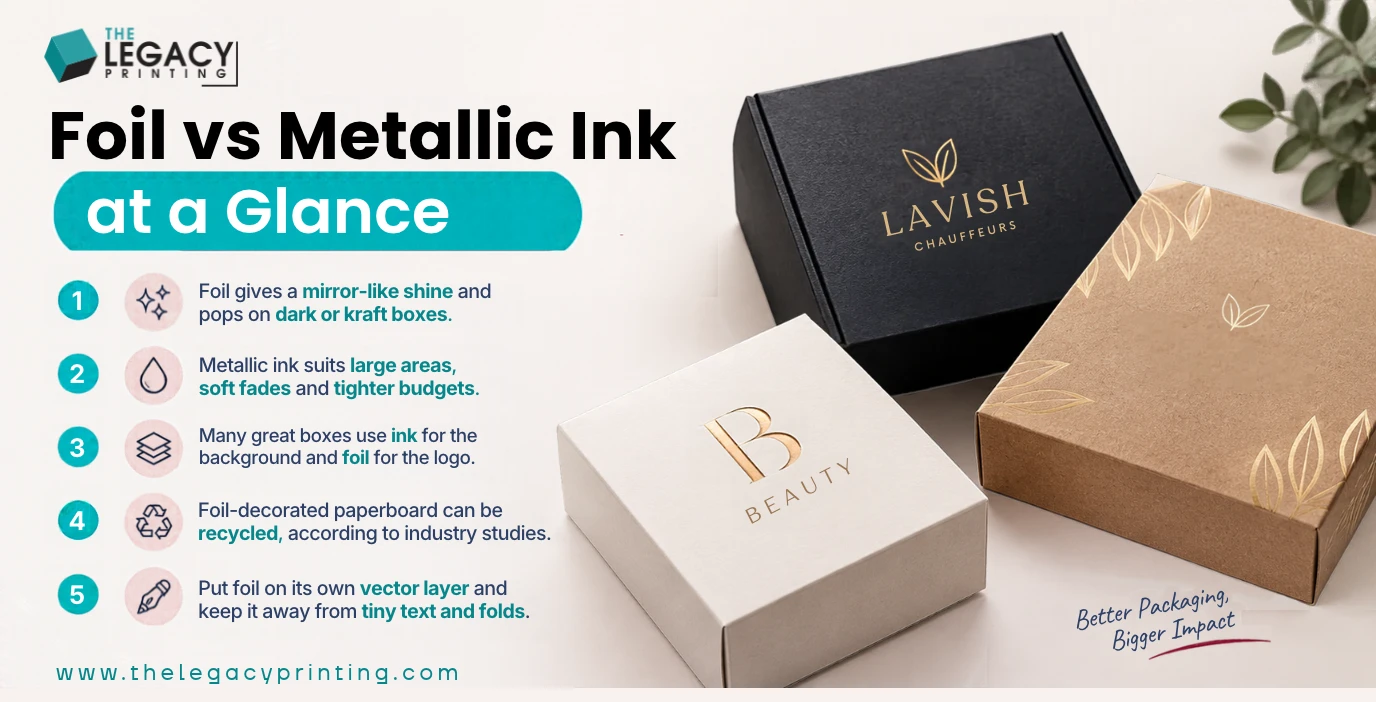
Foil vs Metallic Ink at a Glance
How does metallic ink work?
Metallic ink is ink with real metal particles in it, printed on the press like any other color. The particles catch the light and give a soft, satin shine instead of a mirror.
Metal flakes, printed like any color
Because it's ink, it can do things foil can't. It can print soft fades, called gradients, and tiny dot patterns, called halftones. It also handles thin lines and small text more reliably than stamped foil.
Why it needs a coating
Metallic ink goes on early in printing. Then it gets covered by a varnish or lamination, which is a clear protective coat. Without that coat, the metal particles can dull or turn brittle as they age. The coat protects the ink, but it also softens the shine a bit. Our guide to matte vs gloss lamination for custom boxes shows how each coat changes the look.
Pantone and brand color matching
Most boxes print in CMYK, the four-ink system that mixes cyan, magenta, yellow and black to make all colors. Pantone is a system of exact, pre-mixed colors. If your brand gold has to look the same on every box, ask our team about custom Pantone options for your order.
Foil stamping vs metallic ink: side-by-side comparison
Foil wins on shine, color choice, dark boxes and durability. Metallic ink wins on large areas, fades, fine detail and cost.
| Feature | Foil stamping | Metallic ink |
|---|---|---|
| How it goes on | Heated die presses foil onto the box after printing | Printed on the press like normal ink, then coated |
| Shine | Bright, mirror-like | Soft, satin shimmer |
| Colors | Gold, silver, holographic and almost any other color | Mostly gold, silver and a few shades |
| Fine lines and tiny text | Can fill in if too thin | Prints more reliably |
| Gradients and halftones | No, foil is a solid fill | Yes |
| Dark boxes | Pops clearly | Can fade a little |
| Kraft or uncoated board | Usually the better pick (test first) | Loses much of its shine |
| Durability | Lasts well over time | Can dull without a coating |
| Emboss or deboss | Pairs well (foil emboss) | Can crack when embossed |
| Main cost driver | Area covered by foil | Standard print setup |
| Best for | Logos, accents, luxury and dark boxes | Large patterns, fades, full panels |
On cost, foil gets pricier as the covered area grows. That's why metallic ink is much more cost-effective for big metallic areas, as this metallic ink vs foil table explains. There's no fixed price gap you can count on, because it depends on box size, quantity and setup. The only way to know is a real quote for your exact box.
Foil stamping: pros and cons
- Pros: true mirror shine, huge color range, stands out on black and kraft, pairs with embossing, holds up to handling.
- Cons: no fades, very thin details can fill in, and big foil areas cost more.
Metallic ink: pros and cons
- Pros: good value for large areas, prints fades, handles fine lines and small text.
- Cons: softer shine, weaker on dark or uncoated board, needs a protective coat, can crack if embossed.
Which finish fits your box?
Pick by what your design needs most: shine, area, detail or budget. Start with this table, then find your product below.
| If you need… | Pick | Why |
|---|---|---|
| A small logo or accent that shines | Foil | Mirror flash on a small area keeps cost in check |
| A large metallic pattern or full panel | Metallic ink | Far more cost-effective over big areas |
| Metallic on a black or dark box | Foil | Ink can fade on dark backgrounds |
| Metallic on a kraft box | Foil | Ink soaks into absorbent board |
| A gold-to-cream fade | Metallic ink | Foil can't print gradients |
| Boxes that get handled a lot in shipping | Foil | More durable over time |
| A raised, foiled logo | Foil emboss | Ink can crack when embossed |
| Shine on a tight budget | Metallic ink, or one small foil spot | Keeps the foil area small |
Cosmetics and skincare cartons
Foil and cosmetic boxes are a natural match. A foil brand name on a white or matte carton reads as premium on a crowded shelf. Keep ingredient lists and small print in normal ink, where they'll stay sharp. Browse our custom cosmetic boxes for lipstick, serum, perfume and eyelash styles.
Bakery and candy boxes
For a bakery or chocolate box, a small foil logo on the lid adds a gift feel while keeping the foil area small. A soft metallic ink border can frame a window nicely. Ask our team which board and finish suit your food product.
Candle and gift boxes
Candles and gifts are all about the moment someone opens them. A foil logo on the closure flap, or a foil message inside the lid, makes that unboxing feel special. See our custom gift boxes for styles that suit foil.
Rigid and magnetic boxes
Rigid boxes are a great home for foil plus embossing. A combination die raises the design and lays foil on it in one step, which can make the foil look a little brighter. It needs tight registration, meaning the foil and the raised shape must line up exactly. Read more about combination embossing and foil, or see our post on embossed vs debossed printing.
Mailers and subscription boxes
Mailer boxes get rubbed by tape, conveyor belts and other boxes. Foil holds up better than metallic ink here. A foil logo on the outside works, but many brands save it for the inside lid, where the big reveal happens.
Foil stamping vs spot UV: what's the difference?
Foil is a metallic, opaque film. Spot UV is a clear, glossy coat added to chosen spots, so it shines but isn't metallic.
Metal vs clear gloss
Spot UV lets the color underneath show through and makes it look richer. Foil covers what's underneath with metal. For example, a black logo on a black box with spot UV gives a subtle "now you see it" effect. If you want gold, though, you need foil or metallic ink.
Matte or soft-touch base
Spot UV stands out best on matte or soft-touch lamination. Soft-touch is a coat with a smooth, velvet feel. The contrast between dull and shiny is what makes the effect work.
Pairing a foil logo with a spot UV pattern
You can use foil and spot UV on the same box. A foil logo plus a spot UV pattern looks great on a matte black box. Just know that each extra finish adds setup and another press pass. A third route is a metalized box, where the whole surface is metallic before printing. Ask us if that suits your product better.
Is a foil-stamped box recyclable?
Yes, foil-decorated paperboard can be recycled, according to industry studies. The foil layer is so thin that it breaks apart during recycling.
What industry studies found
Paper recycling starts with repulping, which means breaking the paper down in water. A PIRA study looked at both hot and cold foil. A Georgia Tech study for the Foil & Specialty Effects Association (FSEA) found that foil-decorated board caused no problems in common repulping. You can read a summary of these studies on foil-stamped carton recycling.
The real question is whether the board itself can be repulped, as this foil manufacturer's environment page points out. So "foil means not recyclable" doesn't hold up for paper boxes.
Kraft and recycled board with foil
We offer kraft paper and recycled cardboard in almost every category, with no extra premium. A gold or black foil logo on kraft looks warm and handmade. The board's texture can change how sharp the foil looks, so test it first. Explore our eco-friendly boxes for kraft and recycled options.
Common mistakes to avoid
Many foil problems start in the artwork file, long before the box reaches the press. Watch out for these.
Too-fine lines and tiny text
Foil can spread into tiny gaps, which printers call filling in. Hairline strokes and small, decorative fonts are the usual cause. Keep foil for bold shapes and let ink handle the fine print.
Foil over folds
Every box starts as a flat dieline, the outline that shows where the box is cut and folded. Foil laid across a fold line can crack when the box is bent. Keep foil inside the flat panels.
Judging shine on a screen
A PDF can't show real metal. On screen, foil often looks like flat yellow, and metallic ink looks the same. Use a physical sample to judge the shine.
Not testing on dark or textured stock
Metallic ink on a dark box can look muddy, especially in halftone dots, because the dark board shows through. Foil on rough kraft can lose some crispness. Test before a big run.
Making the foil file in CMYK gold
A gold made from CMYK inks prints as yellowish-brown ink, not foil. The foil must sit on its own separate layer.
How do I prepare artwork for foil stamping?
Put the foil on its own solid vector layer, keep it the same size as the print file, and add bleed.
Foil on its own layer
Make a separate layer, often called a foil mask, filled 100% solid with a spot color (a single named color, not a CMYK mix). Name it clearly, like "Gold Foil," so the factory knows which die or plate to make.
Vector files and outlined fonts
A vector file (.ai, .eps or .pdf) is made of lines and shapes, not pixels, so it stays sharp at any size. Dies are made from vector art. Turn fonts into outlines so nothing shifts.
Bleed
Bleed is extra artwork past the cut line, so no white edge shows after trimming. The common standard is 0.125 in (3 mm), as this foil artwork setup guide shows.
Let our free design team do it
Not a designer? No problem! Send your logo and idea, and our team will prepare the dieline and print-ready files for free.
How The Legacy Printing helps
We make it easy to try foil, metallic ink or both, even on a small first order. Here's what you get:
- Free design support: our team sets up your foil layer, dieline and print-ready artwork.
- 3D rendering before production: you approve placement and layout before anything prints. A screen can't show true metal shine, so judge the shine from a sample.
- No die and plate charges: no extra fee for dies or plates on your order.
- Low minimum order of 50 boxes: test a foil logo on a new product line without buying thousands.
- Digital and offset printing: digital needs no plate setup and suits low quantities. Offset suits large runs with CMYK color.
- In-house manufacturing: we make your boxes ourselves, with no subcontracting.
- Free shipping anywhere in the USA: no hidden freight costs.
- Sample kits: request one and we'll follow up within 2 hours, then ship it within days.
We're rated 4.9/5 from 1,159+ orders and reviews, and we're a BBB accredited business. Our reps are available 24/7, and new customers save 20% on their first purchase.
Frequently Asked Questions
What is foil stamping?
Foil stamping is a finish that presses a thin metallic layer onto a box with a heated metal die. The foil sticks only where the die touches, which creates a crisp, shiny logo or design.
Is foil stamping better than metallic ink?
Not always, because each one wins at different jobs. Foil is better for shine, dark boxes and durability. Metallic ink is better for large areas, fades and tighter budgets.
Is metallic ink as shiny as foil?
No, metallic ink has a softer, satin shine. Foil sits on top after printing and reflects light like a mirror, while ink is usually covered by a protective coat.
Is metallic ink cheaper than foil stamping?
Usually, yes, for large metallic areas. Foil cost grows with the area covered, so a small foil logo can still be affordable. Ask for a quote on your exact box to compare.
Does metallic ink work on dark or kraft boxes?
It works, but it's weaker. Metallic ink can fade a little on dark backgrounds and loses much of its shine on absorbent board like kraft. Foil is the stronger pick for both.
Does foil stamping rub off?
Foil generally holds up well and lasts longer than metallic ink. Foil laid across folds can crack, so keep it on flat panels.
Can you use foil and metallic ink on the same box?
Yes, and it's often the best look. Use metallic ink for the large pattern and a small foil element as the focal point.
Pick your finish, then see it on your box
Foil gives you a mirror shine that lasts. Metallic ink gives you a soft glow at a friendlier cost for big areas. Put them together, and you often get the best box of all!
Not sure which fits your product? Tell us what you're packing and how many boxes you need. We'll help you choose the box style, material and finish.
Get a free quote and free design proof, or call us at 800 719 2780.