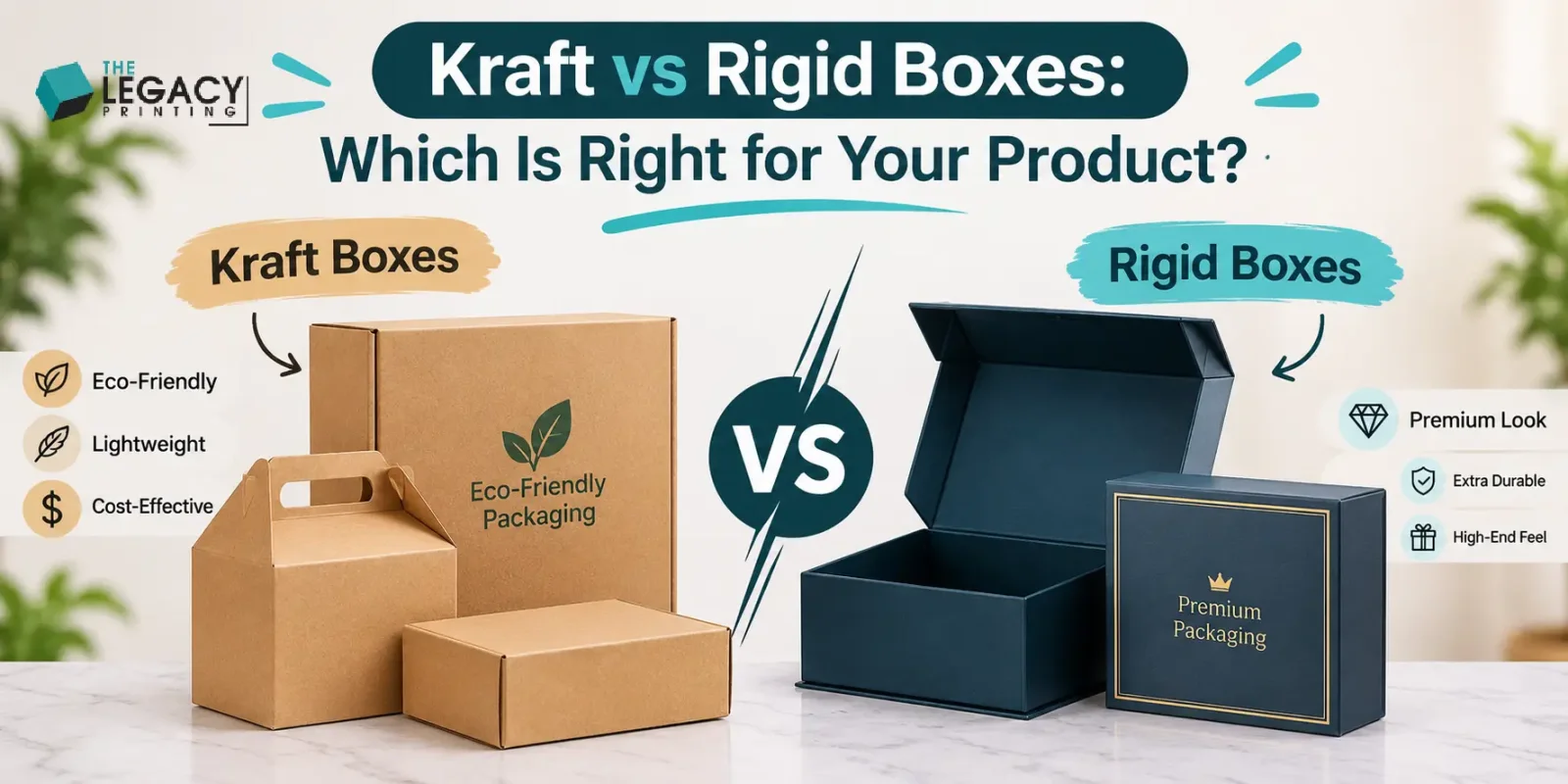
Most people treat this as an easy call: kraft is the cheap box, and rigid is the fancy one. That's partly true, but it skips the most useful point. In the kraft vs rigid boxes question, "kraft" is a type of paper, while "rigid" describes how a box is built.
So the real question is what you want your customer to feel. Do you want a light box that ships flat and looks natural? Or a thick, pre-built box that feels like a gift in their hands? Kraft fits everyday products, shipping and eco-minded brands on a budget. Rigid fits higher-priced products where the unboxing is part of what people pay for. And yes, you can mix the two!
Kraft vs Rigid Boxes: The Short Answer
Kraft boxes win on cost, weight and a natural look. Rigid boxes win on luxury feel, shelf strength and keepsake value.
Pick kraft if...
- Your product sells at an everyday price, like soap, coffee, cookies or T-shirts.
- You ship a lot of orders and want to keep box weight and storage space low.
- Your brand story is natural, handmade or earth-friendly.
- You're testing a new product and want to spend less on the first run.
Pick rigid if...
- Your product is premium, like jewelry, perfume, watches or a holiday gift set.
- You want customers to keep the box and reuse it.
- You plan to add luxury details like a magnetic lid, a foil logo or a fitted insert.
- The extra box cost is small next to your product's price.
Quick comparison table
| Feature | Kraft boxes | Rigid boxes |
|---|---|---|
| What it is | Box made from kraft paperboard, often a folding carton or mailer | Thick board wrapped in paper, built at the factory |
| Look | Natural, rustic, simple (brown or white) | Polished, heavy, luxury |
| Strength | Good; strong when made with corrugated board | Very stiff; holds its shape well |
| Cost level | Lower per box | Higher per box |
| Shipping and storage | Ships flat, light, takes little space | Ships assembled, heavier, takes full space |
| Printing | Brown color dulls bright inks; white kraft prints cleaner | Printed wrap paper gives sharp, rich color |
| Recycling | Usually simple when kept plain | Paper-based, but magnets, foil and laminates can complicate it |
| Best for | Food, candles, soap, apparel, e-commerce mailers | Jewelry, perfume, gift sets, premium cosmetics |
What Are Kraft Boxes?
Kraft boxes are made from kraft paperboard, a strong paper made from wood pulp. Most are brown, but you can also get white (bleached) kraft.
The name comes from the kraft process, which turns wood chips into pulp using strong chemicals. According to this kraft pulp overview, the process removes about 90–95% of lignin, the natural "glue" that holds wood fibers together. What's left are long, strong fibers. Unbleached pulp is dark brown, which gives kraft its classic look. It's also the main pulping method used around the world.
Brown vs white kraft
Brown kraft is unbleached, so it keeps its natural color and reads as rustic and earthy. White kraft is bleached, which gives a cleaner base and brighter printed colors. Still torn? Our guide on kraft vs white boxes shows how each one looks with real brand colors.
Kraft-lined corrugated for shipping
Corrugated board has a wavy paper layer glued between two flat layers. That wavy layer cushions your product. Put kraft paper on the outside, and you get the brown mailer box most people know from online orders.
The waves are called "flutes." E-flute is thin and smooth, so it prints well and suits lighter products. B-flute is thicker and gives more cushion for heavier items. For example, a T-shirt mailer usually works in E-flute, while a set of glass jars may need B-flute. Ask our team which one fits your product's weight.
Pros and cons of kraft boxes
- Pros: lower cost per box, light, ships and stores flat, natural look, recyclable when kept plain.
- Cons: brown color makes bright inks look duller, and thin kraft cartons don't protect fragile items without an insert.
Best uses
Kraft works well for bakery treats, coffee, tea, candles, soap, apparel and subscription mailers. At The Legacy Printing, kraft paper and recycled cardboard come in almost every category with no extra premium. You can browse options on our eco-friendly boxes page.
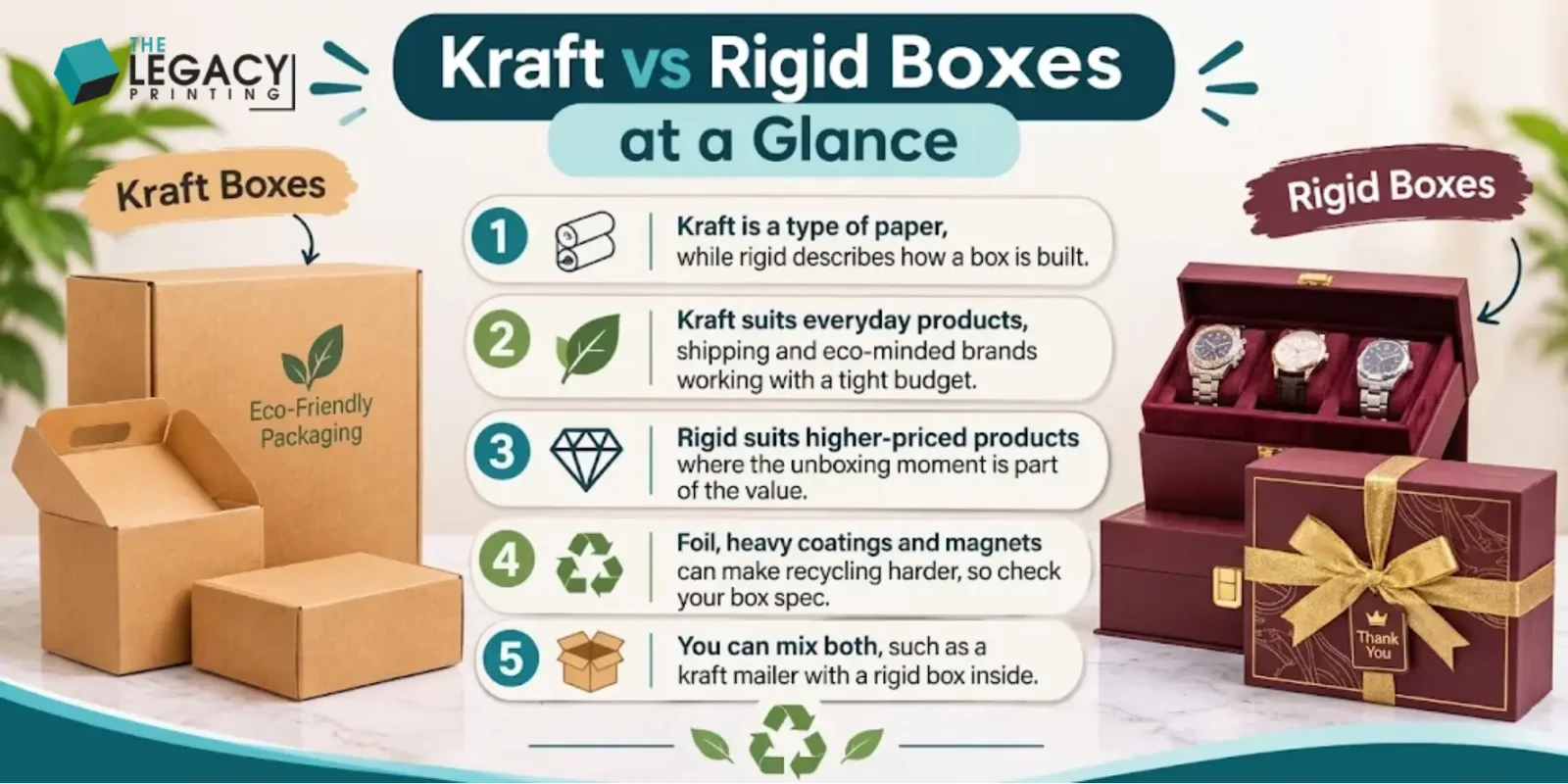
Kraft vs Rigid Boxes at a Glance
What Are Rigid Boxes?
A rigid box is a thick, sturdy box built at the factory. It doesn't fold flat, which is why you'll also hear it called a "set-up box."
Thick board wrapped in paper
The core is greyboard, also called chipboard, a thick and stiff board. Printed paper is wrapped over it and glued in place. That's why rigid boxes feel heavy and solid in your hand. They arrive already built, so you just open them and pack.
Popular styles of custom rigid boxes
Custom rigid boxes come in a few classic styles, and each one creates a different opening moment:
- Two-piece rigid box: the lid lifts straight off the base. Simple and elegant.
- Magnetic closure: a flap with hidden magnets snaps shut. Very popular for gifts.
- Drawer or slide box: a tray slides out of an outer sleeve. Great for jewelry and small sets.
Pros and cons of rigid boxes
- Pros: luxury feel, strong shape, rich printing on the wrap paper, and customers often keep and reuse them.
- Cons: higher cost per box, heavier, takes full space in storage, and usually needs an outer mailer for shipping.
Best uses
You'll see rigid boxes packaging most often with jewelry, perfume, watches, premium skincare, tech accessories and corporate gifts. Building a gift program? Our custom gift boxes come in rigid styles with inserts and ribbon options.
Kraft Boxes vs Rigid Boxes: Side-by-Side
Kraft boxes cost less and ship lighter. Rigid boxes feel more premium and hold their shape better. Here's how they compare on the points buyers ask about most.
Look and unboxing feel
The unboxing experience is how it feels for your customer to open the package. A kraft box says "honest, natural, handmade." A rigid box says "this is special." Neither wins on its own. A rustic candle in a heavy black rigid box can feel off, and a diamond ring in a thin brown carton can feel cheap. Match the box to the story your product tells.
Protection and strength
Rigid boxes are stiffer, so they resist crushing on a shelf or in a gift bag. But stiff isn't the same as ship-safe. The wrap paper can scuff in transit, so rigid boxes usually travel inside a corrugated mailer.
Kraft corrugated mailers, on the other hand, are made for shipping. A thin kraft folding carton is fine on a shelf, but fragile items need an insert or an outer box.
Cost level and minimum order
Rigid boxes cost more per box because they use much thicker board, more paper and more building steps. Kraft is usually the budget choice. One catch: heavy finishes, custom inserts and special shapes add cost to any box, kraft included. So a dressed-up kraft box can close some of the gap with a simple rigid one.
MOQ means minimum order quantity, the smallest number of boxes you can order. At The Legacy Printing, minimum orders start as low as 50 pieces. Our team will confirm what works for the style and finish you choose.
Shipping weight and storage space
This one surprises first-time buyers. Kraft cartons and mailers ship flat-packed, so a tall stack fits in a small corner. Rigid boxes arrive built and take their full size even when empty. If you pack orders from a spare room or garage, plan for that space. Rigid boxes also add weight to every parcel, which can raise your postage costs.
Printing and finishes
Printed rigid boxes usually show the sharpest color. The wrap paper is printed first, then glued onto the board. Brown kraft soaks up and tints ink, so bright pinks and blues look muted. White ink or white kraft can help.
Both box types can take these finishes:
- Spot UV: a shiny coating on just one area, like your logo.
- Foil stamping: metallic gold, silver or holographic color pressed onto the box.
- Embossing and debossing: a design that's raised up or pressed in.
- Matte or gloss lamination: a thin protective layer over the print. Matte looks soft, and gloss looks shiny.
Digital printing needs no plate setup and suits small runs. Offset printing suits large runs and gives consistent CMYK color. CMYK mixes four inks to build colors, while Pantone colors are exact premixed shades for tight brand matching.
Eco-Friendly vs Luxury Packaging: Are Kraft Boxes Greener Than Rigid?
Plain kraft is usually the simpler eco choice because it uses less material and is recyclable. Rigid boxes aren't automatically worse, though. It depends on the materials, the finishes and whether the box gets reused.
What the recycling numbers say
Paper packaging has a strong recycling record in the US. EPA data on packaging recycling shows the recycling rate for paper and paperboard packaging was 80.9% in 2018, the latest product-level figure on that page. Of the 33.9 million tons recycled that year, about 32.1 million tons were corrugated boxes. That's good news for kraft corrugated mailers, which fit right into that stream.
Why coatings, foil and magnets matter
The board in both box types is paper-based. Trouble usually comes from what's added on top: heavy laminates, lots of foil, plastic windows and magnets. If recycling matters to your brand, keep finishes light. For example, use foil on your logo only, not across the whole lid. Our team can walk you through the full spec, including coatings and glue.
How to word eco claims on your box
US regulators have clear guidance on eco wording. The FTC Green Guides summary says you should qualify a "recyclable" claim if recycling facilities aren't available to at least 60% of the consumers or communities where you sell. If a box is only partly made from recycled material, name the share, such as "Made from 30% recycled material."
A few simple tips:
- Don't print "eco-friendly" on its own. It's too vague to mean much.
- State facts you can back up, like your recycled content share.
- Want FSC certification (a label showing the wood came from responsibly managed forests)? Ask which stock options are available before you print the logo.
- If you sell in many states, have a lawyer review your eco wording.
The honest case for rigid
Rigid boxes use more material, and that's a real trade-off. But a sturdy box that becomes a jewelry holder or desk organizer gets a long second life. Our view: if your customers will truly keep the box, rigid can make sense. If they won't, go kraft.
Rigid vs Folding Cartons: Where Do Cartons Fit?
A folding carton is a thinner paperboard box that ships flat and gets folded at packing time. It sits between kraft mailers and rigid boxes in cost and feel.
This point clears up a lot of confusion: many kraft boxes are folding cartons, just made from kraft board. Cereal, lipstick and tea boxes are all folding cartons. They're cut flat using a dieline (a flat outline of the box that shows every cut and fold), then folded by you. Rigid boxes, by contrast, are built once at the factory and stay built.
Common carton styles include tuck end, reverse tuck end, window boxes, sleeve boxes and pillow boxes. Kraft sleeve boxes, where a printed sleeve slides over a tray, are a smart middle path. They feel more special than a basic carton but cost less than rigid. For a deeper look, read our guide on folding cartons vs rigid boxes.
A carton beats both kraft mailers and rigid boxes when your product sits on a retail shelf, needs lots of printed info and sells at a mid-range price.
Which Box Is Better for Your Product?
The right box depends on your product's price, how fragile it is and how you sell it. Use this table as a starting point.
Decision table by industry
| Product | Usually the better fit | Why |
|---|---|---|
| Candles | Kraft carton or kraft mailer; rigid for luxury lines | Natural look matches most candle brands; add an insert for glass jars |
| Bakery and treats | Kraft carton with window | Shows the product, low cost, easy to fold at a farmers market stall |
| Cosmetics and skincare | Folding carton for daily items; rigid for sets and launches | Bright printing sells on shelf; rigid works for PR kits |
| Jewelry | Rigid (drawer or magnetic) | High price, small size, customers keep the box |
| Apparel | Kraft corrugated mailer | Light, ships well, easy to brand inside and out |
| CBD and hemp | Folding carton or rigid, depending on price | Child-resistant closure options and space for state-specific labels |
| Subscription boxes | Kraft corrugated mailer | Repeat shipping makes weight and cost matter most |
| Holiday gift sets | Rigid with insert | Gift feel, holds several items in place |
For beauty brands, our custom cosmetic boxes range covers both folding cartons and rigid styles, from lipstick to perfume.
A quick 5-question chooser
- How heavy or fragile is your product? Heavy or breakable items need corrugated board or a rigid box with an insert.
- What's your price point? If the box is a big share of the product price, lean kraft.
- How do you sell it? Shipped orders lean toward kraft mailers. Retail shelves lean toward folding cartons. Gifts lean rigid.
- What's your brand story? Natural and handmade fits kraft. Premium and polished fits rigid.
- What's your budget and quantity? Small first runs make kraft easier to test, though rigid works in small runs too.
Common Mistakes When Choosing Between Kraft and Rigid
Most box regrets come from a mismatch between the box, the product and the shipping plan. Watch for these:
- Rigid boxes for a low-price product. A heavy box can eat your profit on a cheap item.
- Assuming kraft is always cheaper. Add lots of foil, embossing and custom inserts, and the cost climbs.
- Ignoring shipping weight and space. Pre-built rigid boxes need storage room and add weight to every order.
- No insert for fragile items. A thin kraft carton alone won't protect a glass jar or bottle.
- Bright colors on brown kraft. Neon pink will look muddy. Choose white kraft or bolder, darker designs.
- Wrong box size. Too much empty space lets products slide and break. Measure first.
- Vague eco claims. "Eco-friendly" alone isn't specific enough. Name the real fact.
Hybrid Ideas That Mix Eco and Luxury
Plenty of brands get the best of both by mixing kraft and rigid ideas.
Kraft mailer outside, rigid box inside
The kraft mailer handles the bumps of shipping, and the rigid box inside delivers the "wow" moment. This works well for premium skincare kits and corporate gifts.
Kraft with foil or spot UV
A small gold foil logo on brown kraft looks warm and upscale. Keep it to the logo so the box stays simple to recycle.
A kraft sleeve over a printed tray
The sleeve slides off to reveal the product. You get a nice reveal for less money than rigid.
Start with a small test run
Not sure yet? Order a small batch of each style and see how customers react. With minimums as low as 50 boxes, you can test before you commit to a big run.
How The Legacy Printing Helps You Choose
Tell us what you're shipping and how many, and we'll suggest the right structure, material and finish. Then you see the box before it's made. We've spent 10+ years in custom printing and packaging, with 10,000+ orders delivered.
- Free design support: our in-house team prepares the dieline and print-ready artwork for you.
- 3D rendering before production: you see a digital 3D view of your box and approve it first.
- No die and plate charges: no setup fees for cutting tools or printing plates.
- Free shipping across the USA: no hidden freight costs to any US address.
- Sample kits: choose 1 color, 2 colors, 4 colors (CMYK) or a custom Pantone.
- Kraft and recycled cardboard: available in almost every category at no extra premium.
- In-house manufacturing: no subcontracting, plus custom sizes and shapes on every order.
Buying in volume? Kraft boxes wholesale orders and wholesale rigid boxes usually suit offset printing for steady color across large runs. Short runs of custom printed rigid boxes or kraft cartons usually suit digital printing. We're rated 4.9/5 from 1,159+ orders and reviews, and we're a BBB accredited business. New customers can save 20% on their first purchase.
Frequently Asked Questions
What is the difference between kraft boxes and rigid boxes?
Kraft refers to the paper material, while rigid refers to a thick, pre-built box style. Kraft boxes are usually light and ship flat. Rigid boxes use thick greyboard wrapped in paper and arrive assembled. You can even get a rigid box wrapped in kraft-look paper.
Are rigid boxes worth the extra cost?
They're worth it when your product has a higher price and the unboxing matters. For jewelry, perfume and gift sets, the box adds real value. For everyday, low-price items, the extra cost is often hard to justify.
Is kraft packaging cheaper than rigid?
Yes, kraft packaging usually costs less per box than rigid. It uses less material and ships flat. Heavy finishes and custom inserts can raise the cost of any box, so ask for a quote with your exact spec.
Are kraft boxes strong enough for shipping?
Kraft corrugated mailers are strong enough for most shipping. Thin kraft folding cartons are better for shelves, so put them inside a mailer or add an insert for fragile items.
Are rigid boxes recyclable?
The board in rigid boxes is paper-based, but add-ons can make recycling harder. Magnets, heavy laminates, lots of foil and plastic windows are the usual problems. If recycling matters to you, keep finishes light and ask our team about the full spec before you order.
Can I order a small batch to test kraft and rigid boxes?
Yes. Our minimums start as low as 50 pieces, so you can try both styles before a bigger run. Our team will confirm the minimum for the style and finish you pick.
Get a Free Quote for Your Boxes
Still weighing kraft against rigid? Tell us your product, quantity and budget, and we'll suggest a box, material and finish that fit. Design help and shipping across the USA are free, and there are no die or plate charges.
Request a free quote or a sample kit today, or call us at 800 719 2780. We'd rather help you choose right than sell you the wrong box!