How do you create a great unboxing experience on a small budget? Spend on what the customer sees first. Cut the loose extras that cost you on every order. A snug box, a message printed inside the lid, one brand color and a simple thank-you card will beat a pile of filler almost every time.
Our quick verdict: if you only do two things, right-size your box and print inside it. You pay for both once, when the box is made. After that, they add no cost and no packing time per order. Pick the rest of this list to fit your product and your margin.
What Is an Unboxing Experience, and Why Does It Matter?
An unboxing experience is everything your customer sees, touches and feels from the moment the parcel arrives until the product is in their hands. For a small brand, it's often the first real meeting with your business. It shapes how the product inside feels.
Packaging builds your brand. It isn't just a cost.
Online shoppers can't hold your product before they buy. Your box is the first physical thing they get from you. A box that fits well, opens nicely and says thank you shows you care about details.
A dented, oversized box with loose items rolling around says the opposite, even if the product is great. And a good reveal is free marketing. Customers share photos and videos of boxes that look good. A plain brown box with nothing inside gives them nothing to post.
A simple rule: keep packaging spend in step with product price
Spend on packaging in proportion to what you sell. A low-price lip balm doesn't need the same box as a premium gift set. Amazon's seller guide to unboxing design describes three rough tiers: about $0.50 per order for a starter setup (stickers, a printed card and tissue), about $2 for a middle tier, and $5 or more for premium.
The guide suggests picking a tier based on your average order value, margin and brand position. Use those numbers as a rough guide, not a price list. Your real cost depends on your box, quantity and finish.
Budget Unboxing Ideas Compared Side by Side
The best budget unboxing ideas are built into the box itself. You pay once, and they work on every order. Loose extras like tissue and cards add a small cost and some packing time every time you ship.
| Idea | What it does | Cost level | Best for |
|---|---|---|---|
| 1. Right-sized box | Snug fit, less filler, neater look | Low (can save money) | Every shipped product |
| 2. Inside box printing | Hidden message or pattern under the lid | Low to medium, paid once with the box | Mailer boxes, gifts, anything shared online |
| 3. Kraft or recycled cardboard | Natural, simple, earthy look | Low | Candles, soap, food, apparel, eco-minded brands |
| 4. One-color outside print | Bold logo, clean design | Low to medium | New brands, simple logos |
| 5. Branded tissue paper | Soft reveal, protects the surface | Low, but paid per order | Apparel, cosmetics, gifts |
| 6. Thank-you card with QR code | Personal touch, links to your site | Low, paid per order | Every brand, especially repeat-purchase products |
| 7. Stickers, stamps or belly band | Brands a plain box fast | Low, plus hand work | Very small batches, testing a product |
| 8. One brand color everywhere | Makes every layer look planned | No extra cost | Everyone |
| 9. One special finish | Shine or texture where hands touch | Medium | Gifts, premium cosmetics, higher-price items |
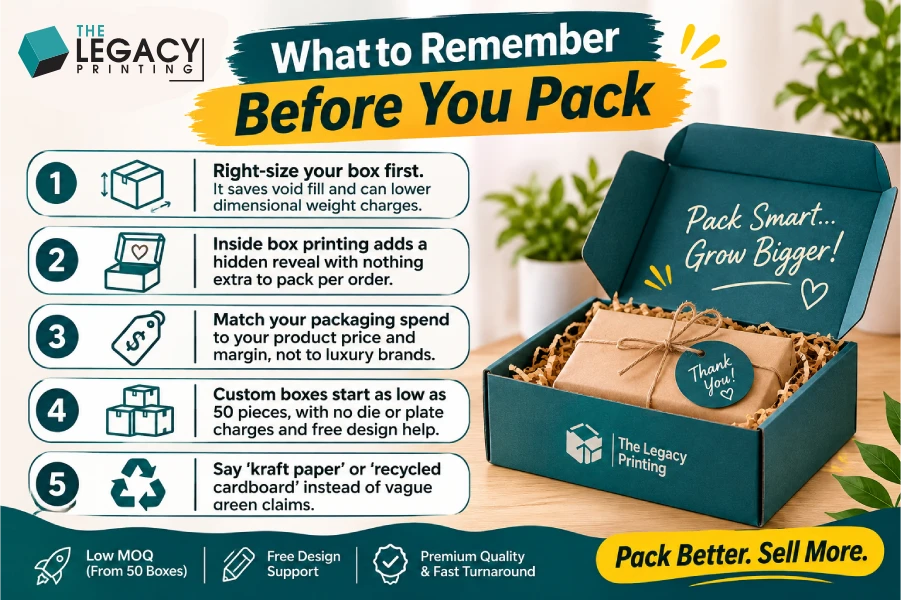
What to Remember Before You Pack
9 Ideas for an Unboxing Experience on a Small Budget
Start with the ideas that save money or cost nothing extra. Then add one or two touches that suit your product. Here's how each one works, with honest pros and cons.
1. Right-size your box (and cut shipping waste)
Right-sizing means choosing a box that fits your product closely, with little empty space. It's the cheapest upgrade on this list, because it often lowers costs instead of adding them. A snug box needs less void fill, the paper or padding that stops a product from moving. It also looks planned, not thrown together.
- Pro: Can lower shipping cost (see the UPS example below) and stops rattling.
- Con: You need accurate measurements, and one box size may not fit everything you sell.
2. Inside box printing: the hidden reveal
Inside box printing puts a message, pattern or logo on the inner side of the box. When the lid opens, the customer gets a small surprise. Most budget tips stop at stickers and tissue, but this is our favorite. It's printed with the box, so there's nothing extra to buy or pack per order.
Keep it simple. A short line like "You made our day!" under the lid works well. So does a one-color pattern across the inside walls. Our guide on printing inside custom boxes walks through the options.
- Pro: Looks great on camera and works on a mailer box (a box that ships and presents your product in one).
- Con: Thin text and small fonts are hard to read inside a shaded box. Go bold and large.
3. Use kraft or recycled cardboard for a natural look
Kraft paper is strong brown paper with a natural, simple look. It suits handmade, food and eco-minded brands. At The Legacy Printing, kraft paper and recycled cardboard are available in almost every box category with no extra premium.
- Pro: A warm, honest look that hides small scuffs from shipping.
- Con: Bright colors look softer on brown. If your brand depends on vivid pink or blue, white board shows color better.
4. Print the outside in one color, not four
A single bold color, like a black logo on kraft, looks clean and confident. It's also easy to match on your tape, stickers and cards. Ask us to quote one color and full color side by side, so you can compare before you decide.
- Pro: Strong branding that's easy to repeat.
- Con: Not ideal if you want photos or detailed art on the box.
5. Add branded tissue paper
Tissue paper is thin wrapping paper. Its thickness is measured in gsm (grams per square meter), and a higher number means thicker paper. Wrapping your product in tissue slows the reveal down and protects the surface from scratches.
- Pro: Makes even a plain box feel like a gift.
- Con: You pay for it and fold it on every order. Messy folds look sloppy, so show your packers one simple way to wrap.
6. Add a thank-you card or insert (with a QR code)
An insert card is a small printed card in the parcel. It can say thanks, share care tips or point to your social pages. Add a QR code, a square code that opens a web page when someone scans it with a phone camera. Link it to a reorder page, a how-to video or care instructions.
- Pro: Personal, cheap and useful. It gives customers an easy path back to your shop.
- Con: A generic "Thanks for your order!" adds little. Write it like a real person, and follow the review rules covered in the mistakes section below.
7. Use stickers, stamps or a belly band to brand a plain box
A logo sticker or rubber stamp is the cheapest way to brand a plain box for small batches. A belly band is a paper strip wrapped around the box. It looks more polished and holds the lid shut. Printed tape works well on larger parcels, and a holiday sticker gives you a seasonal touch without reprinting boxes.
- Pro: Fast to start and very flexible.
- Con: It's hand work on every order, and it still reads "plain box with a sticker." Once orders grow, a printed box often makes more sense.
8. Pick one brand color and repeat it everywhere
Choose one color and use it on the box, inside print, tissue, sticker and card. It costs nothing extra, yet it makes simple parts look like one planned set. For example, red tissue inside a teal box makes a parcel feel random.
- Pro: Free and very effective.
- Con: Colors can shift between printers and paper types. If exact color matters, ask for a custom Pantone sample (Pantone is a standard color-matching code).
9. Add one finish where hands touch the box
One finish in the right spot can make a box feel special. Options include matte coating (smooth, low shine), gloss coating, spot UV (a shiny clear coat on just the logo), embossing (a raised logo), debossing (a pressed-in logo) and foil stamping (a thin gold or silver layer pressed onto the box). Put it on the logo or lid, not everywhere.
- Pro: A premium feel from one small detail.
- Con: On a low-price product, the extra cost may not pay off. Save finishes for gifts and higher-value items.
Which Budget Unboxing Idea Should You Choose?
Choose by product price and by how often customers buy again. Low-price items need a clean, simple setup. Gifts and premium products earn a sturdier box and one special finish.
| Product type | Examples | Suggested setup |
|---|---|---|
| Low-price items | Lip balm, single soap bar, small cookie pack | Right-sized kraft box, logo sticker or one-color print, short thank-you card |
| Mid-price items | Candles, skincare sets, t-shirts | Printed mailer box, one-color outside, inside print, tissue in your brand color |
| Gift or premium items | Jewelry, perfume, client gift sets | Rigid box, one finish such as foil or embossing, an insert that holds the product |
A rigid box is a thick, firm box that doesn't fold flat. It feels premium in the hand. If you sell gifts, our custom gift boxes come in rigid, magnetic closure and drawer styles.
Quick picks by situation:
- Testing a new product? Use stickers on a plain box, or a small run of printed boxes.
- Customers post online? Go with inside printing and one strong brand color.
- Shipping costs hurt? Right-size first.
- Packing orders yourself? Printed boxes save time over tissue and stickers.
- Selling gifts? Choose a rigid box with one finish.
Where to spend vs. where to save
| Item | Spend or save? | Why |
|---|---|---|
| Box fit and strength | Spend | A damaged or rattling parcel ruins everything else |
| Inside print | Spend | Paid once, seen on every order |
| Outside print | Save | One bold color often looks better than busy art |
| Thank-you card | Save | A simple card with good words beats thick, costly stock |
| Tissue paper | Save | One color, one sheet is plenty |
| Extra freebies and filler | Save | They add cost and clutter on every order |
Do You Need Custom Printed Boxes for a Good Unboxing?
No. You can start with stickers on a plain box. But once you ship regularly, a printed box usually looks better and saves packing time. You also don't need a huge order to get one.
Low minimum custom boxes: start with 50 pieces
Many small brands assume custom boxes mean ordering thousands. At The Legacy Printing, the minimum order is as low as 50 pieces. That makes affordable custom packaging realistic for a small business testing a new product line.
Order a small run, ship it and watch what happens. Do customers post photos? Do they reorder? Then scale up. Our guide to starting with small order custom boxes covers the steps.
No die and plate charges
A die is the cutting tool that shapes your box. Plates are used in some printing methods. Some printers bill these as setup costs. We don't charge for dies or plates, which matters most on a small first order. Shipping is free to any address in the USA, too.
Digital vs. offset printing for small runs
Digital printing prints straight from your file with no plate setup, so it suits low quantities. Offset printing uses plates and suits large runs in CMYK color. CMYK is the four-ink mix of cyan, magenta, yellow and black used in most printing. For a first small order, digital is usually the better fit.
Free design support and a 3D preview
Not a designer? That's fine! Our in-house team prepares print-ready artwork for free. That means art sized to the dieline, the flat map showing where your box cuts and folds. You'll also get a digital 3D rendering before production, so you see your box, inside print included, before anything goes to print.
Get a sample kit before you order
Want to feel the board first? Request a sample kit. Our team follows up within 2 hours, and kits ship within days. You can compare print options in 1 color, 2 colors, 4 colors (CMYK) or a custom Pantone color.
How Much Can a Right-Sized Box Save on Shipping?
More than most people expect. Carriers like UPS use dimensional (DIM) weight, a shipping weight based on box size, not on what the scale says. That's why large, light boxes can cost more to ship.
The simple formula, with a worked example
According to the UPS dimensional weight guide, DIM weight is length × width × height in inches, divided by a number called the divisor. The divisor is 139 for UPS Daily Rates and 166 for Retail Rates. Fractions round up to the next whole pound.
Say you ship a 1 lb candle using Daily Rates:
- Oversized box, 12 × 10 × 8 in (30 × 25 × 20 cm): 960 ÷ 139 = 6.9, which rounds up to 7 lb.
- Right-sized box, 10 × 8 × 4 in (25 × 20 × 10 cm): 320 ÷ 139 = 2.3, which rounds up to 3 lb.
Same candle. The snug box has a DIM weight of 3 lb instead of 7 lb, and you ship that difference on every order.
A snug fit also protects the product
Less empty space means less movement, and less movement means fewer breaks. For heavier or fragile items, add a structural insert, a cut piece of board that holds the product in place. Corrugated board has a wavy layer between two flat layers, which adds strength for shipping.
Budget Unboxing Mistakes to Avoid
Oversized boxes top the list. In the Macfarlane Packaging 2025 Unboxing Survey (UK), 80% of shoppers were happy with their unboxing. Among the unhappy ones, oversizing was a top complaint. It's UK data, but the lesson travels: fit beats filler.
Vague green claims are another trap. The FTC summary of the Green Guides says a package made partly from recycled material should say how much, like "Made from 30% recycled material." Say exactly what your box is made of instead of "eco-friendly."
Finally, watch your insert card. Asking for a review is fine. Under the FTC final rule on fake reviews, you can't offer a reward that depends on the review being positive or negative. So skip "Leave 5 stars for 10% off."
Branded Packaging Ideas for Small Business, by Industry
The best setup depends on what you sell. Here are simple starting points for the brands we work with most.
Bakery and food
Use a window box so the treats sell themselves, with a kraft finish for a homemade feel. Print baking or storage tips inside the lid. Browse our custom food boxes, and ask our team which materials suit your food.
Candles and soap
Kraft or recycled cardboard fits the natural look most candle and soap brands want. A belly band works well on soap bars. For candles, add an insert so the jar can't shift.
Cosmetics and beauty
A tuck end box, a folding carton that closes with flaps at the top and bottom, works well for most beauty products. White board shows bright brand colors best. Add spot UV on the logo for a little shine, and use a die-cut insert so lipstick or mascara can't roll around.
FAQ: Unboxing on a Small Budget
What is the cheapest way to improve my unboxing experience?
Right-size your box and pick one brand color. Both cost little or nothing extra, and right-sizing can even lower shipping costs. Then add inside printing if your budget allows.
Does inside box printing cost extra on every order?
No. It's printed when your boxes are made, so you pay once. There's nothing extra to buy or pack when you ship.
What is the minimum order for custom printed boxes?
At The Legacy Printing, you can order as few as 50 pieces. There are no die or plate charges, and design support is free.
Does box size really change shipping cost?
It can. UPS uses dimensional weight, based on box size. In our example above, a snug box dropped the DIM weight of a 1 lb candle from 7 lb to 3 lb.
Can I call my kraft box eco-friendly?
Be specific instead. Say "kraft paper" or "made from recycled materials," and follow the FTC Green Guides if you mention recycled content.
Can my thank-you card ask for a review?
Yes. Just don't offer a reward tied to a positive or negative review. Asking for honest feedback is fine.
Ready to Build Your Box?
Tell us what you're shipping and how many. We'll suggest the right box, material and finish for your budget, with free design help and a 3D preview before printing. First-time customers save 20% on their first purchase.
Call 800 719 2780, email sales@thelegacyprinting.com, or get a free quote today!