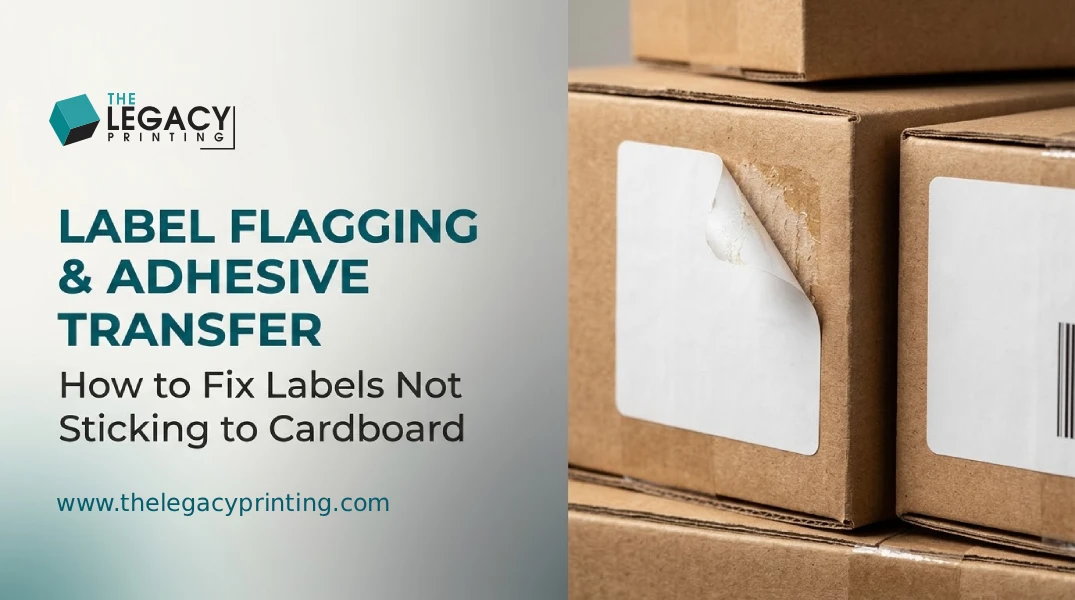
Labels not sticking to cardboard boxes is a common headache, and timing is often part of the story. A label can look stuck and still be far from full grip. Avery Dennison says label glue can take anywhere from 2 to 24 hours to reach full strength, depending on surface roughness and temperature (Avery Dennison adhesive overview). That's why label flagging, when a label's edge lifts up like a little flag, often shows up the next morning, not the moment you press it down.
On boxes, edges usually lift for four reasons. The label is too stiff, the board is rough or dusty, a coating blocks the glue, or the label sits over a corner or seam. Below you'll find the fixes for each, plus how to handle adhesive transfer: sticky residue left on the box, or glue stuck to the backing paper.
What Is Label Flagging and Adhesive Transfer?
Label flagging is when one or more edges of a label lift off the surface and stick out. Adhesive transfer is when glue ends up where it shouldn't, such as on the backing paper, the roll or the box.
Most label makers write about flagging on bottles and tubes, where the curve keeps pulling the label straight. Boxes are mostly flat. So when a label lifts on a box, look for a corner, a fold, a seam, rough kraft, dust or a slick coating. Those are easier to fix than a curve.
How is flagging different from bubbling, ooze or a full peel-off?
Each problem points to a different cause. Name it right and you'll fix it faster.
- Flagging or edge lift: the edges come up first while the middle stays down. The label is fighting the surface, often because it's stiff.
- Bubbling: air pockets form in the middle. The label usually wasn't pressed evenly.
- Ooze: glue squeezes out past the edges and leaves a sticky ring. Heat, pressure or too much glue can cause it.
- Full peel-off: the whole label falls off. Suspect the wrong glue, a dirty surface or a coating the glue can't grip.
What exactly is adhesive transfer?
The glue moves away from the label, and it happens in two ways. Glue can stay on the shiny backing paper (the release liner) when you peel the label, so the label sticks poorly. Or glue can stay on the box when you remove a label, leaving a gummy patch.
Why Are Labels Not Sticking to Cardboard Boxes?
Either the glue can't touch enough of the surface, or the label itself pulls away. Rough board, dust, damp, cold, coatings and stiff label stock are the usual suspects.
Why does a stiff label spring back?
A stiff label wants to stay flat, so it pushes back against any bend. The top printed layer of a label is called the facestock. A thick facestock gets even stiffer with a clear protective film on top (an overlaminate) or a varnish.
When that stiffness beats the glue, the label's ends lift first, because that's where the pulling force builds up. A thin layer of glue (a low coat weight) makes flagging more likely, since there's less grip to hold the label down.
Why do labels stick on glass but not on recycled cardboard?
Glass is smooth, so the glue touches almost all of it. Recycled cardboard is bumpy, uneven and full of loose fibers. Glue needs to flow into every tiny dip of a surface, which label makers call wet-out. On rough kraft or recycled board, it only touches the high points.
Loose fibers and board dust also sit between the glue and the box. The label grips the dust instead of the board. That's why people search for an adhesive for kraft box labels: rough board usually needs a high-adhesion or permanent glue.
Do dust, damp and cold really matter?
Yes. Corrugated board soaks up moisture from the air and gives it off again. In a humid room, the surface can turn slightly damp. In a very dry room, it can turn dusty, and even a thin layer of dust blocks peel-and-stick glue.
Cold is just as tricky. Butler Technologies, a label converter, suggests applying most peel-and-stick labels to surfaces above 50°F (label adhesion failure checklist). Labelprint24 gives a working range of 50°F to 104°F (10°C to 40°C) and warns that going outside it can sharply cut grip (label application techniques). For example, boxes stored in a cold garage in January should come inside and warm up before you label them.
Does a glossy or matte coating change label adhesion?
It can, because the coating sits between the glue and the paper. Gloss lamination, heavy varnish, spot UV (a shiny, raised clear coating), soft-touch finishes, wax and foil all change the surface. Some are slick. Others have low surface energy, which means glue beads up instead of spreading out, like water on a freshly waxed car.
No one can promise how a given label will behave on a given finish. Testing tells you. If you're still choosing a finish, our guide to matte vs gloss lamination for custom boxes compares how each one looks and feels.
Why do corners and seams lift first?
Corners, folds and seams force the label to bend or bridge a gap. A label wrapped over a box edge keeps trying to straighten out. One placed across a glued seam or tuck flap gets pulled every time the box flexes or opens. Sharp label corners also catch on hands, tape guns and other boxes.
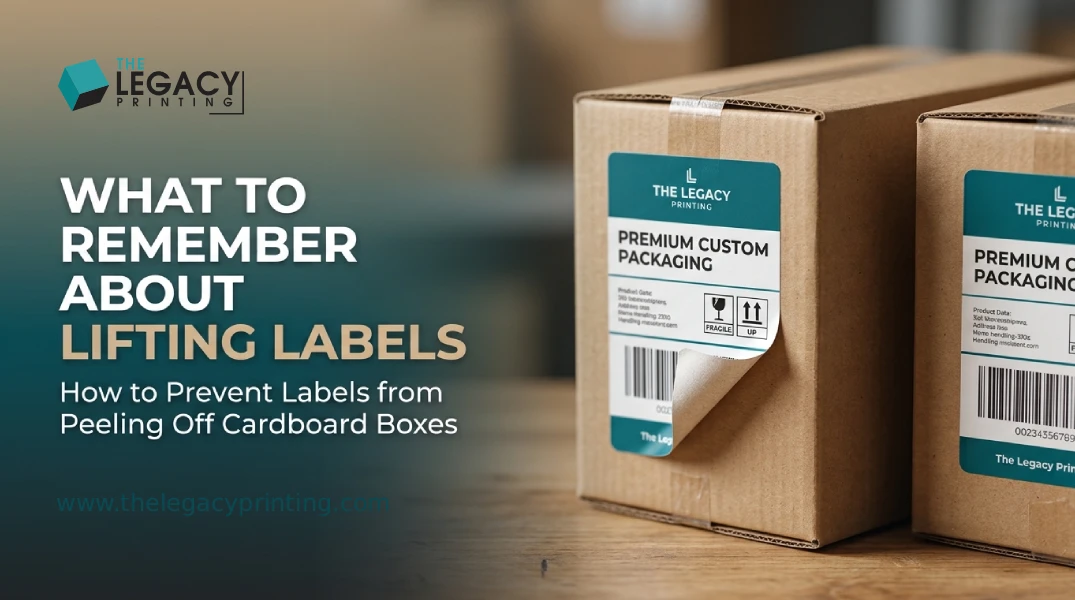
What to Remember About Lifting Labels
Quick Diagnosis: What Are You Seeing?
Match what you see to the likely cause, then try the first fix. One or two changes solve most problems.
| What you see | Likely cause | First fix to try |
|---|---|---|
| Only the edges lift | Stiff label, label stretched while applying, edges not pressed, label over a fold | Press edges firmly, move the label to a flat panel, try thinner stock with rounded corners |
| Whole label peels off | Dust, damp or cold board; removable glue; slick coating | Wipe and dry the spot, warm the boxes, test a permanent or high-tack glue |
| Bubbles in the middle | Uneven pressure, trapped air | Apply from the center out with a squeegee or plastic card |
| Sticky ring around the label | Ooze from heat, pressure or too much glue | Store labels cooler and flat, ask about a different glue |
| Glue left on the backing paper | Crushed or overheated rolls | Store rolls flat and cool, don't stack heavy items on them |
| Gummy patch after removing a label | Label peeled too fast or at a steep angle | Peel slowly at a low angle |
How Do I Stop Label Edges From Lifting?
Clean and dry the spot. Apply at room temperature, press the whole label firmly with the edges last, and leave it alone while the glue builds grip. Keep labels off edges and folds.
What's the right way to apply a label by hand?
- Clean and dry the spot. Wipe off dust with a dry, lint-free cloth. Skip any box that feels damp.
- Check the temperature. The box should be at least 50°F (10°C). Give cold boxes time to warm up.
- Don't touch the glue. Avery warns that oil from your fingertips dulls the adhesive (Avery label adhesion help). Hold labels by the edges.
- Don't stretch it. A stretched label tries to shrink back, and the edges lift as it does.
- Press the whole label, edges last. Work from the center out, then go over every edge. Butler suggests at least 15 to 30 psi (pounds per square inch, a measure of pressing force). In plain terms, use a firm push with a squeegee or roller, not a light pat.
- Give it time. Butler says full bond strength can take 24 to 72 hours. If you can, don't stack, rub or ship the box right away.
What mistakes make label edges lift?
- Pressing only the middle and skipping the edges
- Labeling cold boxes straight from a truck or storage unit
- Labeling boxes that picked up moisture overnight
- Touching the sticky side or repositioning the label several times
- Pulling the label tight to get it straight
- Wrapping labels over corners or across tuck flaps
- Handling or packing boxes right after labeling
- Testing on a smooth sample box instead of the real one
Which Adhesive Works Best on Kraft and Corrugated Boxes?
Rough kraft and corrugated board usually need a permanent or high-adhesion glue, because there's less flat surface for it to touch. Still, only a test on your actual box gives you a reliable answer.
What do the adhesive names mean?
Almost all box labels use a pressure-sensitive adhesive (PSA). That's peel-and-stick glue that works when you press it, with no water or heat. You'll see a few common terms:
- Permanent: made to stay. Usually the right starting point for boxes.
- Removable: peels off easily, but it can be too weak to hold. A common reason labels fall off rough board.
- High-tack or high-adhesion: extra sticky. A good match for rough or recycled surfaces.
Two more terms help when you talk to a label supplier. Initial tack is how sticky a label feels the second you press it. Ultimate adhesion is the strongest grip it reaches once the glue settles. So a label can feel weak at first and still end up strong. Suppliers also link flagging to glue with low shear resistance, meaning it lets the label slowly slide or creep under steady pull.
How should I match the label to my box surface?
Start with the surface, then test. This table gives you a direction, not a guarantee.
| Box surface | What makes it tricky | Adhesive direction | What to test |
|---|---|---|---|
| Raw kraft paper | Fibrous, slightly rough | Permanent or high-tack | Edge grip after 24 hours, then after a rub |
| Recycled corrugated | Rough, uneven, dusty | High-tack or high-adhesion | Grip on several boxes from the same batch |
| Matte-coated | Smoother, but coating type varies | Permanent | Edge lift after a cold or damp room |
| Gloss or UV-coated | Slick, may resist glue | Permanent, possibly high-tack | Full peel test after the glue settles |
| Soft-touch finish | Velvety coating, glue may not grip well | Ask before committing | Skip labels here if possible, or leave an uncoated spot |
A quick word on eco-friendly boxes. At The Legacy Printing, kraft paper and recycled cardboard are available in almost every category with no extra premium. They look great on a natural brand! Just remember that recycled board is rougher, so choose your label glue with that in mind. Our eco-friendly boxes page shows the options.
How Can the Box Design Keep Labels in Place?
Plan for the label before the box is printed. A flat, uncoated spot, a thinner label with rounded corners, or printing the details straight onto the box all stop lifting before it starts.
What is a label zone, and why ask for one?
A label zone is a flat area of the box kept free of spot UV, foil and heavy varnish. You mark it on the dieline, the flat outline of your box that shows every cut and fold. New to dielines? Read what a dieline is and how it's used.
For example, a bakery puts an ingredient label on the side of its kraft boxes. If that side is coated, the label may lift. A plain kraft panel gives it a clean place to grip. The same goes for a candle maker adding a batch sticker to the bottom of the box.
Does label shape and thickness matter?
Yes, both do. Thinner label stock bends more easily and fights the surface less. Rounded corners catch less than sharp ones, so they're slower to start peeling. A thick laminated label looks premium, but it's also the most likely to spring back. If you love the look, a thin varnish instead of a laminate can be a good middle ground.
Can I skip labels by printing directly on the box?
Often, yes. If every box carries the same information, print it on the packaging and the problem disappears. No peeling, no residue, and a cleaner unboxing moment for your customer!
Digital printing needs no plate setup and suits low quantities. Offset printing suits large runs with CMYK color. With a minimum order as low as 50 pieces and no die and plate charges, printed kraft boxes, mailer boxes or corrugated boxes are within reach for small brands. Our custom retail boxes can carry your product details right on the panel.
Labels still have their place. They're ideal for batch numbers, flavors, seasonal offers and anything that changes often. We print custom labels and stickers too, so ask our team which label stock suits your box.
What Is Adhesive Transfer and How Do I Prevent It?
Glue leaves the label and ends up on the liner, the roll or the box. Good storage and slow, careful removal prevent most of it.
How should I store label rolls and sheets?
Keep them flat, cool and uncrushed. Heat can make glue ooze out at the edges. Crushed rolls push glue where it shouldn't go, so never stack heavy boxes on them. Keep labels away from sunny windows and heaters.
How do I remove or move a label without damage?
Lift it slowly at a shallow angle, folding the label back almost flat against itself. Labelprint24 notes this limits glue transfer and surface damage. Pulling straight up tends to tear kraft fibers and leave more glue behind.
What should I do with old address labels?
Remove or cover them before you recycle or reuse a box. Shipping and return labels show names, addresses and order details, and a half-peeled label in a recycling bin can still be read. Peel it off, black out the details, or cover them with a new label.
Where Should a Shipping Label Go on a Box?
Flat on the largest side, away from seams and edges. USPS guidance says not to wrap a label around a package edge and to make sure all its edges are secure (USPS Postal Bulletin on label placement).
Which side of the box is best for a shipping label?
The top, or the biggest flat panel. On a subscription box, that's often the lid. On an e-commerce mailer, it's the flat top, away from the tuck flap. If you include a return label, slip it inside loose rather than sticking it near the closure. For more on what goes where, read our article on tapes and labels for boxes.
Why does a wrapped label cause problems?
A label bent over an edge keeps trying to straighten out, so it lifts. It can wrinkle too. A bent or wrinkled barcode may not scan, which can slow your package down.
How Do I Test Labels Before I Order a Full Run?
Put sample labels on your real production box, press them firmly, wait at least a day, then stress them. It's a small effort that can save a whole order.
What is a simple label test?
- Use real boxes in the same material and finish you'll order, not a smooth sample.
- Apply 5 to 10 labels in the spots you plan to use.
- Press firmly, edges last.
- Wait 24 to 72 hours, in line with the Butler guidance.
- Leave some boxes in a cold room and some in a damp one overnight.
- Rub, shake and stack them the way shipping would.
- Check every edge and write down which labels lifted and by how many millimeters.
Need real box material for the test? Request a sample kit. We follow up on sample kit requests within 2 hours, and kits ship within days.
What should I tell my printer?
- Where labels will go on the box
- That you want a label zone with no spot UV, foil or heavy varnish
- What the label is for: shipping, batch, ingredients or branding
- Whether the box will be shipped, stored cold or shelved in a store
- Whether some label text could be printed on the box instead
Quick Answers at a Glance
The key points in one place:
| Question | Short answer |
|---|---|
| What is label flagging? | Label edges lifting off the surface like a little flag |
| Why do labels peel off boxes? | Dust, damp, cold, slick coatings, stiff labels, corners and seams |
| How do I stop edges lifting? | Clean, dry, warm surface; firm pressure, edges last; no stretching; wait |
| Best glue for rough board? | Usually permanent or high-tack, confirmed by testing |
| How long until full grip? | Hours, not seconds: 2 to 24 hours per Avery Dennison, up to 72 per Butler |
| What is adhesive transfer? | Glue left on the liner, roll or box |
| Best long-term fix? | A flat label zone, or printing the information on the box |
Frequently Asked Questions
Why are my labels not sticking to kraft paper boxes?
Kraft is rough and fibrous, so the glue touches less of it. Dust, loose fibers and moisture make it worse. Wipe the spot, label at room temperature, press firmly, and try a permanent or high-tack glue.
What is the best adhesive for labels on corrugated cardboard?
Start with a permanent or high-adhesion glue. Corrugated board is often uneven and dusty, and recycled board even more so. Test any label on your real boxes before you order in bulk.
How long does it take for a label adhesive to fully stick?
Hours, not seconds. Avery Dennison gives a range of 2 to 24 hours, and Butler Technologies says full strength can take 24 to 72 hours. Rough surfaces and cold temperatures slow it down.
Can you put a label over a corner or edge of a box?
Best not. A label bent over an edge pulls against the bend and lifts. For shipping labels, USPS guidance says not to wrap them around package edges.
Does cold weather make labels peel?
Yes. Labelprint24 says applying below about 50°F (10°C) can sharply cut grip. Let cold boxes warm up before labeling, and give the glue time to settle.
Should I use a permanent or removable label on a box?
Permanent, for most box labels. Removable glue is designed to let go, so it often fails on rough kraft or corrugated board. Save it for things you'll take off soon, like a temporary price tag.
Can I tape over a shipping label to keep it on?
You can tape the edges to hold a lifting label down. Keep tape off the barcode if you can, since glare or wrinkles can stop a scanner from reading it. Better still, apply the label flat on a clean panel so it never needs tape.
Get Boxes and Labels That Work Together
The easiest way to stop lifting labels is to plan the box and the label together. Our in-house design team can add a clean label zone to your dieline or print your details straight onto the box. You'll approve a digital 3D rendering before anything goes to production.
You also get free design support, no die and plate charges, a minimum order as low as 50 pieces, and free shipping to any address in the USA. Your packaging is part of your brand, and your labels should look as good on day thirty as on day one!
Ready to fix lifting labels for good? Get a free quote and free design proof, or call 800 719 2780.