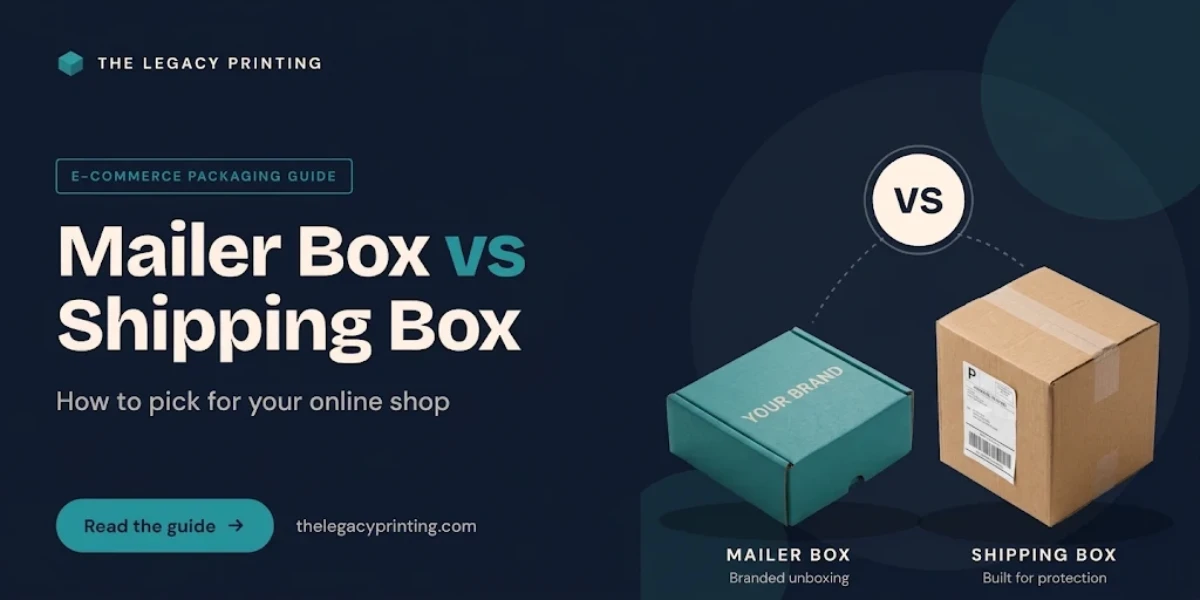
Many first-time buyers think a mailer box is just a prettier shipping box. It's really a different tool for a different job. In the mailer box vs shipping box choice, a mailer box is the printed, tape-free box that opens like a gift. It works best for light, brand-led orders. A shipping box is the plain four-flap box you tape shut, and it's the safer pick for heavy, fragile or stacked loads.
Plenty of online shops use both. If this is your first custom box order, your biggest worry is probably paying for the wrong box. Below are the ten differences that matter most, a product-by-product table, and five questions to help you choose with confidence.
Mailer Box vs Shipping Box: The Quick Answer
Pick a mailer box when your product is light and the unboxing helps sell your brand. Pick a shipping box when the order is heavy, breakable, or will sit under other boxes on the way.
The one-line verdict
Mailer for looks and light loads, shipping box for strength and heavy loads. Need both? Put a printed mailer inside a plain shipping box.
Why many shops use both
Few shops sell only one kind of product. A skincare brand might send single serums in mailers and pack big gift sets in an outer carton. That's normal, and it often keeps costs down without putting products at risk.
What Is a Mailer Box?
A mailer box is a one-piece cardboard box that folds and locks shut on its own. It usually needs no tape, and it opens from the front like a gift box.
Mailers are made from corrugated board. That's cardboard with a wavy layer glued between two flat sheets. The waves add strength and a little cushioning.
The most common style is the roll end tuck top (RETT). The front lid tucks into the box, and the side flaps roll in for extra strength. Because the board is smooth and there's no tape seam, you can print it outside and inside.
That's why mailers are popular for apparel, cosmetics, candles and subscription box packaging. Not sure about sizes yet? Our guide to mailer box dimensions shows common sizes and how to measure.
What to Remember Before You Order
What Is a Shipping Box (RSC)?
A shipping box is the plain brown box with four flaps on top and four on the bottom. The trade name is RSC, short for regular slotted container. You close it with tape, and most are plain or carry a simple one-color logo. It's built to move goods safely, not to impress anyone.
Shipping boxes come in single wall, with one wavy layer, or double wall, with two. Double wall is thicker and stronger, so heavy or bulky orders often need it.
Mailer Boxes vs Shipping Boxes: 10 Differences That Decide Your Pick
These ten points affect your cost, your damage risk and your customer's first impression. Each one comes with a simple example.
1. How the box closes
What it is: A mailer locks with a tuck lid. A shipping box closes with tape across the flaps.
Why it matters: Tape costs money and packing time. Your customer also has to cut it open, and a blade can scratch the product.
Example: A clothing shop packing orders after work can fold a mailer shut in seconds. An RSC needs a strip of tape on the top and the bottom of every box.
2. Board and flute size
What it is: The "flute" is the wavy layer inside the board, and its size sets how thick the board is. E-flute is thin and prints smoothly. B-flute is thicker, and C-flute is thicker again and stacks better. Mailers usually use E or B, while shipping boxes usually use B or C.
Why it matters: Thin board gives sharper print but less padding. Thick board protects more but looks less refined.
Example: A lip balm gift set looks crisp in an E-flute mailer. A cast-iron pan belongs in a double-wall shipping box.
3. Print area and branding
What it is: Custom mailer boxes can be printed on every outside panel and on the inside too. Custom shipping boxes are usually plain or lightly printed.
Why it matters: The unboxing experience is how it feels to open your package: the colors, the note inside the lid, the insert holding the product. It's often the first time your customer touches your brand.
Example: A candle brand prints burn-care tips inside the lid, so customers read them right when they need them.
4. Packing speed
What it is: Mailers fold and tuck. Shipping boxes need folding, taping and often loose filler.
Why it matters: Packing time is a real cost, even when it's your own time.
Example: A subscription brand packing a full month of orders saves hours when no box needs tape.
5. Weight and stacking strength
What it is: Box makers rate corrugated board with two lab tests. The edge crush test (ISO 3037), or ECT, measures how much force the board's edge takes before it crushes. It predicts stacking strength. The Mullen (burst) test measures the pressure needed to burst the board face, which predicts puncture resistance.
Why it matters: According to these ECT and Mullen ratings explained by one corrugated maker, single-wall 32 ECT and 200# Mullen board are both rated up to 65 lb for box plus contents. That rating covers boxes up to 75 in (191 cm) of combined length, width and depth. Single-wall 44 ECT board is listed at 95 lb. These are ratings for the board, not a promise for any one box. And "32 ECT" doesn't mean "holds 32 pounds."
Example: Packaging sites give different weight limits for mailers, and they don't agree. So there's no single safe rule. Pack your real product, shake it, then drop it from waist height onto a hard floor. If the corners crush or the lid pops open, choose stronger board or ask our team.
6. Protection for fragile items
What it is: A mailer with a snug insert can protect many delicate items. An insert is a cut piece of board that holds the product in place. Heavy glass or bottles usually need a shipping box, or a mailer inside one.
Why it matters: A product that can slide around takes a hit every time the box gets bumped. Holding it still matters as much as the board around it.
Example: A small candle jar in a mailer with a fitted insert often travels well. A set of three glass jars is safer double-boxed. Our guide on how to package candles for shipping walks through this step by step.
7. Shipping cost and DIM weight
What it is: Carriers charge by dimensional (DIM) weight as well as scale weight. DIM weight is a pricing weight based on box size. You multiply length × width × height in inches, divide by the carrier's DIM divisor (a set number each carrier chooses), and round up. The carrier bills whichever is higher, actual weight or DIM weight. That's your billable weight.
Why it matters: A big, light box can cost as much to ship as a heavy one, and a lower divisor means a higher charge. In one dimensional weight example, an 18 × 14 × 12 in (46 × 36 × 30 cm) box bills at no less than 22 lb with a divisor of 139. With a divisor of 166, it bills at 19 lb. The bigger lesson: shrinking the box usually saves more than finding a better divisor.
Example: Using a divisor of 139, a T-shirt in a 16 × 12 × 8 in (41 × 30 × 20 cm) shipping box comes to 1,536 cubic inches. That's about 11.05 after dividing, so it bills as 12 lb. A snug 12 × 10 × 3 in (30 × 25 × 8 cm) mailer comes to 360 cubic inches and bills as 3 lb. Same shirt, a quarter of the billable weight.
Divisors and rounding rules change, and some carriers now round each side up to the next whole inch. Check your carrier's current rules before you lock in box sizes.
8. Total cost per order
What it is: A printed mailer often costs more per box than a plain shipping box. But the box is only one line on the bill.
Why it matters: Your real cost per order includes the box, tape, filler, packing time, shipping, and any damaged items or returns.
Example: A plain box that needs tape, paper filler and a bigger shipping charge can end up costing more than a right-sized mailer. Our post on what changes the cost of custom boxes breaks down every factor.
9. Repeat orders and subscriptions
What it is: Subscription shops send the same box again and again, so the box becomes part of the product.
Why it matters: One standard box size makes packing faster, storage simpler and shipping costs easier to predict. Both box types arrive flat-packed, which saves shelf space.
Example: A monthly snack or beauty kit in the same printed mailer gives customers something they recognize on the porch.
10. Recycling and eco claims
What it is: Both box types are made from paper-based corrugated board. Both can be made in kraft paper or recycled cardboard.
Why it matters: What you print about recycling has rules. The FTC Green Guides summary says to qualify a "recyclable" claim when recycling facilities aren't available to at least 60 percent of the consumers or communities where you sell. It also says to qualify recycled-content claims, for example by giving the percentage. If you sell in California, check the state's rules on "recyclable" claims and the chasing-arrows symbol as well.
Example: "Please recycle this box where facilities exist" is a safer line than a bold "recyclable everywhere!" you can't fully back up.
Which Box Wins on Each Factor?
Mailers win on looks, packing speed and right-sizing. Shipping boxes win on strength, stacking and heavy loads. The table sums it up.
| Factor | Mailer box | Shipping box (RSC) | Edge goes to |
|---|---|---|---|
| Closure | Tuck lid, usually no tape | Four flaps, taped | Mailer |
| Board | Usually E or B flute | Usually B or C flute, single or double wall | Depends on load |
| Print area | Outside and inside | Mostly plain | Mailer |
| Packing speed | Fast fold and tuck | Slower, needs tape | Mailer |
| Heavy loads and stacking | Light to medium loads | Built for weight and stacking | Shipping box |
| Fragile items | Good with a snug insert | Better for glass and heavy items | Shipping box or both |
| DIM weight | Easy to size snugly | Often oversized for small items | Mailer |
| Price per box | Usually higher | Usually lower | Shipping box |
| Unboxing experience | Strong brand moment | Plain | Mailer |
| Recycling | Paper-based corrugated | Paper-based corrugated | Tie |
Which Box Fits Your Product?
Most light, everyday ecommerce packaging boxes should be mailers. Glass, heavy and high-value items usually need a shipping box or a mailer inside one.
| Product | Best pick | Why |
|---|---|---|
| Apparel and accessories | Mailer | Light, soft and easy to size snugly |
| Cosmetics and skincare | Mailer with insert | Small items, high brand value |
| Candles and soap | Mailer with insert, or both for large jars | Glass jars need to stay still |
| Bakery and food gifts | Mailer with insert | Holds treats in place and looks like a gift |
| Books and prints | Mailer | Flat, protects corners |
| Glass bottles and jars | Both | Two layers of protection |
| Electronics | Shipping box, or both | Weight and value |
| Heavy or bulky items | Shipping box, often double wall | Strength and stacking |
| Subscription kits | Mailer | Repeat brand moment, one standard size |
For food packaging, ask our team which materials suit your exact product before you order. You can also browse packaging ideas by industry to see box styles made for your field.
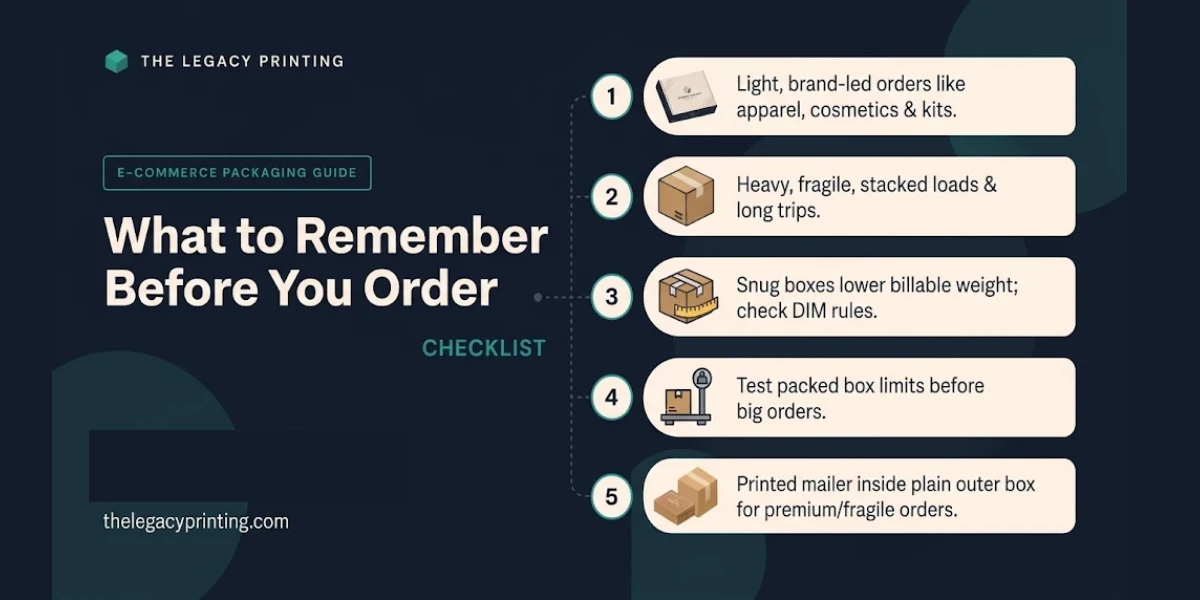
How to Choose: 5 Questions to Ask Before You Order
Picture one typical packed order and answer these five questions. Your answers will point to the right box.
- How heavy is the packed order? Light orders lean mailer. Heavy ones lean shipping box.
- Can it break? If yes, plan an insert, and consider a second outer box for glass.
- Will boxes be stacked? Warehouses and freight trucks stack boxes high, and stacking favors thicker board.
- How much does the unboxing matter? Gifts, beauty and subscriptions gain a lot from a printed mailer.
- How do you pack? If you pack by hand at home, tape-free mailers save real time.
Mostly "light, sturdy, brand-led"? Go mailer. Mostly "heavy, fragile, stacked"? Go shipping box. A mix of both? Use both.
When Should You Use Both a Mailer and a Shipping Box?
Use both when the item is fragile, premium or traveling a long way. The printed mailer delivers the unboxing moment. The plain outer box, often called a master carton or outer carton, takes the knocks.
When it's worth the extra box
- Glass bottles, jars or perfume
- High-value gift sets
- Orders that may be stacked in freight
Privacy and porch safety
A plain outer box hides what's inside while it sits on a porch. If discretion matters, keep any logo on the outer box small. Put shipping labels on a flat panel, not across seams or flaps, so they stay in place.
Common Mistakes That Cost Small Shops Money
Most packaging problems come from a few avoidable choices. These are the ones to watch for first.
- An oversized box. You pay to ship air, and the product rattles. Measure first with our guide on what size box you need.
- No insert. Items that shift around are easy to damage. A simple board insert holds them still.
- A mailer for heavy or breakable goods. Glass and heavy items need thicker board or a second box.
- Skipping a sample. Test your real product in a real box before a big run.
- Artwork not set on the dieline. A dieline is the flat map of the box that shows every cut and fold. Art placed off it can land on a fold or end up upside down.
- A plain box with no brand moment. Even a short printed message inside the lid makes the order feel cared for.
- Big eco claims you can't back up. Use honest, qualified wording, as the FTC Green Guides advise.
Eco-Friendly Choices for Both Box Types
Both mailers and shipping boxes can be made from kraft paper or recycled cardboard. At The Legacy Printing, those materials are available in almost every category with no extra premium.
Kraft paper is strong brown paper with a natural look, so it suits brands that want a simple, earthy feel. Print clear recycling instructions and keep your claims honest. See our eco-friendly boxes for styles and finishes.
How The Legacy Printing Helps
We make custom mailer boxes and custom shipping boxes in-house, with no subcontracting. Tell us what you're shipping and how many, and we'll suggest the right box structure and material.
- Free design support. Our team prepares the dieline and print-ready artwork for you.
- A digital 3D rendering to approve before anything goes to print.
- No die and plate charges, and minimums as low as 50 pieces.
- Free shipping to any address in the USA, with no hidden freight costs.
- Custom sizes and shapes, plus finishes like matte or gloss coating, spot UV, foil and embossing.
- Sample kits. Requests get a follow-up within 2 hours, and kits ship within days.
The process has four steps. Choose your style and size, then send your artwork or have it designed free. Approve your 3D rendering, and get free, fast shipping. We're a BBB accredited business rated 4.9/5 from 1,159+ orders and reviews, and our customer service team is available 24/7.
First order? You can save 20%! Get a free quote, call 800 719 2780, or email sales@thelegacyprinting.com, and we'll help you pick the right box the first time.
Frequently Asked Questions
What is the difference between a mailer box and a shipping box?
A mailer box is a printed, tape-free box made for light orders and a strong unboxing moment. A shipping box is a taped four-flap box made for strength. Mailers usually use thinner board that prints well, while shipping boxes usually use thicker board that stacks well.
Are mailer boxes strong enough to ship without an outer box?
Yes, for most light and non-fragile products. Mailers ship on their own every day. For glass, heavy items or long freight trips, add an outer box or choose thicker board.
Which is cheaper, a mailer box or a shipping box?
A plain shipping box usually costs less per box, but a mailer can cost less per order. Count tape, filler, packing time, shipping charges and damage, not just the box price.
How much weight can a mailer box hold?
It depends on the board, the box size and the product, so there's no single safe number. Sources give different limits. Test your packed box with a shake and drop test, and ask our team to suggest a board strength for your product.
Does box size really change my shipping cost?
Yes. Carriers bill the higher of actual weight and DIM weight, which is based on box size. A snug box usually lowers your billable weight, so measure your product before you choose dimensions.
Can I test a box before placing a full order?
Yes. Request a sample kit to check board, print and fit with your real product. When you're ready, get a free quote and our team will help with design, size and material at no extra charge.