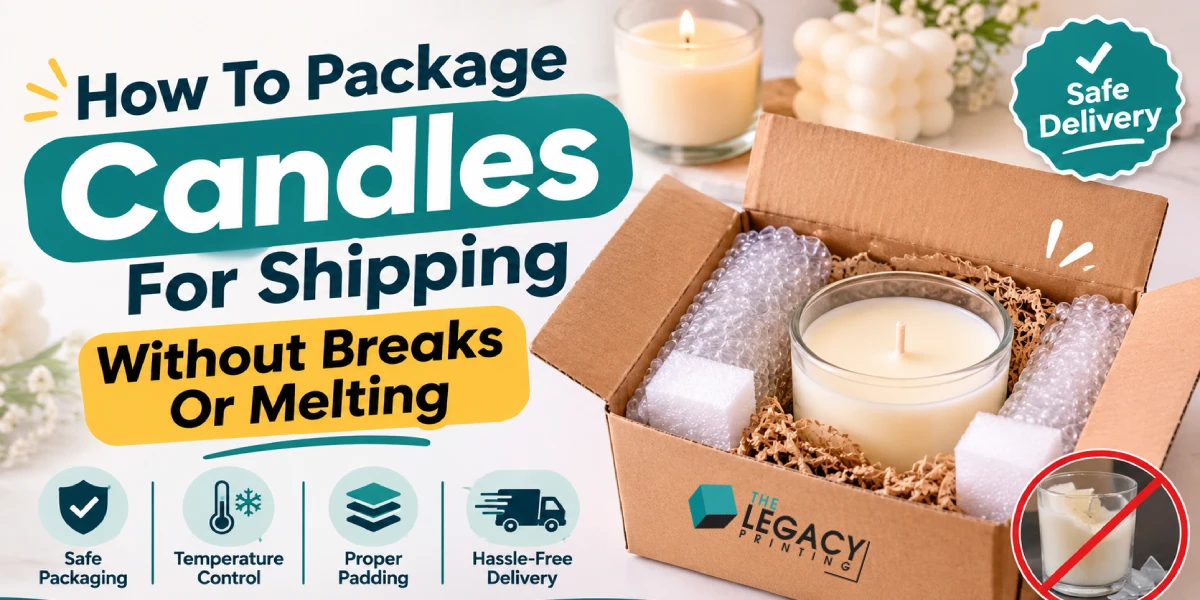
To package candles for shipping, wrap each candle, set it in a snug box with dividers, and fill every gap so nothing moves. Then seal all seams with wide tape and shake the box before it goes out. Skip a step and you risk a cracked jar or a slumped candle, which costs you the product, the postage and often the customer.
Candles bring two problems at once. Glass is heavy and breaks, and wax goes soft in hot trucks. Solve both, and your packages arrive looking just like your product photos!
Quick answer: how to package candles for shipping
Use five layers of protection: wrap, fit, cushion, seal and test. Here's the short version before the details.
| What you need | Time | Result |
|---|---|---|
| Corrugated shipping box, inner product box or sleeve, dividers or a die-cut insert, kraft or honeycomb paper (or tissue), void fill, wide shipping tape, a "Fragile" label. In summer: insulated liner and gel packs. | A few minutes per order once you have a routine. Custom-fit inserts make it faster. | Candles that don't move, don't touch each other and stay cooler for longer in transit. |
Wrap, fit, cushion, seal, test
- Wrap: Cover each candle in paper or tissue so glass never touches glass.
- Fit: Pick a box that's snug but leaves room for padding on every side.
- Cushion: Fill all empty space with void fill. That's any soft material that fills gaps, like crumpled paper or air pillows.
- Seal: Tape every seam, not just the middle flap.
- Test: Shake the closed box. If anything shifts, add more fill.
Why candles break and why they melt
Candles break because they move. A heavy jar with even a little room to slide picks up speed when the box drops, then slams into the wall or another jar. USPS warns that parcels go through automated machines and share space with packages up to 70 pounds. So strong packaging with room for cushioning matters.
Candles melt because of heat. Every wax has a melting point, the temperature where it turns soft or liquid. A parked delivery truck or a warehouse over a summer weekend can get hot enough to soften some waxes.
Heat damage shows up as frosting (a rough, white top), wet spots (wax pulling away from the glass) or slumping (the candle sags). Every step below fights movement, heat or both.
What is the best candle shipping box?
For glass and tin candles, the best candle shipping box is corrugated. Corrugated board has a wavy paper layer, called the flute, glued between two flat sheets. Those waves soak up bumps and drops.
Corrugated vs mailer vs poly mailer
Corrugated shipping boxes are the safe pick for anything heavy or breakable. According to the USPS guide to preparing packages, sturdy paperboard or corrugated fiberboard boxes work best for items up to 10 pounds. For heavy candle sets, a double-wall box (two layers of flute in the walls) adds strength.
Mailer boxes fold together and act as both the shipper and the display box. Corrugated mailers suit pillars, tins and tea lights, and they look good on arrival.
Poly mailers are soft plastic bags. Our honest opinion? Never put a glass candle in one. There's no wall to absorb a hit, and one drop can crack the jar.
The two-layer system: branded inner box plus outer shipper
Your pretty retail carton is not a shipping box. It's only the inner layer. The safest setup has two parts:
- Inner box: A printed product box that holds one candle and creates the unboxing moment.
- Outer shipper: A plain or printed corrugated box that takes the knocks.
Some sellers combine both jobs in one strong corrugated mailer with a die-cut insert. That's a cardboard piece cut to the exact shape of your jar. It holds the candle in place, so you use less loose fill and pack faster.
Selling in stores too? You can use the same inner box on the shelf. Our custom retail boxes are made for exactly this kind of double duty.
Right-size the box
Snug is good. Tight is not. USPS asks for a box with enough room for cushioning around the contents. Too much empty space lets the candle rattle, and you pay to ship air.
Measure the candle with its lid on, then add room for padding on all sides. Our guide on how to measure a product for a custom box walks you through it.
Candle type vs best packing method
| Candle type | Inner wrap | Box | Divider | Main risk |
|---|---|---|---|---|
| Glass jar | Double wrap in kraft or honeycomb paper | Corrugated box or corrugated mailer | Die-cut insert or cardboard dividers | Cracks from drops and jar-to-jar contact |
| Tin | Single layer of paper | Corrugated mailer | Helpful for sets | Dents and loose lids |
| Pillar | Tissue paper | Mailer with a snug fit | Yes, if more than one | Chips, scuffs and heat |
| Taper | Tissue, bundled in pairs | Narrow box | Slots keep them straight | Snapping and bending in heat |
| Wax melts | Sealed clamshell or bag inside a box | Small mailer | Usually not needed | Heat, since they're small and thin |
| Multi-candle set | Each candle wrapped on its own | Corrugated, double-wall for heavy sets | Always | Candles hitting each other |
Why tissue for pillars and tapers? Bubble wrap can leave marks in soft wax. Tins need less padding than glass, but they still shouldn't rattle.
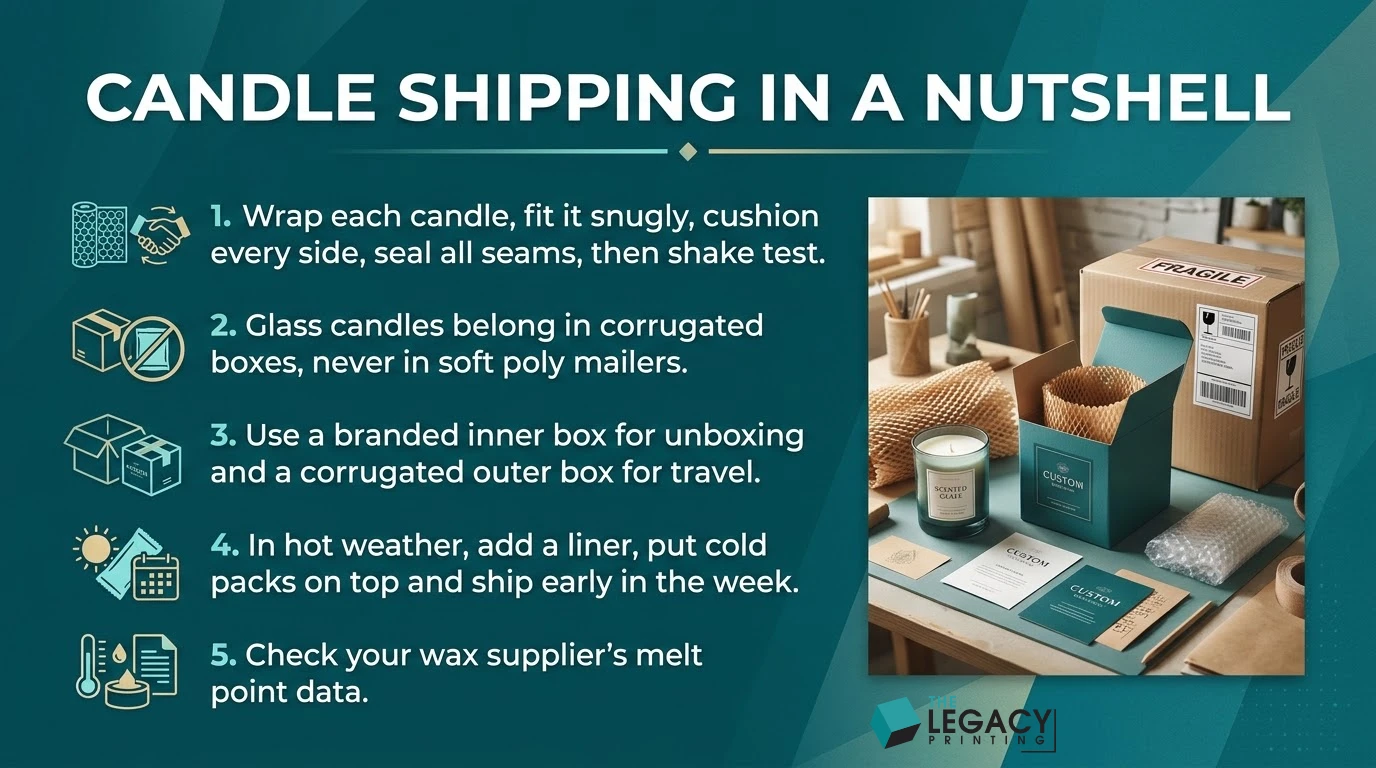
Candle Shipping in a Nutshell
How do you pack glass jar candles? Step by step
Lock the lid, wrap the jar, hold it with a divider, fill every gap, seal all seams and test. Use these six steps on every glass candle order.
1. Secure the lid and wick
Lids pop off when boxes drop, and a loose lid can roll around and chip the rim. Run a small strip of tape across the lid edge, or seal it with a branded sticker. While you're there, check that the wick is centered and the wick tab is set.
2. Wrap each jar
Wrap the jar in two layers of honeycomb kraft paper or crumpled kraft paper. Cover the base and the top, not only the sides. If the jar sits in its own printed box, wrap that box too or pad around it.
3. Add dividers or a die-cut insert
Dividers are cardboard walls that keep candles apart. A die-cut insert does the same job and also stops the jar from sliding up and down. For a one-candle order, a fitted insert can replace most of the loose fill.
4. Fill the gaps and keep candles upright
Put a layer of fill on the bottom first. Set the candles in upright, then fill the sides and top. The USPS Domestic Mail Manual 601 packaging standards say loose fill should overfill the box before you close it. When the flaps press down on the fill, the candle can't move.
5. Seal every seam and label flat
Use wide shipping tape. Masking tape and thin household tape can peel off with heat and handling. Tape the center seam and both edge seams, top and bottom.
Stick the shipping label flat on the largest side, away from seams. Then add a "Fragile" mark. USPS says that mark is for packages with delicate items like glass, so it fits jar candles. Our guide to tapes and labels for boxes covers which tape goes where.
6. Run the shake test and drop check
Close the box and shake it. The USPS rule is simple: if you hear things shifting, add more cushioning. For a new box setup, also drop a sample order from about waist height onto a hard floor. Open it and look for cracks, loose lids or crushed corners.
Big brands use lab tests instead. ISTA 3A is a lab test that simulates a parcel delivery trip for packed products up to 150 lb. Most small shops don't need it, but your home test follows the same idea.
Shipping multiple candles and candle sets in one box
Give every candle its own cell and keep the heaviest ones at the bottom. No candle should touch another.
Dividers and no contact
Glass knocking against glass is a common cause of cracks in multi-candle orders. Use a divider grid or a custom insert with one slot per candle. Wrap each candle even when it has its own slot. That extra layer helps when a box lands on a corner.
Heavy ones at the bottom, double-wall for heavier sets
Put large jars low and small tins or wax melts on top. USPS says not to pack heavy, dense items with fragile ones unless they're carefully separated, so add a firm cardboard layer between them. When the box gets heavy, move up to a double-wall corrugated shipper. It costs a bit more than a single-wall box, but far less than a refund.
How do you ship candles in summer without melting?
Know your wax, slow the heat with a liner and cold packs, pick a faster service and ship early in the week. In a real heat wave, pausing is often smarter than gambling.
Know your wax and its melt point
Different waxes soften at different temperatures. Here are example ranges from a candle wax melting point reference:
| Wax | Example melt range | Summer risk |
|---|---|---|
| Coconut | 99-108°F | Highest |
| Soy | 120-135°F | High |
| Paraffin | 120-150°F | Medium to high |
| Beeswax | 143-150°F | Lower |
Treat these as rough guides. Other sources list lower ranges for soy, and every blend behaves differently. Your wax supplier's data sheet is the number that counts. Wax can also frost or pull away from the glass well before it fully melts.
Insulated liners and gel packs
An insulated liner (foil or foam) slows heat on its way to the candles. A gel pack is a frozen pack that keeps the box cooler for a while. Shipping guides advise placing cold packs above the candles, not under them. Some also suggest a foil sleeve plus a cold pack for soy candles in summer.
Wrap each gel pack in paper so moisture doesn't soak your inner box or labels.
Choose faster service and ship early in the week
Less time in transit means less time in a hot truck, so pick the fastest service your margins allow. Ship Monday to Wednesday so the package doesn't sit in a warehouse over the weekend. Orders headed to hot places like Arizona, Texas and the rest of the Southwest and Southeast need the most care.
| Season or destination | What to do |
|---|---|
| Cool months, including the holiday season | Standard packing and ground shipping are usually fine. |
| Warm weather | Add an insulated liner and pick a faster service. |
| Heat wave or hot destination | Liner, cold pack on top, fastest service you can offer, ship early in the week, or pause. |
This is general guidance, not a promise. Test your own wax and routes.
Test it with a temperature indicator label
A temperature indicator label is a sticker that records the highest heat it reached. Put one inside a test box and mail it to a friend in a hot state. When it arrives, you'll know how hot the trip got and whether your candle survived. That beats guessing.
When to pause shipping
Many candle shops hold orders during extreme heat. Say so clearly at checkout. For example: "During heat waves, we may hold orders for a few days so your candles arrive in great shape." Most customers would rather wait a little than get a melted candle.
Care note to include for customers
Tuck a small care card in the box. Explain what frosting looks like, ask buyers to let a warm candle rest at room temperature before lighting, and tell them how to reach you if anything looks wrong. It shows you care and cuts down on worried emails.
Carrier rules for shipping candles in the US
Most shops ship candles with USPS, UPS or FedEx. The rules below come from USPS, so check the other carriers' packing guides too. The basics: cushion fragile items, stop movement, mark glass "Fragile" and watch out for fragrance liquids.
USPS packing rules in plain words
- Pick a box with room for cushioning around the contents.
- Keep items from shifting. If it rattles, add fill.
- Don't pack heavy, dense items next to fragile ones without a firm divider.
- Mark packages with glass "Fragile."
- Packages over 70 pounds can't be mailed.
Are candles hazmat? Fragrance oils and Publication 52
Hazmat means hazardous materials: items that could catch fire or hurt people, so special rules apply. USPS notes that items with perfume or alcohol may need special handling. It points sellers to Publication 52, its rule book for hazardous, restricted and perishable mail.
A finished wax candle is not the same as a loose bottle of fragrance oil or a room spray. If you add oils, sprays or diffusers to a candle box, check the USPS hazardous materials guidance and your carrier's rules first.
Package size and weight affect shipping cost
Carriers often charge by box size as well as weight. This is called dimensional (DIM) weight, and it means a big, light box can cost as much to ship as a heavy one. Some USPS options price mainly by box size, so check the current rules for your box. A snug custom size is one of the simplest ways to keep postage down.
Common candle packing mistakes and fixes
Many broken or melted candles trace back to the same few mistakes. Here's each one with its fix.
| Mistake | What happens | Fix |
|---|---|---|
| Box too big | Candle slides and cracks; higher postage | Right-size the box or use a die-cut insert |
| Poly mailer for glass | Jar can break on the first drop | Use a corrugated box or mailer |
| Retail carton used as the shipper | Crushed box, damaged candle | Put it inside a corrugated outer box |
| No dividers in sets | Jars knock and crack | One slot per candle |
| Thin or household tape | Seams open in transit | Wide shipping tape on all seams |
| Bubble wrap on soft wax | Marks on pillars and tapers | Wrap in tissue first |
| Loose lid | Lid pops off, chips the rim | Tape or sticker-seal the lid |
| Cold pack under the candle | Top of the candle still overheats | Place cold packs on top |
| Shipping on Friday in summer | Box sits in a hot warehouse all weekend | Ship Monday to Wednesday |
| Odd shapes or tubes | Can cost more to ship | Use a standard rectangular box when you can, and check your carrier's rules |
Pro tips for faster, safer candle packing
Small changes at your packing station save time and cut breakage:
- Standardize sizes. One box size per candle size means no guessing at the packing table.
- Swap loose fill for inserts. A fitted insert is quicker to pack and looks neater.
- Pre-fold boxes in quiet hours. Your busy days go faster.
- Keep a test box. Re-test whenever you change jars, wax or suppliers.
- Plan for the holidays. Cool weather makes shipping easier, but order volume jumps. Order boxes early.
Make the box part of the unboxing
Your candle box is the first thing your customer touches. Good candle packaging for shipping protects the jar and makes opening the box feel like getting a gift.
Custom printed candle boxes with inserts
A printed inner box with a die-cut insert holds the candle tight and shows off your brand at the same time. Print your logo, scent notes and burn tips right on the box. Finishes like matte or gloss coating, spot UV (a shiny coating on just one area) and gold foil add a special touch. For more ideas, see our post on premium candle packaging boxes.
Kraft and recycled board options
Candle buyers often love natural, earthy packaging. We offer kraft paper and recycled cardboard in almost every box category, with no extra premium. Browse our eco-friendly boxes if that fits your brand.
Care card and tissue ideas on a small budget
Impressing customers doesn't take a big budget. A sheet of tissue, a branded sticker seal and a printed care card go a long way. Add a short thank-you line printed inside the lid. It costs little, and people remember it.
Match your box to the candle
Glass jars do well in corrugated mailers with inserts. Tins and wax melts fit neatly in kraft mailers. Luxury candles look their best in rigid gift-style boxes packed inside a shipper. Not sure which fits your candle? Ask our team, and we'll help you pick the structure and material.
Frequently Asked Questions
How do you ship candles?
Wrap each candle, place it in a snug corrugated box with dividers, fill all gaps, seal every seam with wide tape and mark glass "Fragile." Run a shake test before you hand it to USPS, UPS or FedEx.
How do you wrap candles for shipping?
Wrap glass jars in two layers of kraft or honeycomb paper, covering the top and base. Use tissue on soft pillars and tapers, since bubble wrap can mark soft wax.
How do you pack pillar candles for shipping?
Wrap each pillar in tissue and fit it into a snug mailer box. If you ship several, give each pillar its own slot. Add a liner in hot weather.
How do you package multiple candles for shipping?
Use a divider or insert with one slot per candle so they never touch. Put the heaviest candles at the bottom, and use a double-wall box for heavy sets.
Do candles melt in shipping?
They can, especially low-melt waxes like coconut and many soy blends in summer. An insulated liner, cold packs on top, faster service and early-week shipping all lower the risk.
Can I get a sample before ordering in bulk?
Yes! Request a sample kit to check materials and print options. Our team follows up on sample kit requests within 2 hours, and kits ship within days.
What is the minimum order for custom candle boxes?
Our minimum order is as low as 50 pieces. That makes it easy to test a new candle line before you scale up. Read more about starting with just 50 custom boxes.
Ready to ship candles that arrive looking great?
The right box does most of the work. A snug, sturdy box with a fitted insert stops breaks, speeds up packing and can lower postage.
The Legacy Printing is a BBB accredited business, rated 4.9/5 from 1,159+ orders and reviews. Here's what you get when you order custom candle boxes from us:
- Free design support. Our team prepares print-ready artwork for you.
- A digital 3D rendering to approve before production.
- No die and plate charges.
- Orders from just 50 boxes.
- Free shipping to any address in the USA.
- Kraft and recycled board with no extra premium.
Tell us your candle size and style, and we'll help you choose the right structure and material. Get a free quote and free design proof today!