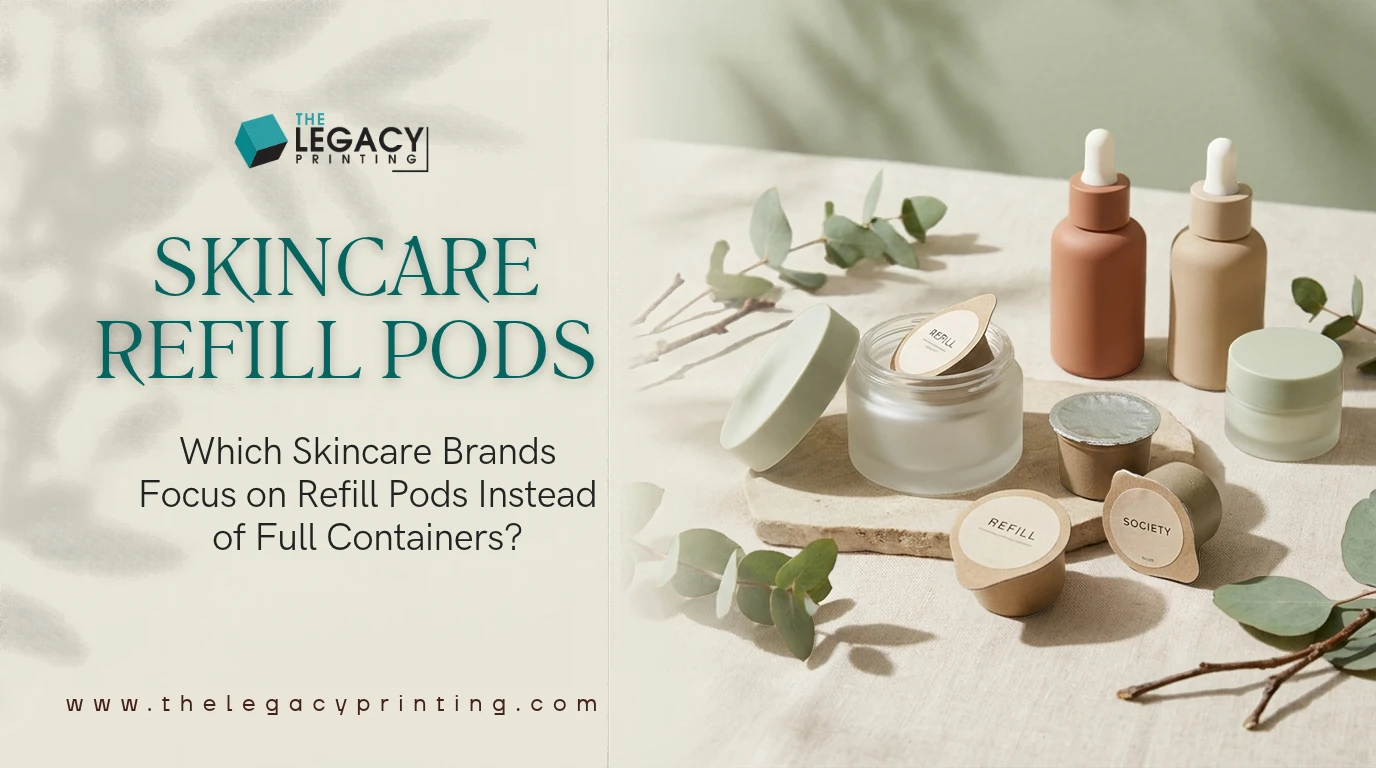
Which skincare brands focus on refill pods instead of full containers? Fewer than most people expect. Skincare refill pods are easy to find, but very few brands gave up jars for good. Big names like Tata Harper, Drunk Elephant, Glow Recipe, Tatcha and Kiehl's sell skincare refill pods for some of their creams. They still sell the full jar too.
If you run a skincare brand, there's a costlier mistake to watch for. Founders often spend months on the pod and the jar, then rush the box that holds the refill. The result is a carton that rattles, looks just like the full-size product, or carries an eco claim the brand can't back up. The safe fix is to plan the refill box alongside the pod, size it to the pod and keep every claim specific.
| Quick answer | Details |
|---|---|
| What you need | Exact pod size (with lid), your artwork or a design brief, and claim wording you can prove |
| Time it takes | A few rounds of review: size, artwork, then a 3D rendering to approve before production |
| Result | A refill carton that fits the pod snugly, clearly says "refill" and still feels like your brand when opened |
Which skincare brands focus on refill pods instead of full containers?
Very few brands sell only refills. Most well-known names offer a pod for one or two best-selling creams and keep the full jar on sale right next to it.
Brands that sell pods for select creams
Sephora's refillable skincare list in the US shows refill options from Tatcha, Drunk Elephant, Glow Recipe, Skinfix, Fenty Skin and Kiehl's. Tata Harper, Laneige, Avène, Honest and Maya Chia also come up often for skincare refill pods. Most of these pods hold a moisturizer or an eye cream. Refill lines change often, so check each brand's own site to see what it sells today.
Brands built around refills
A smaller group of brands plans its whole line around refills from day one. These brands often use pouches, cartridges or bulk refills, not only pods. It takes more planning up front, but the refill becomes the main brand story instead of a side option.
Pod, pouch or cartridge: what's the difference?
- Refill pod: a small inner cup of cream that clicks into your old jar. You keep the jar and buy only the new cream.
- Refill pouch: a soft bag of product you pour into your bottle. It uses less material than a new bottle.
- Cartridge (inner chamber): a part inside the jar or pump that you swap out when it's empty.
- Bulk refill: a large container or in-store station you use to top up your own bottle.
Refill pod vs full container: how do they compare?
A refill pod usually costs a little less and uses less packaging than a new full jar. How much good it does depends on one thing: the shopper keeping and reusing the jar.
| Factor | Refill pod | Refill pouch | Full container |
|---|---|---|---|
| Waste per purchase | Lower than a new jar | Often the lowest material use | Highest: new jar, lid and box each time |
| Price to shopper | Usually a few dollars less | Often less than a new bottle | Full price |
| Look on the shelf | Small; needs a clear refill box | Soft, plain look | Strong shelf presence |
| Ease of use | Very easy: pop out, click in | Needs pouring, can be messy | Nothing to do |
| Box needed | Small carton with an insert | Sleeve, mailer or no box | Standard cosmetic carton or rigid box |
Honest limits worth knowing
Refills have weak spots, and your customers will ask about them. The savings are small. On Sephora's list, a refill usually costs only a few dollars less than the full jar. Glass jars feel premium, but they're heavy to ship. And a pod only cuts waste if the shopper keeps using the old jar instead of buying a new set.
The bigger picture still matters. The EPA containers and packaging data shows containers and packaging made up 82.2 million tons of US municipal solid waste (everyday trash from homes and businesses) in 2018. That was 28.1 percent of the total. Plastic packaging alone came to 14.5 million tons that year, and only about 13.6 percent of it was recycled. Using less plastic per purchase is a fair goal, even if each refill helps only a little.
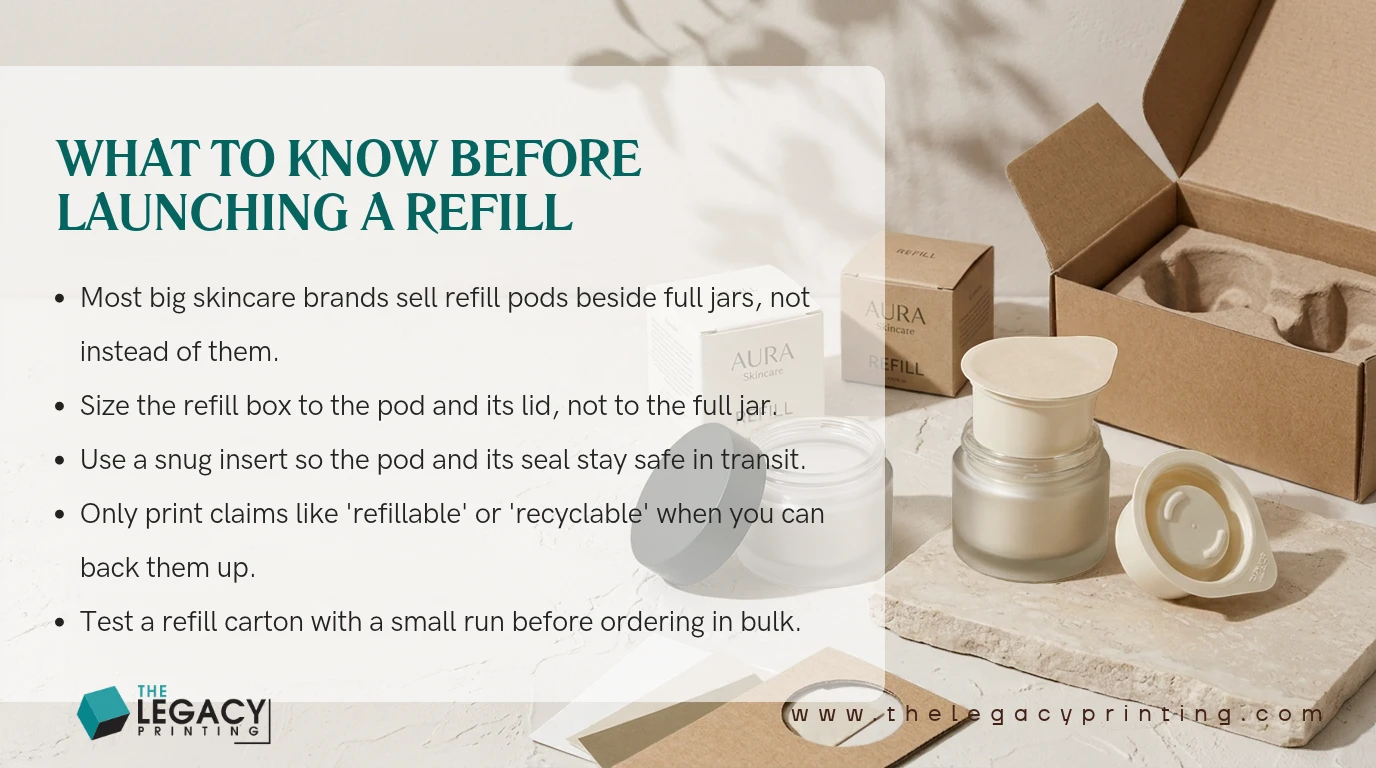
What to Know Before Launching a Refill
Why do most big brands choose pods?
Pods let a brand keep its familiar jar and sell a smaller, lighter refill beside it. Shoppers don't need to learn a new routine. They pop out the old cup and click in the new one.
There's a business trade-off, though. Each pod sale can replace the sale of a full jar. Refills also have to be truly easy to use, or shoppers go back to buying the full product. For a small brand, the safer move is to test one refill product first rather than switch the whole line at once.
How refillable skincare packaging works
Refillable skincare packaging has two layers: the part that touches the cream and the box around it. Each one does a different job.
Primary packaging is the jar or pod that holds the product. Your pod or jar supplier makes this part. Secondary packaging is the box that holds the jar or pod. That's our part at The Legacy Printing. We make the printed carton, insert and outer box, not the pod itself.
Every box starts with a dieline. That's a flat template showing where the box gets cut and folded. Your artwork sits on this template, so text and logos land in the right spot once the box is folded. Our design team prepares the dieline and a design proof for you, free.
What box does a refill pod need?
A refill-only pod needs a small, snug folding carton with an insert. A starter set (jar plus pod) suits a sturdier rigid or sleeve box. Refills sold online need a mailer that can handle shipping.
| Product | Box style | Material | Finish ideas |
|---|---|---|---|
| Moisturizer or cream refill pod | Cosmetic boxes with tuck end | Cardboard or kraft paperboard | Matte coating, spot UV on the logo |
| Serum or eye cream refill | Cosmetic boxes with reverse tuck end | Cardboard | Small gold or silver foil accent |
| Starter set (jar + pod) | Rigid boxes, two-piece or magnetic closure | Rigid board | Embossing, foil, structural insert |
| Refills shipped to customers | Mailer boxes | Corrugated board | Inside print with refill steps |
| Eco-first brand | Kraft boxes or eco-friendly boxes | Kraft paper or recycled cardboard | One- or two-color print |
| Branded wrap over a simple carton | Sleeve boxes | Cardboard | Color band that marks "refill" |
A few terms from the table, in plain words. A tuck end box closes with a flap that tucks inside. Rigid board is thick, stiff board that gives a gift-box feel. Corrugated board has a wavy middle layer that cushions the product in the mail.
You can see more shapes on our custom cosmetic boxes page. Size and shape can be customized to fit your pod.
How to package skincare refill pods: 7 steps
Start with the pod's real size and finish with a small test run. Each step below heads off a common, costly error.
1. Measure the pod, not the jar
The refill box holds the pod, so measure the pod with its lid and seal on. A box sized for the jar leaves empty space, and the pod slides around. Write down length, width and height, then allow a little room for the insert. Our guide on what size box you need for your product walks through it.
2. Decide: refill-only, starter set, or both
Most refill brands need two boxes. The starter set holds the jar and first pod, and it makes the big first impression. The refill-only carton is smaller and lighter, but it should still look like your brand. Shoppers will open it again and again, so treat it as a repeat unboxing moment, not a cost to cut.
3. Pick the box style and material
For refill cartons, a tuck end box in cardboard or kraft paperboard is a safe, simple choice. If your brand tells a green story, kraft paper and recycled cardboard are available in almost every category at no extra premium. Browse our eco-friendly boxes for ideas. Not sure which structure fits? Tell us about your pod and we'll suggest a style and material.
4. Add an insert that holds the pod still
An insert is a paper or board piece inside the box that keeps the pod in place. It stops sliding, protects the lid and seal, and helps the box keep its shape in transit. A cracked seal is a quick way to lose a repeat customer. We make custom structural inserts sized to your pod.
5. Print cues that tell refill from starter
Shoppers should spot the refill box at a glance. Use a clear "REFILL" label, a different color band or a small icon. Print the refill steps inside the lid or on a small card. You can also add a QR code that links to a short how-to video.
For finishes, matte coating gives a soft, calm look. Spot UV adds a shiny layer to one area only, such as the logo. Our post on matte vs gloss lamination can help you pick.
6. Write claims you can prove
Green words on a box come with rules. The FTC summary of the Green Guides says you shouldn't call a package "refillable" unless buyers have a real way to refill it. For example, a refill pod you actually sell, or a program that collects and refills the package.
- "Recyclable": the FTC says to qualify this claim when recycling isn't available to at least 60 percent of the consumers or communities where you sell.
- Recycled content: if only part of the box is recycled, say how much, as in "Made from 30% recycled material." Use only a number your supplier can prove.
- California: the state's SB 343 law limits the chasing arrows (the recycling symbol) and the word "recyclable" on packaging. Its enforcement has shifted during 2026, including a reported court pause, so check the current rules before you print.
Stick to plain, specific wording like "box made with recycled cardboard," and keep your supplier's proof on file. A vague word like "eco-friendly" on its own invites questions you may not be able to answer. Making a product sound greener than it is has a name: greenwashing.
7. Approve a 3D rendering and start small
Before production, we send a digital 3D rendering so you can check the box from every side. Once you approve it, you can order as few as 50 pieces. There are no die or plate charges, and shipping is free to any US address.
Digital printing needs no plate setup, so it suits short runs like this. Offset printing makes more sense later for large runs in CMYK (four-ink full color). Want to hold a box first? Request a sample kit. We follow up within 2 hours, and kits ship within days. Our post on starting small with 50 custom boxes has more.
Common mistakes and how to fix them
Most refill box problems come from sizing, claims or a design that blends in. Each one is easy to fix before anything goes to print.
| Mistake | Why it costs you | Fix |
|---|---|---|
| Box sized for the jar, not the pod | Pod slides, seal can break, more returns | Measure the pod with its lid and add a snug insert |
| "Refillable" printed with no pod for sale | Can mislead buyers under FTC guidance | Launch the refill before printing the claim |
| Unqualified "recyclable" or "eco-friendly" | Vague claims can be called greenwashing | Name the real fact, like "made with recycled cardboard" |
| Refill carton looks identical to the full one | Shoppers buy the wrong item and get upset | Add a color band, icon or "REFILL" label |
| Too much empty space | Wastes material and looks careless | Choose a custom size that fits the pod closely |
Pro tips for refillable moisturizer packaging
Small details make a refill feel like a treat instead of a chore. Most of these cost very little.
- Keep the same logo, fonts and main colors on starter and refill boxes. Change just one cue.
- Print a short thank-you line inside the refill box. A plain reorder becomes a small, friendly moment.
- Try one-color printing on kraft for a clean, low-ink look that suits sustainable cosmetic packaging.
- Save foil and embossing for the starter set, where first impressions count most.
- If you ship refills, pick a mailer that fits the refill carton closely, so you need no loose filler.
Frequently Asked Questions
Are refill pods cheaper than buying a full jar?
Usually, but only by a little. On US retail listings, refills are often a few dollars below the full jar. The bigger win is using less packaging over time.
Are skincare refill pods really more sustainable?
They can be, as long as people keep reusing the jar. A pod uses less material than a new jar and lid. The benefit shrinks if a heavy glass jar gets thrown away early.
Can you refill any moisturizer jar with a pod?
No. Pods are made to fit one brand's own jar, so a pod from one brand usually won't lock into another brand's jar.
Are refill pods recyclable or compostable?
It depends on what the pod is made of and on your local program, so follow the brand's own instructions. The paper box around the pod is often easier to recycle than the pod. Paper-based boxes have a strong record: the EPA Facts and Figures FAQ reports corrugated boxes were recycled at 96.5 percent in 2018. Local rules still vary.
Is refillable skincare hygienic?
Generally yes, when the pod arrives sealed and you follow the brand's cleaning steps. The new cream stays in its own cup, so it doesn't mix with old product. Wash and dry the jar as the brand suggests before adding a new pod.
What is the difference between a refill pod and a refill pouch?
A pod is a whole cup that clicks into the jar, while a pouch is a soft bag you pour from. Pods are quicker and cleaner to use. Pouches often use less material but can get messy.
Can I get a sample before ordering in bulk?
Yes! Request a sample kit before you place a bulk order. Our team follows up within 2 hours and kits ship within days, so you can feel the board, print and finish in your own hands.
Next step: Get a free quote and free design proof
A refill pod is only half the launch. The box tells shoppers what they're buying and makes the refill worth opening. We build every box in-house, with no subcontracting. You get free design support, a 3D rendering before production, no die or plate charges and free shipping across the USA. Since you can start with just 50 boxes, testing a refill carton stays low-risk!
Questions about size, inserts or claims? Call 800 719 2780 or email sales@thelegacyprinting.com. Our team is available 24/7. Ready to see your refill box come to life? Get a free quote and free design proof today.