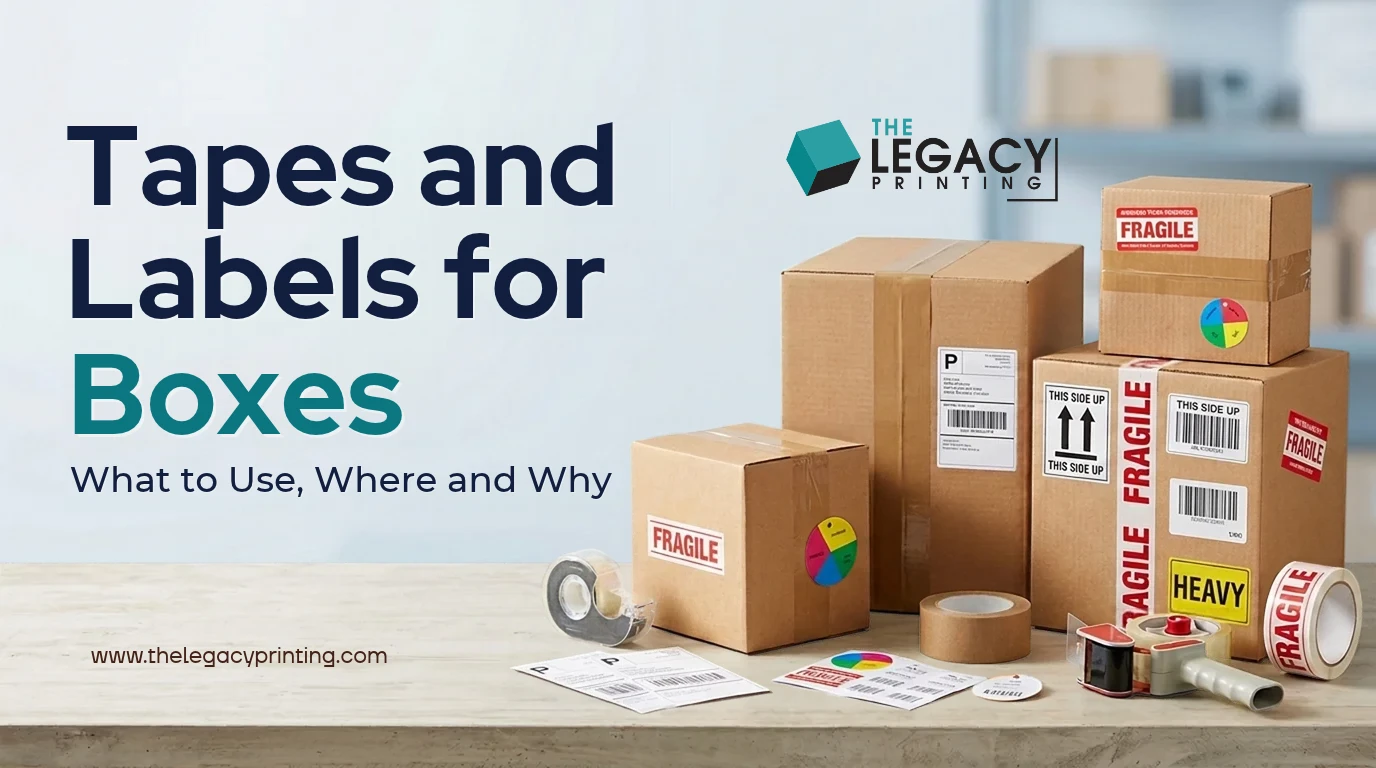
What tapes and labels should you use on your boxes? Tape closes and protects the box. Labels tell carriers and customers what they need to know. For most shipments, that means a good carton sealing tape on the seams and a firmly stuck shipping label on the largest flat side, away from seams and edges.
Simple enough on paper. But a box that pops open in a cold truck, or a label that peels off at the sort center, can cost you a reship and an unhappy customer. Below, we go through the problems sellers run into most, what causes them, and how to fix each one. Since custom printed boxes are what we make, we'll also show where tape and labels fit into your unboxing experience.
Tapes and Labels: What Each One Does
Tape holds the box shut while it travels. Labels carry information, like the address, handling notes, product details or your brand.
Tape closes and protects
The trade name for box tape is carton sealing tape. It's used to close corrugated boxes, which are boxes made from layered cardboard with a wavy middle. Many clear box tapes use BOPP film, a thin but strong plastic film. The glue is a pressure-sensitive adhesive (PSA). That just means it sticks when you press it, with no water or heat needed.
Labels tell carriers and customers things
Labels fall into a few main groups:
- Shipping labels: the address and barcode for USPS, UPS or FedEx. Many sellers make printed mailing labels right from their shipping software.
- Handling labels: notes like Fragile, This Way Up or Keep Dry.
- Product labels: shade, scent, batch number or ingredient details. Labels for food packaging and custom chapstick labels for lip balm tubes belong here.
- Brand and advertising labels: a logo sticker, a thank-you seal, or a promo code with a QR code.
Where each one fits in the unboxing
The outer shipper is what the carrier sees. The inner box is what your customer remembers. A plain, strong tape outside and one neat branded sticker inside usually look cleaner than fancy extras on every surface. Your packaging is part of your brand, so give each piece a clear job.
Signs Your Tape or Labels Are Letting You Down
Most problems show up in the same few ways. If any of these sound familiar, the causes and fixes further down will help.
- Tape lifts off the flaps a day after packing, or the box arrives half open.
- Tape looks stuck but peels away from kraft boxes with a layer of dust on it.
- One end of the shipping label curls up and sticks out. People in the trade call this label flagging.
- The carrier can't scan the barcode, or the package shows up late with a "label issue" note.
- Labels fall off boxes stored in a cold garage or warehouse.
- The address print fades or rubs away before delivery.
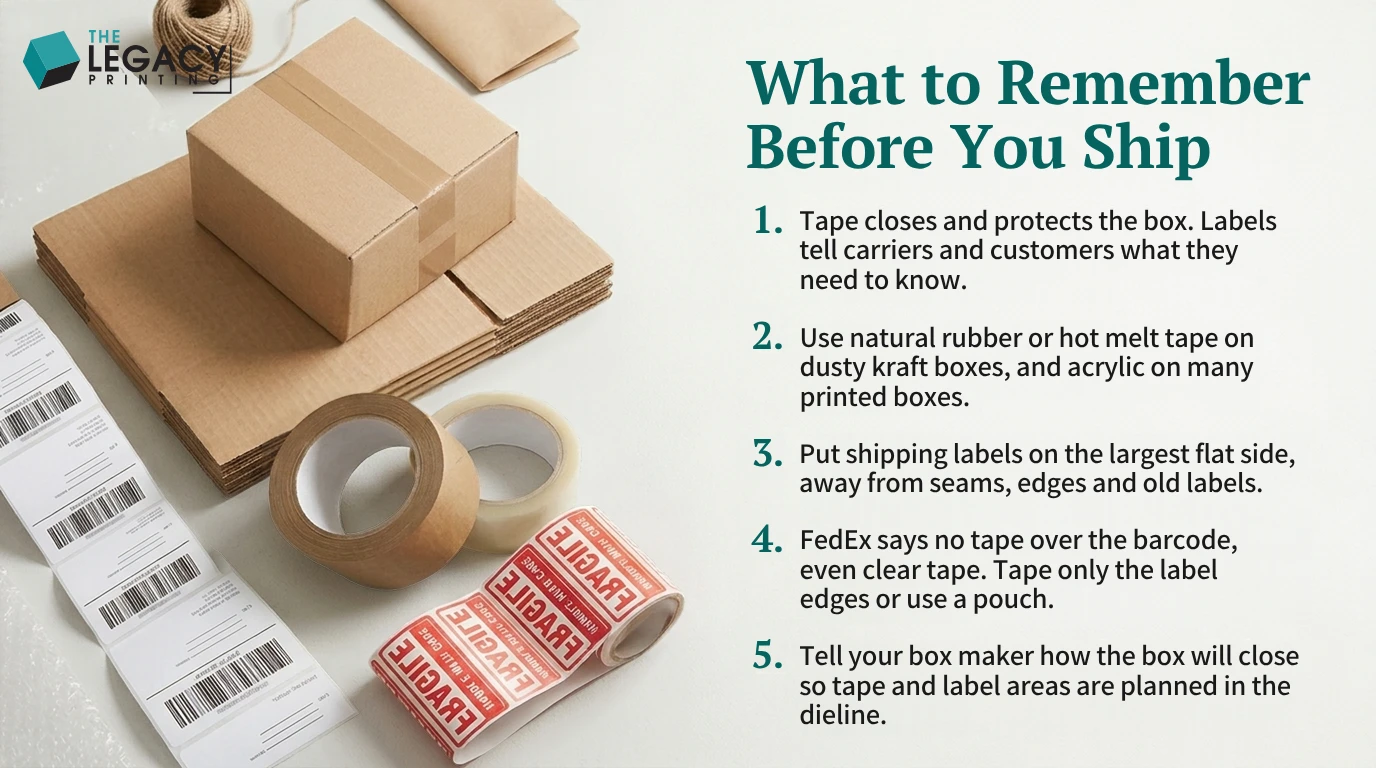
What to Remember Before You Ship
Which Box Sealing Tape Types Fit Which Job?
For most e-commerce boxes, hot melt or acrylic carton tape works well. Pick natural rubber tape for dusty or recycled boxes. Go with water-activated paper tape when you want to see if a box was opened, and add filament tape for heavy loads.
There are four main box sealing tape types. Tape makers such as Intertape Polymer Group make all four: water-activated, natural rubber, acrylic and hot melt.
Acrylic
Acrylic glue is clear and stable. Intertape rates its acrylic tapes for 32°F to 149°F (0°C to 65°C), and says they resist aging, UV light and yellowing. That makes acrylic a good pick for boxes that sit in storage or near a sunny window. It's also a common choice for printed boxes. Press it down firmly so the glue makes full contact.
Hot melt
Hot melt tape is the everyday workhorse at many shipping desks. It grabs quickly and does a solid job on plain brown corrugated shippers. On some printed surfaces, though, it may not grip as well.
Natural rubber
Natural rubber tape has a strong, quick grab on rough boxes. Tape makers point to rubber or hot melt for dusty, recycled cardboard, because standard acrylic can struggle on those surfaces.
Water-activated paper tape
This paper tape is also called gummed kraft tape. You wet it to make it sticky, and it bonds into the fibers of the cardboard. Because it's hard to peel off without tearing, you'll see it if someone opened the box. Tape makers suggest it when security matters. It needs a water dispenser, so it suits shops that pack a lot of orders.
Filament tape for heavy boxes
Filament tape, also called strapping tape, has strong fibers running through it. It doesn't replace your sealing tape. You add it on top to reinforce heavy boxes, like a case of candles or a box of books.
Thickness, width and the H-tape method
Tape thickness is measured in mils, and one mil is one thousandth of an inch. Thicker tape usually has more tensile strength, which means it can take more pulling before it breaks. Wider tape covers more of the seam, so it suits bigger boxes.
How you tape matters as much as which tape you buy. FedEx's packing advice recommends the H-tape method: one strip along the center seam, then one across each end seam. From above, the tape forms the letter H and closes the gaps where corners tend to burst.
Quick comparison table
| Tape type | Best for | Watch out for |
|---|---|---|
| Acrylic | Storage, sunlight, many printed boxes | Needs firm pressure to bond well |
| Hot melt | Everyday shipping on brown corrugated boxes | Can grip poorly on some coated or printed surfaces |
| Natural rubber | Dusty or recycled cardboard | Not the top pick for long storage in sunlight |
| Water-activated paper | Showing if a box was opened, paper-only look | Needs water and usually a dispenser |
| Filament | Reinforcing heavy boxes | An add-on, not a sealing tape by itself |
Why Do Labels Peel Off Boxes and Tape Let Go?
It's rarely just "bad tape." Usually the glue doesn't match the surface, or the surface is dirty, cold, curved or wrinkled. Each cause below has its own fix.
Cause 1: Coated or printed surfaces
Matte and gloss coatings, spot UV (a shiny coating printed only on certain areas), ink and varnish all change how glue grabs. Some of these surfaces have low surface energy, which means glue doesn't spread on them easily. One packaging supplier notes that common hot melt and rubber tapes can grip poorly on digitally printed boxes, and suggests acrylic tape instead. If you're still picking a finish, our guide to matte vs gloss lamination explains how each one looks and feels.
The easiest fix starts before printing. Tell our team how the box will close when you ask for a quote. Then the tape or glue areas can be planned in the dieline, the flat map of your box that shows every fold and cut. For example, the flap where tape goes can be kept free of heavy coating.
Cause 2: Dusty kraft and recycled boxes
Kraft paper and recycled corrugated board have a rough surface that holds fine dust. Glue sticks to the dust instead of the box. Wipe the area with a dry cloth first, then use natural rubber or hot melt tape. For labels, pick a high-tack adhesive, which is a stronger, grabbier glue.
Kraft and recycled cardboard are available in almost every category we make, with no extra premium. So if you love the eco-friendly box look, keep it! Just match your tape and labels to it.
Cause 3: Cold rooms
Packing in a cold garage or warehouse makes tape and labels harder to stick, especially on printed surfaces. The glue stiffens and can't flow into the surface. Pack in a warm area when you can, and let cold boxes warm up before you tape them.
Cause 4: Labels on seams, edges and corners
Label flagging happens when a label wraps over a corner, crosses a flap gap or sits on a curve. The label wants to lie flat, so one end springs up. The USPS Domestic Mail Manual 601 says an address label must be firmly attached, with no more than a 1/8-inch (about 3 mm) gap between the label ends and the box. Size the label to fit a flat panel, and keep it off corners and flaps.
Cause 5: The wrong label type
Permanent labels stay on. Removable labels peel off clean, but they can fall off in transit, so skip them for shipping. The face stock, meaning the top material of the label, matters too. Paper is fine for most dry boxes, while synthetic film labels handle moisture and rubbing better. Many sellers use thermal labels, which are printed with heat instead of ink. They're fast, but the print can fade if it gets rubbed or covered.
Cause 6: No time to set
Glue needs firm, even pressure and a little time to bond. This wait is called dwell time. Rub the whole label down with your hand or a flat card, then leave it alone for a while, especially before boxes go into cold storage.
According to Avery's guide to shipping label problems, peeling usually comes from the adhesive or from a dirty, dusty, damp, oily or wrinkled surface. Their fix is simple: put labels on a clean, dry, flat surface.
Troubleshooting Table: Symptom, Cause and Fix
Find your problem in the first column, then read across to the fix.
| What you notice | Likely cause | Fix |
|---|---|---|
| Tape lifts from printed flaps | Coating or ink lowers grip | Try acrylic tape; plan a tape area in the dieline |
| Tape peels off kraft with dust on it | Dusty, rough surface | Wipe first; use natural rubber or hot melt tape |
| Box corners burst open | Only the center seam was taped | Use the H-tape method; add filament tape for heavy boxes |
| Label end sticks up (flagging) | Label over a corner, flap or curve | Move it to a flat panel; use a smaller label |
| Labels fall off in cold storage | Glue too stiff to bond | Pack in a warm room; press firmly; allow dwell time |
| Barcode won't scan | Glossy tape glare or wrinkles on a seam | Keep tape off the barcode; place the label away from seams |
| Address print fades | Thermal label rubbed or covered | Use a label pouch or tape only the edges |
Where Should the Shipping Label Go, and Can You Tape Over It?
Put the label on the largest flat side, away from seams, edges and old labels. Don't tape over the barcode. Use the label's own adhesive, a clear pouch, or tape around the edges only.
Largest flat side, parallel to the longest side
The USPS guide to preparing a package says to place the shipping label parallel to the longest side of the box. Keep all labels on the same side. Don't fold them, bend them over edges or overlap them.
Seams, edges and old labels
FedEx asks shippers to keep labels off middle seams and edges, because wrinkles there can cause scanning problems. If you reuse a box, remove or fully cover every old label and barcode. A leftover barcode can confuse the scanners.
Taping over labels: what USPS and FedEx say
This is where advice online gets confusing. Plenty of sellers tape over the whole label to protect it. But the FedEx shipping label guide says not to put tape over the barcode, and that includes clear tape. Shiny tape can reflect light and cause glare, so the scanner can't read the code. Avery doesn't recommend covering the whole label either.
Our honest take: skip the full cover. Carrier rules do change, so check your carrier's current page before a big shipping season.
Pouches and edge taping
A clear, self-adhesive label pouch keeps the label dry without tape on the barcode. Full-adhesive labels need no tape at all. If you must tape, run thin strips along the edges only.
Handling labels like Fragile and This Way Up
Handling labels such as Fragile, This Way Up and Keep Dry tell carriers how to treat the box. They help, but they don't replace good packing inside. Put them on the same side as the shipping label without covering it. Carriers have their own rules for heavy items and dangerous goods, so check those first.
How to Seal and Label a Box, Step by Step
Follow these steps in order, and most tape and label problems go away.
- Pack in a warm, dry area if you can.
- Put the packing slip and any return label inside the box.
- Close the flaps and wipe any dust off the seams.
- Seal with the right tape for your box, using the H-tape method.
- Add filament tape if the box is heavy.
- Pick the largest flat side for the shipping label, away from seams and edges.
- Peel and place the label in one go, then press it down firmly from the center out.
- Add handling labels on the same side without covering the shipping label.
- Give the glue time to set before stacking boxes or moving them into the cold.
Branded Packaging Tape vs Stickers vs Hang Tags
Branded packaging tape suits plain outer shippers that need sealing anyway. Stickers and hang tags suit product boxes and gift boxes that already close on their own.
When a custom tape strip makes sense
If you ship in brown corrugated boxes, you need tape no matter what. Printing your logo on it turns a cost you already have into branding. A custom tape strip also works well on subscription boxes, so the box feels special from the doorstep. A smart split: brand the tape on the shipper, and let the printed product box inside do the rest.
When a sticker seal or tag is better
A round sticker seal closes a bakery box or tissue wrap and looks neat in photos. Custom sticker labels can also carry a thank-you note, a care tip or a QR code. A ribbon hang tag adds a gift feel to rigid and magnetic boxes. Wondering how a sticker will look on brown board? Our post on kraft vs white boxes shows how colors read on each.
Shopping for a custom labels printer for your stickers and tags? Ask our team which printed products we can make alongside your boxes. That way, your tags and labels printing can match your box design.
Boxes that close without tape
Many mailer, tuck end, magnetic and drawer boxes close by their own design, so tape is optional. A sticker seal shows the box hasn't been opened, and customers enjoy breaking it. If the box ships by itself, though, seal it fully for the carrier.
Quick Decision Table by Product and Shipping Method
Use this table as a starting point. Then ask our team which materials suit your exact product.
| Product | Box | Tape | Labels and extras |
|---|---|---|---|
| Bakery and food | Window or tuck bakery box; corrugated shipper for mail | Hot melt or acrylic on the shipper only | Sticker seal on the bakery box; product label with the details your local rules require |
| Cosmetics | Tuck end cartons inside a mailer | Usually none on the carton; acrylic on a printed mailer | Small labels for shade or batch; logo sticker inside |
| Candles and soap | Kraft mailer or corrugated shipper | Natural rubber or hot melt; filament for heavy cases | Fragile label; scent sticker on the product box |
| Apparel and subscription | Printed mailer box | Optional; branded tape on outer shippers | Sticker seal; packing slip and return label inside |
| Gifts and luxury | Rigid or magnetic box in an outer shipper | None on the rigid box; strong tape on the shipper | Ribbon hang tag; thank-you card |
Bakery and food
Keep tape off food boxes where it could touch the product. A sticker seal is cleaner. Browse our custom food boxes for window, tuck and gable styles.
Cosmetics
Small product boxes look best with no tape at all, so let the box style do the closing. See our custom cosmetic boxes for tuck end, sleeve and display options.
Candles and soap
Kraft mailers are a natural fit for candles and soap. Pair them with rubber or hot melt tape, and wipe the dust off first.
Apparel and subscription boxes
Mailer boxes close well on their own. A sticker seal outside and a packing slip inside make the unboxing feel finished.
Privacy Tips for Labels and Reused Boxes
Shipping labels show names and addresses, so handle them with care. A few habits keep your customers' details private.
- Remove or black out old labels before you reuse a box.
- Tear or shred labels before you recycle boxes.
- Don't print personal details on stickers or hang tags.
- Put the packing slip inside the box, not in a pouch outside.
How to Stop These Problems Next Time
Plan the closure and labels at the same time as the box. It's far easier than fixing problems after printing.
When you work with us, our team prepares print-ready artwork for you. Tell us whether you'll use tape, stickers or no closure at all, and where labels will go. You'll approve a digital 3D rendering before production, so you can check every panel. Design support is free, there are no die and plate charges, and orders start at just 50 pieces. Shipping is free to any address in the USA, with no hidden freight costs.
Frequently Asked Questions
What is the best tape for sealing shipping boxes?
For most shipping boxes, hot melt or acrylic carton sealing tape works well. Use natural rubber tape on dusty or recycled boxes, and add filament tape on heavy ones.
What is the difference between packaging tape and packing tape?
In everyday use, there's usually no real difference. Both names mean tape for sealing boxes. Some sellers use "packaging tape" as a wider term that also covers paper, filament and printed tapes.
Which adhesive is best: acrylic, hot melt or natural rubber?
It depends on your box and where it goes. Acrylic suits storage, sunlight and many printed boxes. Hot melt suits everyday shipping on plain corrugated boxes. Natural rubber suits rough, dusty or recycled cardboard.
Can you put tape over a shipping label?
Not over the barcode. FedEx says not to tape over the barcode, even with clear tape, because glare can stop scanning. Tape the edges only or use a clear label pouch.
Where should I put the shipping label on a box?
Put it on the largest flat side, parallel to the longest side of the box. Keep it away from seams, edges and old labels, and keep all labels on that same side.
What tape sticks to printed or coated boxes?
Acrylic tape is often the better choice on printed or coated boxes. Coatings and ink can weaken grip, so ask your box maker to plan a tape area on the flaps.
Ready to Get Your Boxes and Labels Right?
Good tape keeps your box shut, and a well-placed label gets it to the right door. The box itself is what your customer remembers. Tell us what you're shipping and how many, and we'll help you pick the right box style, material and closure, with tape and label areas planned from the start.
You'll get free design support, a 3D rendering before production, no die and plate charges and free shipping across the USA. New customers save 20% on their first purchase! Call 800 719 2780, email sales@thelegacyprinting.com, or request a sample kit. Ready when you are: Get a Free Quote today.