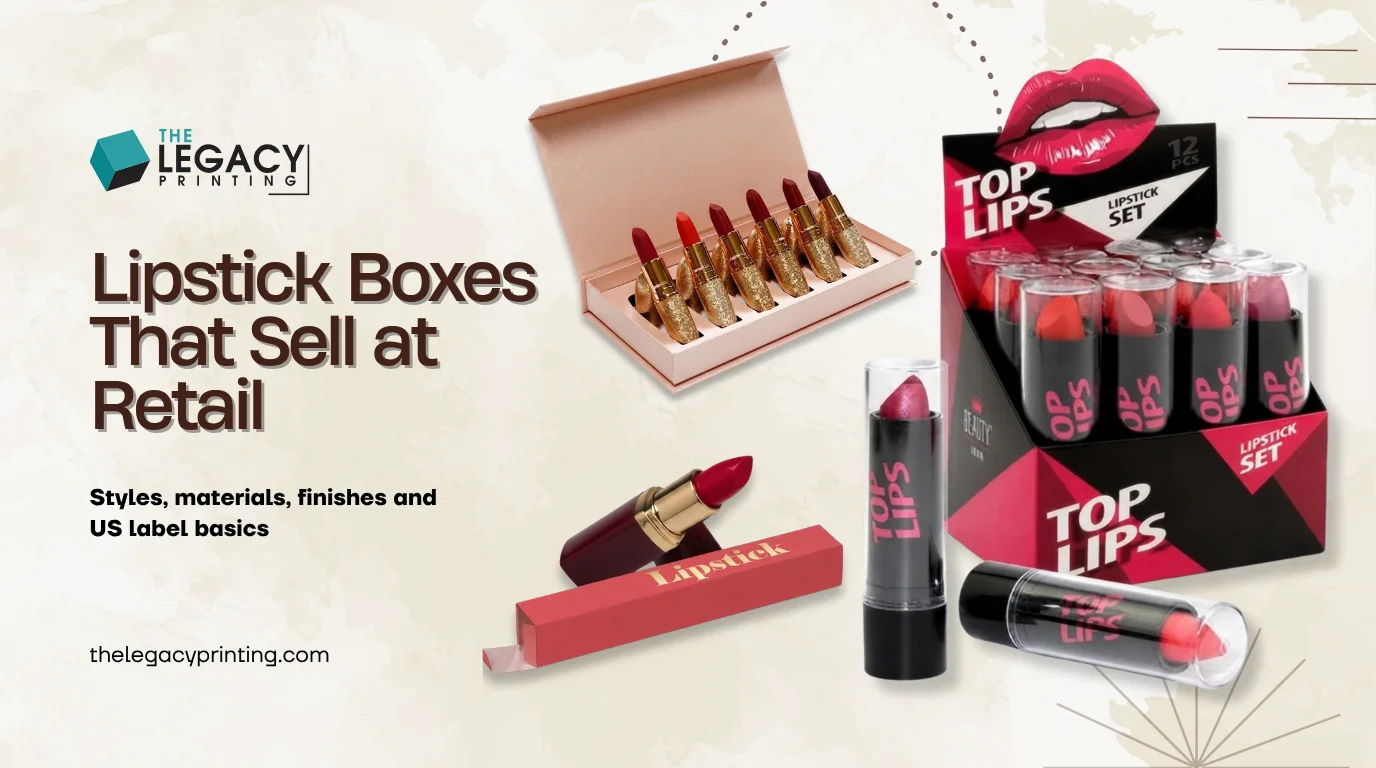
How to Package Lipstick for Retail Sale: The Short Answer
To package lipstick for retail sale, start with where it will be sold. Then pick a box style that works in that spot. Measure your tube, choose a snug carton (add an insert if it moves), and pick finishes that match your brand. Print the label details US rules ask for, check a 3D proof, and test a small run before you order big.
Your lipstick box is often the first thing a shopper picks up. It has to show the shade, carry the legal text, and protect a soft product that can dent, scuff or melt. That's a lot of work for a small box! The good news is that it comes down to a few clear choices. If you already know you want a printed carton, take a look at our custom cosmetic boxes for lipstick, lip gloss and lip balm.
| Decision | A good place to start | Why it works |
|---|---|---|
| Box for store shelves | Straight or reverse tuck end carton | Simple, light and easy to stack |
| Box for gifts or luxury lines | Two-piece rigid or magnetic box | Feels solid and premium in the hand |
| Material | Paperboard, or kraft for a natural look | Prints well and folds flat to save space |
| Showing the shade | Window cutout or a printed color band | Shoppers find their color fast |
| Printing for a first run | Digital printing | No plates, so small quantities make sense |
| Label basics | Name and net quantity on the front; ingredients and contact on the side or back | Follows the usual US cosmetic label layout |
| Checking before print | 3D rendering plus a sample kit | You see the design and feel the stock first |
Start With Where It Will Be Sold
The sales channel decides most of your choices. A box that looks great online can fail on a peg wall, so picture the real spot first.
- Drugstore or boutique peg wall: a carton with a hang tab, which is a small hole or flap that lets the box hang on a store hook.
- Department store, salon or checkout counter: a display box that holds several lipsticks upright so shoppers can grab one.
- Shopify or Etsy shop: a printed inner carton packed inside a sturdier mailer box for shipping.
- Gift sets and PR kits: a rigid or magnetic box with an insert that holds several shades.
Step 1: Measure Your Tube and Pick a Fit
Measure Height, Width, Cap and Base
Measure the tube with the cap on. Note the full height, the widest point (often the base or the cap), and the depth. Measure a few tubes, not just one, because parts from a supplier can vary a little. Lipstick formats differ too. A bullet lipstick is short and round, a liquid lipstick tube is usually taller and thinner, and a lip crayon is shaped like a pencil.
Please don't copy box sizes from another brand's listing. There's no official standard lipstick box size, so your own tube is the only measurement that counts.
Why a Snug Fit and Insert Matter
A box that's too loose lets the tube rattle, which feels cheap and can scratch the case. A box that's too tight scuffs the print when people pull the tube out. An insert is a piece inside the box that holds the tube in place. It's very helpful for gift sets and for tubes with an odd shape.
Check the Fit With a Free 3D Rendering
A 3D rendering is a computer picture of your finished box. We make one for free before production, so you can see the size, layout and artwork together. If something looks off, you fix it on screen instead of on a pallet of printed boxes.
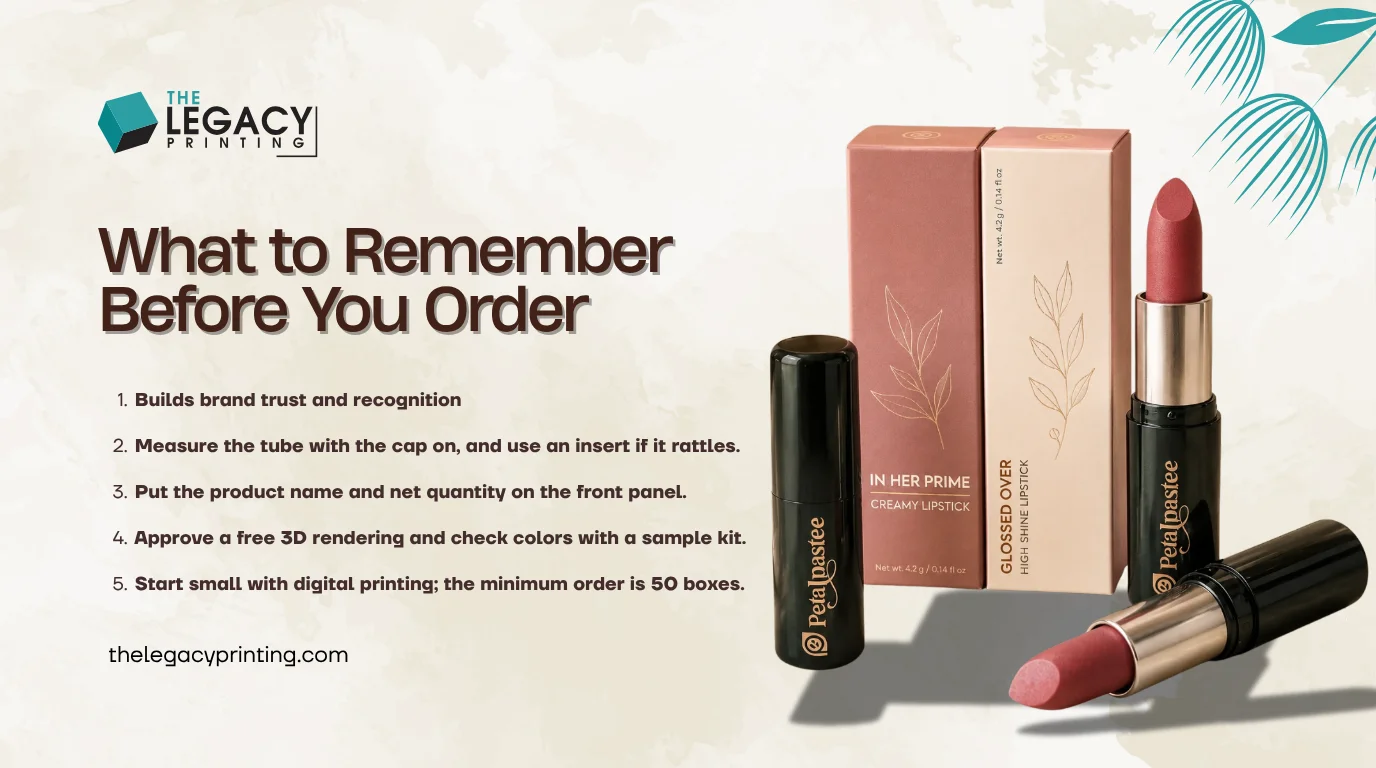
What to Remember Before You Order
Step 2: Choose a Lipstick Box Style
Tuck End (Straight and Reverse)
A straight tuck end box has both flaps tucking in on the same side. A reverse tuck end box has flaps that tuck in on opposite sides, so the top and bottom open from opposite ends. Both are the classic lipstick carton. They're light, they ship flat, and they work for most shelf sales.
Auto Bottom and Seal End
An auto bottom (also called a snap-lock bottom) snaps into place when you open the box. It's quick to set up and holds heavier items well. A seal end box is glued shut at the ends. It's sturdy and often used for large runs. Ask us which closure suits your tube and your packing process.
Sleeve, Drawer and Two-Piece Rigid
A sleeve box is a paper sleeve that slides over a tray or inner box. A drawer box works the same way, with a tray that slides out like a drawer. A two-piece rigid box has a thick, firm lid and base that fit together. These styles add a little ceremony to the unboxing, which shoppers often remember.
Magnetic and Display Boxes
A magnetic closure box has a lid held shut by hidden magnets. It's a strong pick for collections and PR kits. A display box (or counter display) holds several lipsticks upright on a shelf or counter, so the box itself becomes a small sales stand.
Window and Hang Tab Options
A die-cut window is a hole in the box, often covered with clear film, so shoppers can see the lipstick. It works best when the tube or bullet shows the true shade. A hang tab lets the box hang on store pegs, which is common in drugstores and big chain stores.
Decision Table: Channel, Style, Material and Feel
| Where it sells | Box style | Material | Finish and feel | Where to start |
|---|---|---|---|---|
| Drugstore or chain store peg wall | Tuck end with hang tab | Paperboard | Gloss or matte, clear shade label | Retail boxes |
| Salon or department store counter | Display box plus single cartons | Paperboard | Spot UV logo, bold front panel | Cosmetic boxes |
| Natural or clean beauty boutique | Tuck end or sleeve | Kraft or recycled cardboard | Simple print, earthy look | Eco-friendly boxes |
| Online shop | Inner carton inside a mailer | Paperboard inside, corrugated outside | Printed inside for unboxing | Cosmetic boxes |
| Gift set or PR kit | Two-piece rigid or magnetic | Rigid board with insert | Foil, embossing, soft feel | Gift boxes |
Step 3: Pick the Material
Paperboard and Cardboard
Paperboard (also called cardstock) is thin, firm paper used for folding boxes. Its thickness is shown in "pt," or points. A higher number means a thicker board. Most single lipstick cartons use paperboard because it prints sharply, folds cleanly and ships flat.
Kraft and Recycled Cardboard (No Extra Premium)
Kraft paper is natural brown paper that's often recycled. It gives an earthy, handmade look that fits clean beauty and vegan brands. At The Legacy Printing, kraft and recycled cardboard are available with no extra premium. So going green doesn't have to raise your box cost.
Rigid Board for Premium Sets
Rigid board (often called grey board) is thick, hard board wrapped in printed paper. It doesn't fold flat, so it takes more space to store and ship. Still, for a holiday collection or influencer kit, that solid feel is worth it. Our article on folding cartons vs. rigid boxes compares the two in more detail.
Corrugated Board for Bundles and Shipping
Corrugated board is cardboard with a wavy layer inside. It's strong and handles bumps in transit. Use it for multi-packs, shipping cases and outer mailers, not usually for the single carton on a shelf.
Step 4: Choose Print and Finishes
Digital vs Offset for Small and Large Runs
Digital printing needs no plate setup, so it suits low quantities. It's a smart way to test a new shade range. Offset printing uses plates and CMYK color, which means four inks (cyan, magenta, yellow and black) mixed to make most colors. It suits large runs once you know what sells. Read more in offset vs. digital printing for packaging.
Matte, Gloss and Soft-Touch
Matte coating looks calm and modern. Gloss coating makes colors pop under bright store lights. Soft-touch lamination is a coating that feels velvety, which many luxury brands like. Ask your rep which coatings fit your stock and style.
Spot UV, Foil and Emboss/Deboss
Spot UV is a shiny clear coat on only some parts of the box, such as the logo. Foil stamping presses thin metal-look film onto the box in gold, silver or holographic. Embossing pushes a design up from the surface, and debossing presses it down. One or two of these is usually plenty on a small lipstick box. More can look busy.
Match Your Brand Color With Pantone
Pantone (PMS) is a color-matching system that helps your brand color print the same every time. This matters a lot for lipstick, because a box color that doesn't match the product confuses shoppers. Our sample kits come in 1 color, 2 colors, 4 colors (CMYK) or custom Pantone, so you can check color on real stock before you approve.
Step 5: Put the Right Info on the Box (US Rules)
This section is general information, not legal advice. Rules change, so check the FDA's own pages or ask a regulatory expert before you print.
What Goes on the Front Panel and the Info Panel
The principal display panel (PDP) is the front of the box that shoppers see first. It carries the statement of identity, which is a plain label saying what the product is, such as "lipstick." It also carries the net quantity, meaning how much product is inside.
The information panel is the side or back. That's where the ingredient list, company name and place of business, and any warnings usually go. The FDA Cosmetic Labeling Guide explains each item. It also has special type-size rules for small or decorative containers and for products of 1/4 oz or less. Many lipsticks may fall into that group, so check the guide for your exact box.
Net Quantity Placement and Type Size
Normally, the net quantity must sit in the bottom 30% of the front panel, on a line parallel to the base. But that placement rule doesn't apply when the front panel is 5 square inches or less, which is common for small lipstick cartons. The minimum letter height depends on panel size, per 21 CFR 701.13 on net quantity:
| Front panel size | Minimum letter height |
|---|---|
| 5 sq in or less | 1/16 in |
| More than 5 up to 25 sq in | 1/8 in |
| More than 25 up to 100 sq in | 3/16 in |
| More than 100 sq in | 1/4 in |
The FDA says US customary units (such as ounces) are required and metric units may be added. Some other sources say both are required, so confirm in the FDA guide before you finalize the artwork.
Ingredient List
Cosmetics sold to consumers need an ingredient declaration. That's a list of everything in the product, from the most to the least. Most brands use INCI names, the standard international ingredient names used on labels. Leave enough room on the side panel, because ingredient lists for lipstick can get long.
The MoCRA Contact Line
MoCRA (the Modernization of Cosmetics Regulation Act) added a new label item. Cosmetic labels must now include a US address, US phone number or electronic contact, such as a website, for reports of bad reactions. According to the Congressional Research Service MoCRA overview, this has applied since December 29, 2024. Small businesses with low sales may skip facility registration and product listing, but that exemption doesn't cover the label contact rule. Check the FDA's site for the current details.
Words to Be Careful With
- "Hypoallergenic," "fragrance-free," "for sensitive skin": federal rules don't define these terms. Don't present them as if they're official.
- SPF or "protects from sun": a sun protection claim can make your product a drug in the FDA's eyes, with stricter labeling.
- Treatment claims: words like "heals" or "treats" can also push a cosmetic into drug rules.
Step 6: Plan Your Shades and Range
Shade Names, Numbers and Color Bands
Put the shade name and number where people look. That means the front panel and the top or end panel, since stacked boxes often show only one end. A printed color band or a window cutout helps shoppers and store staff find a shade in seconds.
Keep One Layout Across the Collection
Use the same logo spot, the same font and the same shade area on every box. Only the color and the name should change. A shelf of matching boxes looks planned, and it makes restocking easier for retailers.
Gift Sets and Multi-Packs
For three or four shades, a rigid or sleeve box with a shaped insert keeps each tube in place. Add a small story card about the collection if you like. It's a nice touch for holiday sales and influencer mailings.
Lip Balm Packaging: What Changes
Smaller Sizes and Multi-Packs
Lip balm tubes are usually smaller and lighter than lipstick. Many brands sell them in multi-packs, on hang cards, or in a counter display near the register. Pots and tins need a different insert shape than sticks, so measure each format on its own.
Hang Tab and Sleeve Ideas
A slim tuck end box with a hang tab works well on peg walls. A printed sleeve over a small tray is a low-cost way to bundle two or three flavors. And if your balm has SPF, check the FDA label rules first, because sun protection claims can change the product's category.
Eco-Friendly Kraft Option
Kraft boxes suit natural balms made with beeswax or plant oils. Since we offer kraft and recycled cardboard at no extra premium, it's an easy upgrade for a green brand.
Common Mistakes to Avoid
| Problem | Why it happens | Fix |
|---|---|---|
| Tube rattles in the box | Box sized without the cap or base | Measure with the cap on and add an insert |
| Text too small to read | Too much text on a tiny panel | Follow the FDA type-size rules and cut extra copy |
| Missing contact line | Old artwork made before MoCRA | Add a US address, phone or website |
| Box color doesn't match the shade | Screen colors differ from print | Use Pantone and check a sample kit |
| Shade name hidden on the side | Design made for one view only | Repeat the shade on the front and end panel |
| Thousands of boxes left over | Big offset order before testing | Start with a small digital run |
A few more tips help prevent trouble later:
- Plan for heat. Lipstick can soften in hot trucks or warehouses. Use a snug box and give retailers simple storage notes.
- Never skip the proof. Read every word on the 3D rendering, including shade names and the net quantity.
- Order a sample kit early. Feeling the stock and finish in your hand beats guessing from a screen.
How Ordering Works at The Legacy Printing
Every custom box starts as a dieline. That's a flat drawing of the box with cut and fold lines, and your artwork gets placed on it. You don't have to make one yourself. Our team prepares print-ready artwork for free. Here's the full process in four steps:
- Choose your style and size. Tell us the box style and your tube measurements. Not sure? We'll help you pick a structure and material.
- Send artwork or get it designed free. Our design team builds the print-ready file on the dieline.
- Approve your 3D rendering. You see the finished box on screen before anything is printed.
- Get free shipping. We ship free to any address in the USA, with no hidden freight costs.
A few facts that matter for new brands:
- The minimum order is 50 boxes, so you can test a single shade without a big bet.
- There are no die or plate charges.
- Production takes 8–12 working days after design approval.
- All boxes are made in-house in Anaheim, California, with no subcontracting.
- Your first order gets 20% off.
- We're rated 4.9/5 from 1,159+ orders and reviews, and we're a BBB accredited business.
Frequently Asked Questions
What is the minimum order for custom lipstick boxes?
Our minimum order is 50 boxes. That makes it practical to test a new shade, a seasonal color or a small boutique order before you commit to larger runs. Since there are no die or plate charges, a small order doesn't come with extra setup fees.
Can I see my box design before printing?
Yes! We send a free 3D digital rendering before production starts. You can check the layout, shade names, label text and colors on screen, and ask for changes. Production only begins after you approve it.
Are eco-friendly lipstick boxes more expensive?
Not with us. Kraft paper and recycled cardboard are available in almost every category with no extra premium. Your final quote still depends on size, quantity and finishes, but choosing kraft on its own doesn't add a green surcharge.
Do you charge for dies or printing plates?
No. We don't charge die or plate fees on custom boxes. That's a big help for lipstick brands that need several shade versions of the same box.
Can I order a sample first?
Yes, you can request a free sample kit. We follow up on sample kit requests within 2 hours, and kits ship within days. You can choose 1 color, 2 colors, 4 colors (CMYK) or custom Pantone to check how your brand color prints.
What must be printed on a lipstick box in the US?
In general, the front panel needs the product identity and the net quantity. The side or back usually carries the ingredient list, company name and place of business, any warnings, and the MoCRA contact line. Small boxes have special rules, so check the FDA Cosmetic Labeling Guide before you print. This isn't legal advice.
Next Step: Get a Free Quote
A good lipstick box does three jobs at once. It protects the tube, shows off the shade and tells your brand story the moment someone picks it up. Start with your sales channel, measure your tube, pick a style and finish, and get the label right. Then check it all on a 3D proof.
When you're ready, explore our lipstick and cosmetic box options. For greener lines, see our kraft and recycled packaging, and for holiday sets, browse our custom gift boxes.
Get a free quote for your custom boxes. Minimum 50, free shipping in the USA. Call us at 800 719 2780 or email sales@thelegacyprinting.com. Our customer service team is available 24/7.