Under US rules, the ingredient list and the net quantity belong on the outer box of a cosmetic, not only on the jar. That makes your box part of your label. It's not just a pretty wrapper.
So the best packaging for cosmetics is a paper-based box that fits the container snugly, protects it, leaves room for required text and matches your price point. For most everyday products, that's a printed folding carton. For gift sets, perfume and hero products, a rigid box is often worth the extra cost.
Use the checklist below to plan your first custom cosmetic boxes or to fix old ones. It works for one lip balm or a full line.
What is the best packaging for cosmetics?
The best packaging for cosmetics protects your product, shows your brand clearly and fits your selling price. There's no single winner. A low-cost lip balm and a luxury perfume need very different boxes.
Short rule: protect, show, and fit your price
- Protect: The product doesn't move, scratch or break inside the box.
- Show: A shopper knows what it is and who made it in a couple of seconds.
- Fit your price: The box feels right for the price and doesn't eat your margin.
3 layers: inner container, outer box, shipping box
Cosmetic packaging usually has three layers. Each one does a different job.
- Primary packaging: the container that touches the product, like a jar, tube, dropper bottle or compact.
- Secondary (outer) packaging: the box around that container. Shoppers see it on the shelf or when they open an order.
- Shipping box: a corrugated box or mailer that protects everything in transit. Corrugated board is cardboard with a wavy layer inside for cushioning.
The checklists below cover the outer box and the shipping box. Still, the inner container shapes everything, because the box is built around it. Glass needs more support than a plastic tube, and a tall dropper bottle needs a different shape than a flat palette.
Folding carton vs rigid box: which is better for cosmetics?
For most cosmetics, pick a folding carton. It costs less, ships flat and prints beautifully. Choose a rigid box when the product is a gift, a premium item or something fragile like perfume.
A folding carton is a thin paperboard box that is cut, folded and glued. A rigid box (also called a set-up box) is made from thick, hard board called chipboard or greyboard. It arrives already built and doesn't fold flat.
| Point | Folding carton | Rigid box |
|---|---|---|
| How it's made | Thin paperboard, cut and folded | Thick board wrapped in printed paper |
| Shipping and storage | Ships flat, so it takes little space | Ships built, so it needs more storage room |
| Feel in the hand | Light and neat | Heavy, solid and gift-like |
| Protection | Good with an insert and a shipping box | Strong walls; still needs an outer box for mail |
| Cost per box | Usually lower | Usually higher |
| Recycling | Mostly paper, often easy to recycle | Mostly paper, but magnets, heavy foil or lamination can make it harder |
| Best for | Serums, creams, lipstick, mascara, nail polish | Perfume, gift sets, launch kits, premium palettes |
When a folding carton wins
Go with a folding carton if you sell lots of units, sell in stores, or price below the luxury range. Add spot UV or foil and it can look very high-end. Plenty of shoppers won't notice it's the "simple" option.
When a rigid box is worth it
Rigid boxes earn their cost when the box is part of the gift. For example: perfume, holiday sets, PR kits for influencers, or a hero product you want people to keep. A magnetic closure (a hidden magnet that shuts the lid) adds a satisfying snap.
Use both: everyday items vs gift sets
Our honest opinion: most small brands should use both. Put the everyday line in folding cartons and save rigid boxes for gift sets and a few hero products. You get a premium moment without paying rigid-box prices on every order. For more detail, read our guide to folding cartons vs rigid boxes.
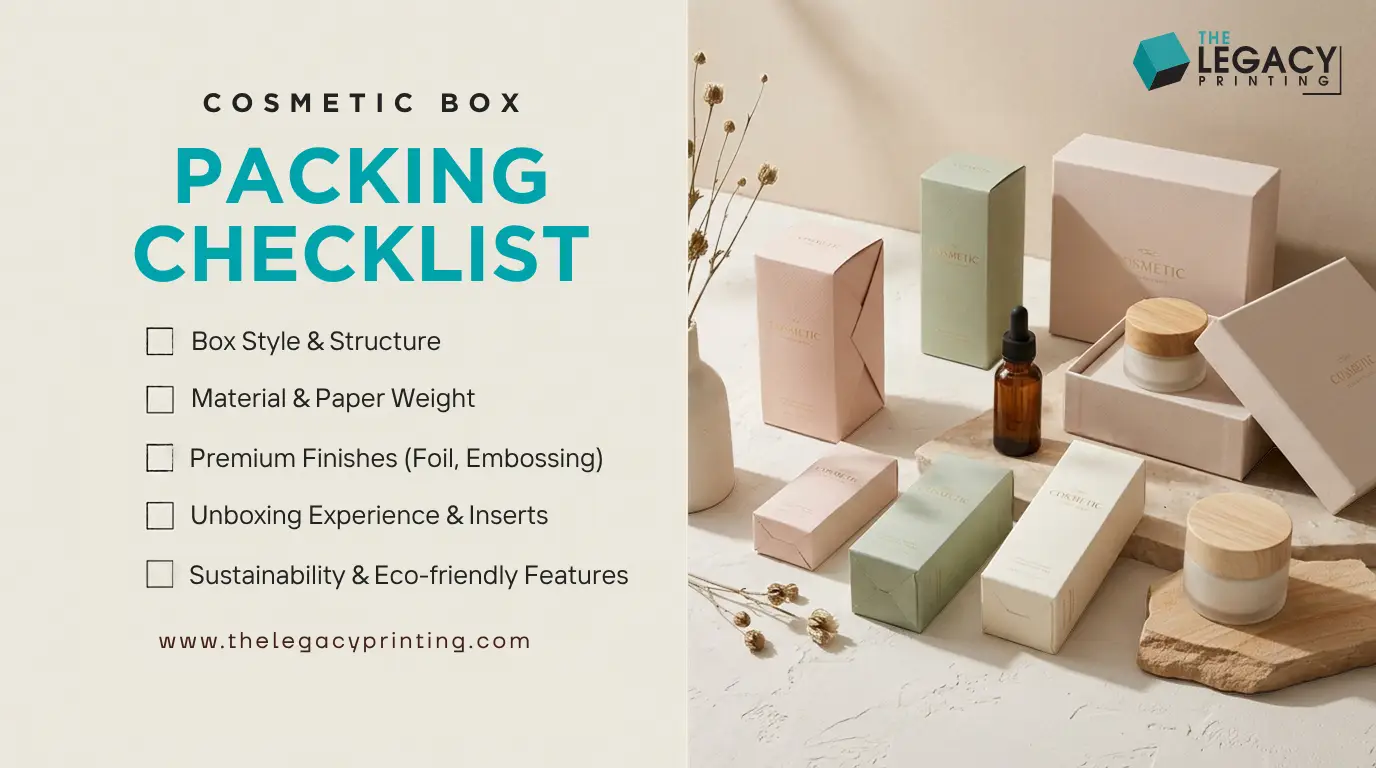
Cosmetic box checklist: what matters most
Best box by product type: quick decision table
Start with your product's shape and weight, then pick the box. Use this table as a starting point.
| Product | Box style | Material | Finish idea | Why it works |
|---|---|---|---|---|
| Serum or dropper bottle | Tuck end or reverse tuck end with insert | Smooth paperboard | Matte with a spot UV logo | The insert holds the glass bottle upright, so it doesn't rattle |
| Face cream jar | Tuck end, or sleeve over a tray | Paperboard; rigid board for premium | Soft-touch matte, foil | Jars are heavy for their size, so a snug fit matters |
| Scrub or bath product | Tuck end or window box | Kraft or recycled cardboard | Simple 1 or 2 color print | A natural look suits ingredient-led products |
| Lipstick, lip gloss, lip balm | Small tuck end or sleeve; display box for counters | Paperboard | Gloss, foil or holographic | Tiny boxes need bold color to stand out |
| Eyeshadow palette or foundation | Sleeve over tray, tuck end; rigid for premium palettes | Paperboard or rigid board | Embossing, foil | Flat palettes need a box that won't bend |
| Perfume | Rigid two-piece or magnetic box with insert | Rigid board | Foil, embossing, soft-touch | Glass bottles and gift buyers both call for extra protection and a strong first look |
| Nail polish | Tuck end; display box for counters | Paperboard | Gloss | Small glass bottles need a tight fit |
| Mascara or eyeliner | Slim reverse tuck end | Paperboard | Matte or gloss with foil | Long, thin shape that should sit neatly on a shelf |
| Eyelashes or hair extensions | Magnetic, drawer, window or custom shape | Paperboard or rigid board | Holographic, foil, die-cut window | Lashes weigh almost nothing, so the box carries the luxury feel |
| Gift set or subscription kit | Rigid magnetic box, or mailer box with insert | Rigid board or corrugated | Inside printing, foil | Several items need slots, and unboxing is the whole point |
Best box for skincare products
For serums, creams and scrubs, a tuck end folding carton with a paperboard insert is the safest all-round choice. It protects glass, prints well and leaves room for the ingredient list. Move up to a rigid box only for a premium set or a hero product.
Custom eyelash packaging
Eyelash box packaging is where brands get creative. Drawer boxes, magnetic boxes and window boxes are all popular. Some lash brands choose hexagon packaging, a six-sided box made with a custom die-cut (a shape cut by a special blade). A clear window and holographic foil let shoppers see the lash style and catch the light. If lashes are your main line, read our checklist for choosing an eyelash box manufacturer in the USA.
Stage 1 checklist: before you design the box
Get size, material and transport right first. Most packaging problems start here, long before printing.
Measure and plan the fit
- ☐ Measure the length, width and height of the real container, including the cap or pump.
- ☐ Add room for an insert if you plan to use one.
- ☐ Decide if the box sits on a shelf, ships alone, or goes inside a mailer.
- ☐ Estimate how many units you'll sell in the first few months.
Not sure about sizing? Our guide on what size box you need for your product walks you through it. You can also send our team your container details, and we'll help you pick the size and structure.
Choose the material
- Paperboard: a thin, smooth, firm sheet (often called SBS) that prints sharp colors. It's the go-to for most folding cartons.
- Kraft paper: brown, strong paper with a natural look. It suits clean beauty, scrubs and soap-style products.
- Rigid board: thick, hard board for premium and gift boxes.
- Corrugated board: wavy-core cardboard for mailers and shipping boxes.
One honest warning about kraft: the brown base makes printed colors look darker and warmer. A soft pink that looks fresh on screen can turn muddy on kraft, so ask for a sample before you commit. At The Legacy Printing, kraft paper and recycled cardboard are available in almost every category with no extra premium. See the options on our eco-friendly boxes page.
Plan sustainable choices you can explain
Pick greener options you can describe in one plain sentence. Two easy steps for a small brand: cut extra layers you don't need, and move outer boxes to kraft or recycled paperboard. If recycling matters to you, keep the box to one material where you can. A box made only of paper is simpler for buyers to recycle than one with magnets or plastic film glued in.
Stage 2 checklist: style, finish and inserts
Pick the style that suits how the box opens and where it's shown. Then add only the finishes that earn their cost. One strong finish usually beats three weak ones.
Cosmetic box styles
- Tuck end: a simple box with flaps that tuck in at the top and bottom. A reverse tuck end has the flaps on opposite sides. Both are low-cost, quick and shelf-friendly.
- Sleeve box: a paper sleeve that slides over a tray. Nice for palettes and small sets.
- Drawer box: a tray that slides out like a drawer. Popular for lashes.
- Magnetic box: a rigid box with a hidden magnet in the lid. Best for gifts and perfume.
- Window box: a die-cut window shows the product inside.
- Display box: an open-front box that holds many units on a counter.
- Mailer box: a corrugated box with a fold-in lid, built for online orders and subscription kits.
Finishes
- Matte lamination: a thin coating with low shine. Soft-touch versions feel smooth and velvety. Great for skincare.
- Gloss lamination: a shiny coating that makes colors pop. Great for lip and nail products.
- Spot UV: a shiny clear coat on chosen spots, such as your logo.
- Foil stamping: a thin gold, silver or holographic layer pressed onto the box.
- Embossing and debossing: raised or pressed-in shapes you can feel with your fingers.
Inserts and inside printing
- ☐ Add a paperboard insert for anything glass or anything that can slide.
- ☐ Print a short thank-you note or how-to-use steps inside the lid.
- ☐ On a small budget, try tissue paper, a sticker seal, a ribbon hang tag and a printed insert card.
What must be printed on a US cosmetic box?
The front of the box must show the product name, what it is or does, and an accurate net quantity. The ingredient list also has to appear on the outer box. Plan space for all of it before anyone starts the design.
Principal display panel and information panel
The principal display panel (PDP) is the panel shoppers see first. The FDA Cosmetics Labeling Guide treats the outer box or folding carton as the "package," and says the PDP is usually its front panel. The information panel is a side or back panel that holds other required text, such as the ingredient list.
Net quantity of contents means how much is inside, shown by weight, measure or count. According to the FDA summary of cosmetics labeling requirements, ingredient labeling and net quantity on the PDP apply to the outer container. The FDA also calls a cosmetic "misbranded" if its labeling is false or misleading, misses required info, or its container is made or filled in a deceptive way. For example, a huge box around a tiny jar could raise that last concern.
Leave space on the dieline
A dieline is a flat map of your box that shows where it gets cut and folded. Your artwork sits on top of it. Mark the PDP and information panel on the dieline first, then design around them. Our free design team prepares print-ready artwork and a 3D rendering before printing, so you can check every panel.
MoCRA labeling info: check current rules
MoCRA is a 2022 US law on cosmetics. The Congressional Research Service overview of MoCRA says it requires facility registration, product listing, safety records, adverse event reporting and certain labeling info. Fragrance allergen labeling is set to follow in future FDA rules. Your brand is responsible for its own label. We make boxes, not legal calls, so confirm current rules with a regulatory expert before you print.
Cosmetic packaging for small business: budget and order size
You can start small. With digital printing and a low minimum order, a new beauty brand can get custom boxes without buying thousands up front.
Digital vs offset printing
Digital printing needs no plate setup, so it suits short runs and test launches. Offset printing suits large runs and uses CMYK, a mix of four inks that builds full color. For a brand color that must match every time, ask about Pantone, a single pre-mixed ink.
Starting at 50 boxes
Our minimum order quantity is as low as 50 pieces. There are no die and plate charges, design support is free, and shipping is free to any address in the USA. That's the same deal for a lash brand in Indiana or a skincare shop in Los Angeles. New customers also save 20% on their first purchase!
Sample kit before bulk
Order a sample kit before a big run. Kits come in 1 color, 2 colors, 4 colors (CMYK) or custom Pantone options. We follow up on sample kit requests within 2 hours, and kits ship within days. You'll also approve a digital 3D rendering before production starts.
Pre-print check table: what to check, why, red flag
Go through this table before you approve any proof. Each red flag is cheap to fix now and costly to fix after printing.
| What to check | Why it matters | Red flag |
|---|---|---|
| Container size | A loose box rattles; a tight box crushes caps | You guessed the size or skipped the pump or cap |
| Insert | Stops glass from moving and breaking | The sample product slides when you shake it |
| Label space | Ingredients and net quantity go on the outer box | Artwork fills every panel with no room for text |
| Text size | Shoppers and inspectors must be able to read it | Ingredient list is tiny or printed on a busy pattern |
| Colors | Screens and paper show color differently | Brand color only checked on a monitor, or printed on kraft untested |
| Finish vs price | Finishes add cost per box | Foil, embossing and spot UV all on a low-price lip balm |
| Box type vs volume | Rigid boxes cost more and take more storage | Rigid boxes for a high-volume, low-price item |
| Shipping plan | Retail boxes alone aren't built for parcel networks | A rigid box mailed with no outer box arrives dented |
| Eco claims | Vague green claims can mislead buyers | "Eco-friendly" printed with no detail to back it up |
| 3D rendering | Last chance to catch errors before print | Approved in a rush without reading every panel |
A note on honest green claims
Be careful with words like "recyclable" and "recycled." The FTC Green Guides summary says to qualify a "recyclable" claim if recycling facilities aren't available to at least 60 percent of the consumers or communities where you sell. If only part of the box is recycled, say how much, for example "Made from 30% recycled material." Recycled content should only count material recovered from the waste stream. Print "made with recycled kraft" only if it's true for your exact box.
Frequently Asked Questions
What is the best box for skincare products?
A tuck end folding carton with a paperboard insert works best for most skincare products. It protects glass bottles and jars, prints well and costs less than a rigid box. Save rigid boxes for premium sets.
What material is best for cosmetic boxes?
Smooth paperboard suits most cosmetic boxes because it gives sharp color and fine detail. Choose kraft for a natural look, rigid board for luxury and corrugated board for shipping.
Is kraft packaging good for cosmetic brands?
Yes, kraft works well for natural, clean or handmade beauty brands. It looks earthy and simple. Colors print darker on brown kraft, though, so test your brand colors with a sample first.
What size box do I need for my cosmetic product?
Size the box to the container's length, width and height, plus room for any insert. Measure the real container, including the cap or pump. Our team can help you pick the size and structure.
Do cosmetics need an outer box at all?
Not every cosmetic is sold in a box. If you use one, FDA labeling rules treat it as the package, so the ingredient list and net quantity must appear on it. Plan that label space from the start.
Can I order a small number of custom cosmetic boxes?
Yes. Our minimum order is as low as 50 pieces, with no die and plate charges. Digital printing makes short runs practical for test launches and new product lines.
Get a free quote for your cosmetic boxes
Tell us what you're selling, how many units you need and how you'll ship them. We'll suggest the right box style, material and finish, then show you a free 3D rendering before anything goes to print. Request a free quote or a sample kit today, call 800 719 2780, or email sales@thelegacyprinting.com. Your box is the first thing your customer touches, so let's make it count!