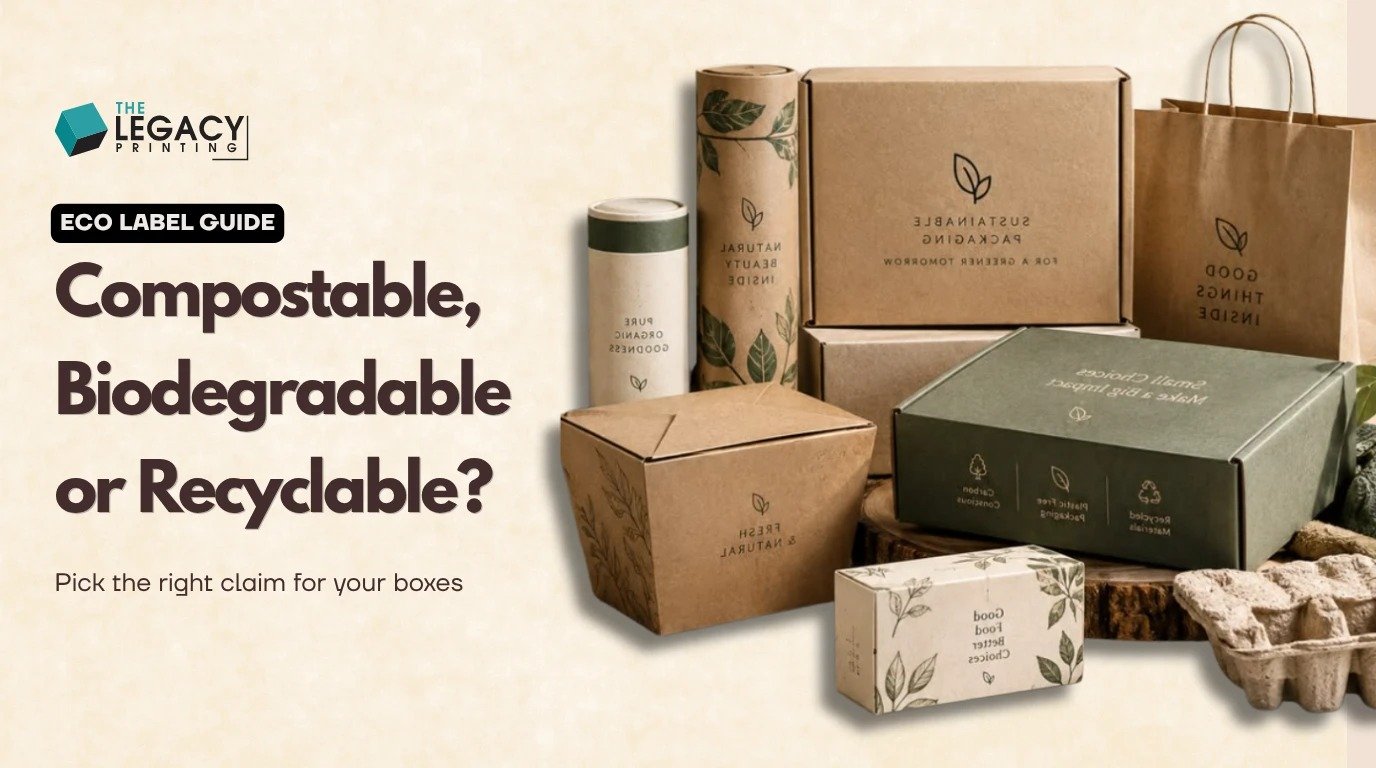
Compostable means a box has been tested to turn into safe compost, usually at a compost facility. Biodegradable only means it will break down someday, with no set time and no required test. Recyclable means it can be made into new products, but only if a local program collects and processes it. That's the real difference in compostable vs biodegradable vs recyclable packaging. For most custom shipping and retail boxes, plain kraft or recycled cardboard with an honest recyclable label is the simplest choice.
These words matter more than they used to. The Federal Trade Commission (FTC) has guidance on green claims, and a California law now limits the recycling symbol on packaging. So it pays to choose the right words before your first print run. If you already know you want kraft or recycled board, take a look at our eco-friendly custom boxes while you read.
Compostable vs biodegradable vs recyclable packaging: the quick answer
Here's how the three claims compare at a glance.
| Claim | What it means | Where it ends up | Proof you need | Fits most paper boxes? |
|---|---|---|---|---|
| Compostable | Tested to become safe, soil-like compost | A compost facility, or a backyard pile if certified "home compostable" | A certification or reliable test data | Sometimes, with testing and a certificate |
| Biodegradable | Breaks down someday | Anywhere, with no set time | Hard to prove for normal trash disposal | Rarely worth printing |
| Recyclable | Can be made into new products | A local recycling program | Enough people must have access to recycling for it | Usually, if uncoated and clean |
Compostable
A compostable item passes a test that shows it turns into usable compost. The catch is location. Most compostable items need the heat of an industrial (commercial) compost facility, which is a large site that breaks things down much faster than a backyard pile.
Biodegradable
Biodegradable means tiny living things like bacteria can break the item down over time. But the word has no set timeline and no required test on its own. A leaf and a plastic bag could both be called "biodegradable" if you wait long enough.
Recyclable
Recyclable means the material can be collected, sorted and made into something new. A box is only truly recyclable for your customer if their local program accepts it. That's why "recyclable in theory" and "recyclable in your town" aren't always the same thing.
One more rule worth remembering: all compostable items are biodegradable, but most biodegradable items are not compostable.
How each path works after your customer throws the box away
It helps to picture the three places a box can go. Each one works in a different way.
The recycling bin. A truck takes the box to a sorting facility. Paper and cardboard get pressed into bales and sent to a paper mill. The mill mixes the paper with water to make pulp, which is a wet mash of fibers. Screens pull out tape, staples and plastic. The clean fibers become new paperboard. Used corrugated boxes even have their own trade name, OCC (old corrugated containers), and they're one of the most widely recycled paper types.
The compost pile. At an industrial facility, heat, moisture and microbes break the material down into compost. A home pile is cooler and slower. That's why "home compostable" needs its own separate certification.
The trash can. Most trash goes to a landfill. Landfills are packed tight with little air, so things break down very slowly. Some materials can also give off methane, a greenhouse gas, as they rot. A compostable box in a landfill won't get the conditions it was designed for.
The weak spot in all three paths is contamination. That means the wrong item in a bin spoils a batch. A greasy box or a plastic-coated cup can lower the quality of a whole load of recycling or compost.
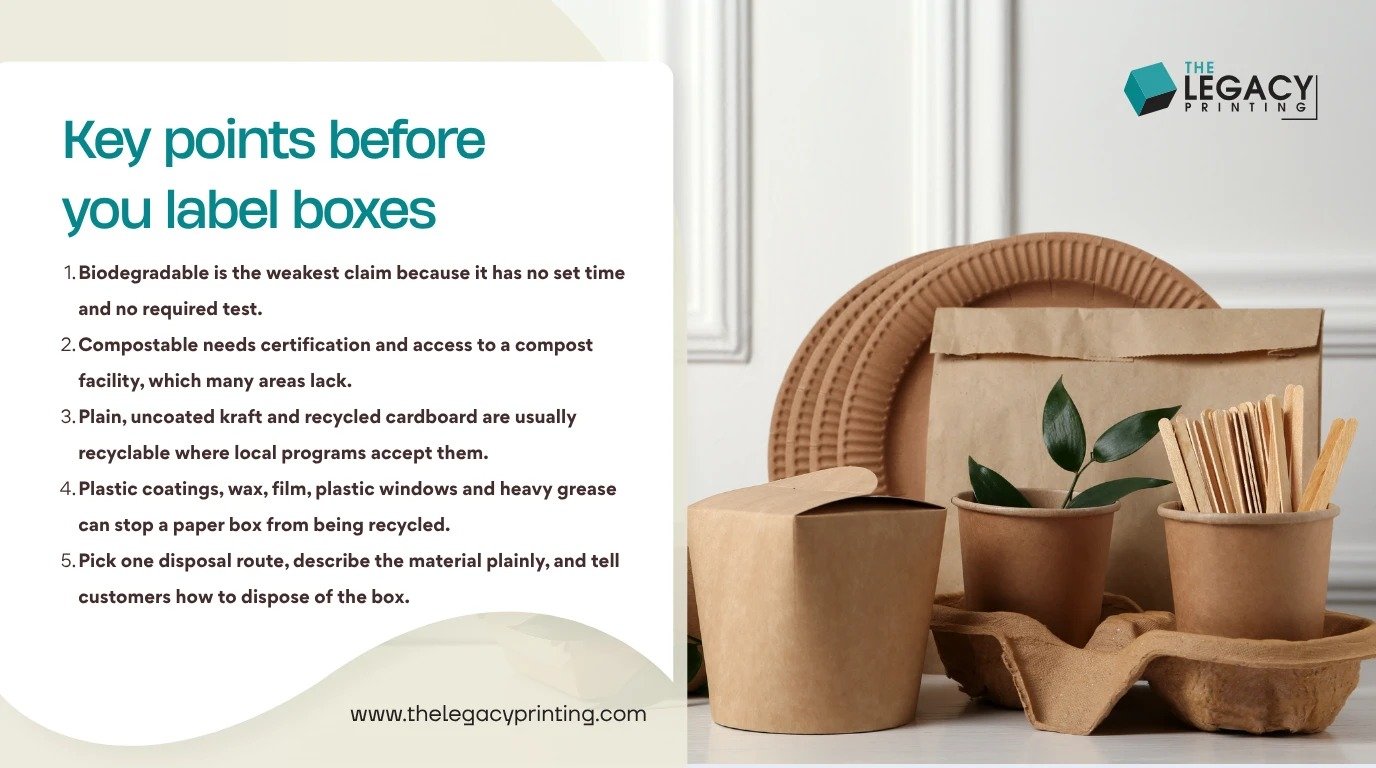
Key points before you label boxes
Why "biodegradable" is the weakest claim
No set time, no required test
"Biodegradable" sounds green, but the word alone tells your customer very little. It doesn't say how long the box takes to break down or where. For a paper box, it adds almost nothing a shopper can act on.
What the FTC says
The FTC's Green Guides are US government advice on honest eco claims in ads and on packages. According to a law firm summary of the Green Guides, an unqualified "biodegradable" claim on solid waste is deceptive unless the item fully breaks down within one year of normal disposal. Items that go to landfills, incinerators or recycling usually can't meet that bar.
In plain words, printing "biodegradable" on a box that will end up in a recycling bin or a landfill is risky. We'd skip it.
Watch out for "oxo-degradable"
Oxo-degradable plastic has additives that make it crumble into tiny pieces. Those pieces don't fully disappear. They become small bits of plastic in soil and water. If a supplier pitches it as "eco," treat that as a red flag for greenwashing, which means making a product sound greener than it really is.
Compostable: home vs industrial
Certifications to know: BPI, ASTM and OK Compost
The Biodegradable Products Institute (BPI) is a North American non-profit. It checks products and lets them use a "compostable" mark. BPI-certified products meet one of two US test standards:
- ASTM D6400: mainly for compostable plastics.
- ASTM D6868: for paper or fiber items with a plastic coating.
Certified products are tested to break down in a managed compost facility. They must also show the BPI mark and meet BPI limits on fluorine, which screens for PFAS. PFAS are "forever chemicals" sometimes used in grease-proof coatings. In Europe, the matching standard is EN 13432, and TÜV Austria's "OK Compost" is a well-known certification mark.
What the FTC expects from a compostable claim
The FTC Green Guides summary says a "compostable" claim needs reliable scientific evidence. All the materials must break down into usable compost, safely, and in about the same time as the other items in the pile. You should also qualify the claim in two cases. One is when the item can't be composted safely or quickly at home. The other is when compost facilities aren't available to a substantial majority of people where you sell.
Why access limits compostable packaging
Many US areas don't have a compost facility that takes packaging. So a certified compostable box may still end up in the trash. That's an honest limit, and it's why we rarely suggest compostable as the main route for shipping or retail boxes.
Can a compostable box be recycled too?
Usually, no. Compostable plastics and coatings can contaminate paper or plastic recycling. In general, pick one route for a package and label that route clearly.
Recyclable: in theory vs in your town
The FTC's 60% guideline
The same law firm summary of the Green Guides says to qualify a "recyclable" claim when recycling facilities aren't available to at least 60% of the consumers or communities where you sell. Plain cardboard is widely collected. Mixed or coated materials often aren't. When in doubt, add a plain note such as "check local recycling."
California SB 343 and the October 4, 2026 date
California's SB 343, often called the "Truth in Recycling" law, limits the chasing arrows symbol and the word "recyclable." The chasing arrows are the three-arrow triangle most people read as "recycle me." Per this California SB 343 overview, items made on or after October 4, 2026 can't show the symbol or a recyclability statement unless they meet strict rules.
- The 60/60 rule: the material must be collected by programs serving at least 60% of Californians and sorted by facilities serving at least 60%.
- The other path: a proven recycling rate of at least 75%.
CalRecycle, the state's recycling agency, published the data used to decide which materials count. A federal lawsuit against the law was pending as of the April 2026 alert.
This matters even if your shop isn't in California. If you ship orders there, your boxes may be covered. California also has AB 1201, a law on "compostable" labels. It's cited as requiring ASTM D6400 or D6868 testing. This article isn't legal advice, so check with a lawyer before a large launch.
Is kraft paper packaging recyclable?
Plain kraft and recycled cardboard
Kraft paper is a strong brown paper made from wood pulp. Plain, uncoated kraft and recycled cardboard are generally accepted in paper recycling. Still, local rules decide what really gets recovered. That's why "recyclable where facilities exist" is a safer phrase than a flat promise.
What can stop a kraft box from being recycled
Kraft paper can be coated with polyethylene (PE), a thin plastic layer, for water and grease resistance. That layer helps the product but can make recycling harder. Here's how common finishes and add-ons compare.
| Finish or add-on | What it does | Effect on paper recycling | Simple tip |
|---|---|---|---|
| Plain uncoated kraft | Natural brown look | Usually accepted | Best base for a recyclable claim |
| Embossing or debossing | Raised or pressed logo | Adds no extra layer | Great for eco designs |
| Matte, gloss or spot UV coating | Protects and highlights print | Depends on the coating type | |
| Film lamination | Shine and scuff protection | Can make recycling harder | Skip it if you want a recyclable label |
| PE coating or wax | Water and grease resistance | Often a problem | Use only where the product truly needs it |
| Foil stamping or metalized board | Gold, silver or holographic shine | Large foil areas can cause trouble | Keep foil to small accents |
| Plastic window | Shows the product | Plastic must be removed or screened out | Tell customers to pop the window out |
| Heavy grease or food residue | Comes from the product, not the box | Can spoil a recycling batch | Use a liner or insert customers can remove |
Kraft isn't automatically compostable
Many websites say kraft is "recyclable, compostable and biodegradable" with no conditions. That's too simple. Plain paper may break down in compost, but inks, glues and coatings change the picture. Without testing and a certificate, don't print "compostable" on a kraft box.
Which claim fits which box?
This table matches common box types with the claim that's usually safest. Your exact build and coatings still decide the final wording.
| Box type | Common build | Safest claim | Watch out for |
|---|---|---|---|
| Mailer and shipping boxes | Kraft or corrugated board | Recyclable where facilities exist | Plastic tape, poly inserts |
| Cosmetic and retail boxes | Printed paperboard | Recyclable where facilities exist, if uncoated or lightly coated | Film lamination, large foil areas, plastic windows |
| Food and bakery boxes | Food-grade paperboard, sometimes coated | Describe the material and add a "remove liner" note | Grease, PE or wax coatings, food residue |
| Rigid and gift boxes | Thick rigid board wrapped in printed paper | Describe the materials; only claim recyclable if the build allows it | Magnets, ribbons, film wraps, foil |
| CBD and cannabis boxes | Paperboard, often with child-resistant parts | Describe the materials and follow your state's label rules | Plastic closure parts that need to be separated |
| Plain kraft eco boxes | Uncoated kraft or recycled board | Recyclable where facilities exist | Plastic tape, stickers and coated labels |
Shipping is where kraft shines. Our custom mailer boxes and corrugated boxes can be made in kraft or recycled board, which keeps the recyclable route simple. For shelf products, our cosmetic boxes can still look premium with embossing or a small foil accent instead of full lamination. For treats and baked goods, our food packaging uses FDA-approved, food-grade materials, and a removable liner can keep grease off the box itself.
How to label your boxes honestly, step by step
Good eco labels are short, specific and easy to follow. Here's a simple process you can use before you send artwork.
- Pick one disposal route. Decide if your box is meant for the recycling bin or the compost bin. Don't print both unless you have proof for both.
- Describe the material plainly. A line like "Made from kraft paperboard" is a fact, not a promise. Shoppers find it useful, and it's easy to back up.
- Add a qualifier when access is limited. Phrases like "Recyclable where facilities exist" or "Check local recycling" tell the truth about access.
- Tell people what to remove. If your box has a plastic window, an insert or a food liner, say so. For example: "Remove the window before recycling."
- Be careful with recycled content numbers. Only print a percentage if your supplier can confirm it.
- Check California rules if you sell there. Under SB 343, the chasing arrows and "recyclable" wording may not be allowed unless the material qualifies. If you're unsure, a plain material description is the safer choice.
- Skip vague words. "Green," "earth-friendly" and "biodegradable" on their own say very little and can draw attention for the wrong reasons.
Your label is part of the unboxing experience. A short, honest note on the inside flap shows customers you care, and it often does more for your brand than a big green leaf icon.
Eco-friendly packaging for small business: where we fit in
Choosing the right material is easier when someone can look at your product and your plans. That's where our team helps. We make boxes in-house in Anaheim, California, with no subcontracting, so we can talk you through structure, board and finish choices for your exact product.
Here's what you get when you order with us:
- Kraft and recycled cardboard at no extra premium in almost every box category.
- A low minimum of 50 boxes, so you can test an eco design before a big run.
- No die or plate charges, even on custom sizes and shapes.
- Free design support. Our team prepares print-ready artwork, including your eco label text.
- A free 3D digital proof before production, so you can check where your recycling note sits.
- Turnaround of 8–12 working days after design approval, plus free shipping to any address in the USA.
- A free sample kit so you can feel the kraft and recycled board yourself.
We can't certify a box as compostable for you, and we won't tell you a claim is legal in your state. What we can do is help you pick simple builds that make an honest recyclable label easier. Want to compare options? Browse our eco-friendly packaging range, or call us at 800 719 2780.
Frequently Asked Questions
Is biodegradable packaging the same as compostable packaging?
No. Compostable packaging is tested to turn into safe compost under set conditions. Biodegradable only means it breaks down at some point, with no set time. All compostable items are biodegradable, but most biodegradable items aren't compostable.
Are custom kraft boxes recyclable?
Plain, uncoated kraft is generally accepted in paper recycling. Coatings, film lamination, wax and plastic windows can make recycling harder. Local programs decide what's accepted, so "recyclable where facilities exist" is the safer label.
Can I put the recycling symbol on my boxes?
It depends on where you sell and what the box is made of. In California, SB 343 limits the chasing arrows on items made on or after October 4, 2026 unless the material qualifies. Check the current rules and talk to a lawyer before a large launch.
Are eco-friendly boxes more expensive?
Not with us. Kraft paper and recycled cardboard are available in almost every category with no extra premium. Your final price depends on size, quantity, printing and finishes, so a free quote is the best way to compare.
What is the minimum order for custom eco boxes?
Our minimum is 50 boxes. There are no die or plate charges, which helps small brands test a new eco design without a big upfront cost.
Can I see my box design before printing?
Yes. We send a free 3D digital rendering before production. You can check your artwork, eco label and disposal note before anything is printed.
Can I order a sample first?
Yes. You can request a free sample kit. We follow up on sample kit requests within 2 hours, and kits ship within days.
Ready to choose your eco-friendly boxes?
The simplest honest path for most brands is plain kraft or recycled board, light finishes, and a clear "recycle where facilities exist" note. Tell us about your product, and we'll help you pick a box style and material that fits it. New customers save 20% on their first purchase, too.
Get a free quote for your custom boxes — minimum 50, free shipping in the USA. Call 800 719 2780 or email sales@thelegacyprinting.com.