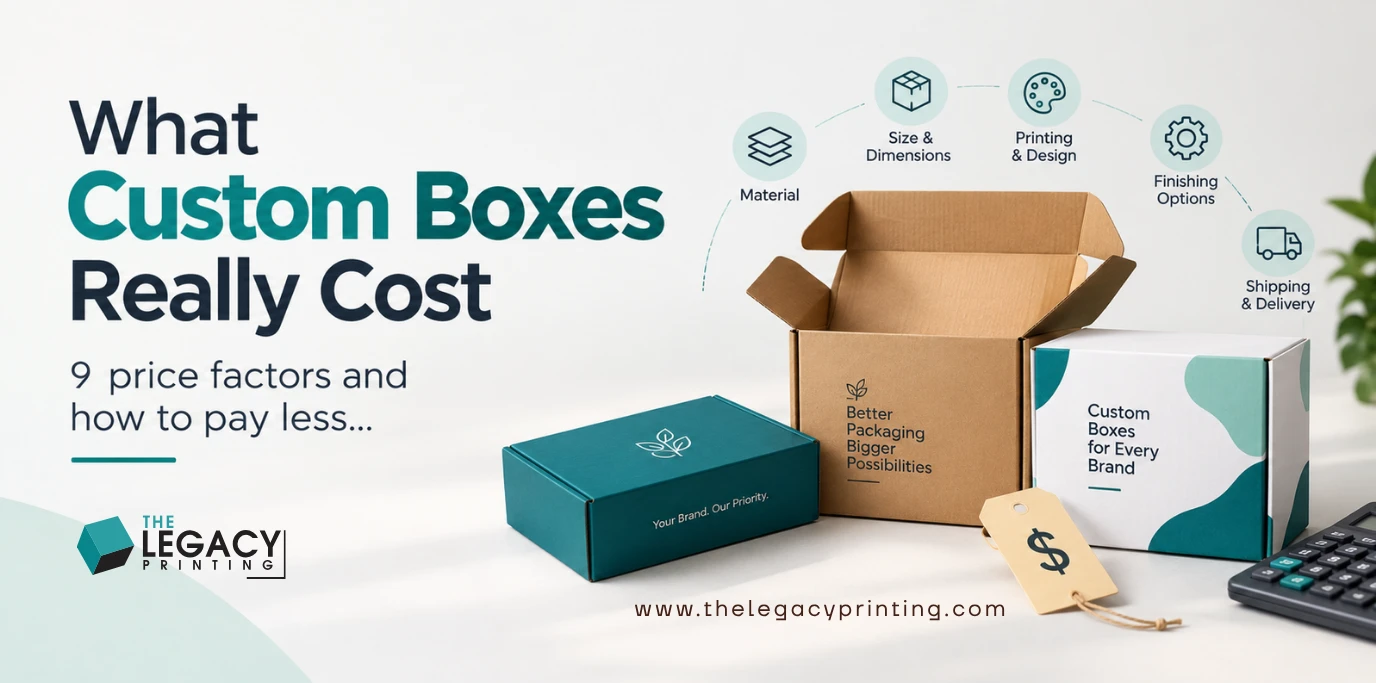
How much do custom boxes cost? It depends on the box you order. Your price comes from six things: quantity, size, style, material, print and finish. Change one, and the price changes. That's why no honest maker can give you one number for every box, and why online price ranges are all over the place.
The good news? You control most of these choices. Once you know what moves the price, you can ask for a sharper quote and skip extras that add cost but not value. Below are the 9 price factors, a box-type table, the truth about 100-box orders, and 7 myths that make people overpay.
How Much Do Custom Boxes Cost? The Short Answer
A custom box costs whatever its specs add up to. Order more, and each box gets cheaper. Simple styles, standard materials and fewer finishes keep the price down.
Why there's no single price per box
A small kraft tuck end box and a foil-stamped magnetic rigid box are both "custom boxes." But they use different board, different machines and very different amounts of hand work. Many pricing guides online list wide price ranges. Those numbers come from different vendors quoting different specs, so we don't find them useful for planning. The only number worth trusting is a quote built on your real product.
The cost per box formula
Use one simple formula to compare quotes fairly:
Cost per box = total order cost ÷ number of boxes
For example, say Quote A shows a lower per-box price but adds a setup fee and freight. Quote B includes everything. Add every fee to each total, then divide by the number of boxes. The lower headline price often loses once the extras are counted.
What a quote from The Legacy Printing includes
Some charges are common in this industry. They never show up on our quotes:
- No die and plate charges. A die is the metal cutter that shapes your box. Plates carry your design onto the press. Many makers bill both as one-time fees.
- Free graphic design support. Our team prepares print-ready artwork and the dieline. A dieline is a flat map of your box that shows where it gets cut and folded.
- Free digital 3D rendering before production, so you see your box before anything is printed.
- Free shipping to any address in the USA, with no hidden freight costs.
9 Custom Box Pricing Factors That Change Your Price
Nine things set your price. Quantity matters most. Size, style and material come next. Print, finishes, inserts and shipping make up the rest.
1. Order quantity
Before printing starts, someone sets up the press, the cutting tools and the colors. That setup work is about the same for 50 boxes or 5,000. On a big run, more boxes share it, so each box costs less. Our minimum order is as low as 50 pieces, so you can start small without filling a storeroom. Read more in our guide to starting with small order custom boxes from 50 pieces.
2. Box size and dimensions
A bigger box uses more board, more ink and more machine time. Even an extra half inch on each side adds up across a full run. Measure your product before you ask for a quote. Our guide to choosing the right box size walks you through it.
3. Box style and structure
A folding carton, like a tuck end box, is light paperboard that ships flat. It's usually the lowest-cost style. Mailer boxes cost more because they're built to travel through the mail on their own. Rigid and magnetic boxes are thick and don't fold flat. They take more material and more hand work, so they sit at the top of the price scale.
4. Material and board
Kraft paper is strong brown paper made from wood pulp. Cardboard here means light paperboard, like a cereal box. Corrugated board has a wavy middle layer between two flat sheets, which makes it tough enough for shipping. Rigid board is the thickest and most premium. As a rule, thicker board means a higher price.
5. Print method: digital vs offset
Digital printing prints straight from a computer file. It needs no plates, so it suits small orders. Offset printing uses plates and ink rollers. It costs less per box on big runs and prints full CMYK color. Say a brand orders custom digitally printed boxes in LA for a short test run. Digital keeps that first order affordable. Our short-run guide to digitally printed boxes in California explains when it fits.
6. Colors and ink coverage
CMYK means four inks (cyan, magenta, yellow and black) that mix to make full-color pictures. Pantone, also called PMS, is a numbered system for exact colors. Brands use it to match a logo color every time. One-color printing costs less than full color. Full ink on every side costs more than a single logo on a plain kraft box. Printing inside the box adds cost, too.
7. Finishes
Lamination is a thin protective coating. Matte lamination feels soft and flat, and gloss lamination is shiny. Spot UV is a shiny clear coat on just one part of the box, like the logo. Foil stamping presses a thin gold or silver film onto the box. Embossing raises a shape, and debossing presses it in, so customers can feel it.
Every finish adds a production step. Custom silver foil boxes look stunning on a shelf. But foil plus embossing plus spot UV on one box adds up fast.
8. Inserts, windows and add-ons
An insert is a piece inside the box that holds your product in place. Die-cut windows, ribbons and hang tags all add material and labor. They earn their cost when they protect the product or help it sell on a shelf. If they're only decoration, skip them on your first order.
9. Turnaround and shipping
Many makers charge more for rush orders, so plan ahead. Shipping comes in two parts, and it's easy to mix them up. We ship your boxes to you for free anywhere in the USA. Shipping your products to your customers is a separate cost that you pay, and box size has a big effect on that bill (see Myth 5 below).
Key Points Before You Ask for a Quote
Cost by Box Type: Quick Comparison Table
Folding cartons and kraft boxes usually cost the least. Mailers sit in the middle. Rigid and magnetic boxes cost the most. This table shows relative cost, not dollar prices.
| Box type | Relative cost | Best for |
|---|---|---|
| Tuck end folding carton | Lower | Cosmetics, soap, small retail items |
| Kraft box | Lower | Candles, bakery, natural and eco brands |
| Sleeve box | Lower to medium | Candles, chocolate, apparel accessories |
| Custom eyelash boxes | Lower to medium (small size, often with a window or foil) | Lash brands and beauty startups |
| Mailer box | Medium | Subscription boxes, e-commerce, clothing |
| Corrugated shipping box | Medium | Heavy or fragile products shipped by carrier |
| Rigid box | Higher | Jewelry, perfume, gift sets |
| Magnetic closure rigid box | Highest | Luxury gifts and premium launches |
Pick by product
- Bakery: window boxes let your treats sell themselves. Ask our team which materials suit your food.
- Cosmetics: lipstick and mascara boxes look sharp with a single spot UV logo. Browse our custom cosmetic boxes.
- Candles: sleeve or kraft boxes give a warm, natural look at a fair price.
- Apparel and retail: printed shelf boxes help your brand stand out. See our custom retail boxes.
- Subscription: mailers with inside print turn opening the box into a small reveal.
- CBD and cannabis: our packaging includes child-resistant closures and space for state-specific labels.
How Much Do 100 Custom Boxes Cost?
There's no fixed price for 100 custom boxes. It depends on your specs. One thing is certain: 100 boxes cost more per box than 500 or 1,000 of the same design.
Why small runs cost more per box
Setup takes the same work whether you print 100 boxes or 1,000. With 100 boxes, that work is split across fewer pieces. Because we charge no die and plate fees, your small order skips a common one-time cost that many makers add.
100 vs 500 vs 1,000: what changes
- 50 to 100 boxes: best for testing a design, a size or a new product line. Digital printing usually fits here.
- 500 boxes: the price per box drops. This works well once your size and artwork are proven.
- 1,000+ boxes: offset printing often becomes the better value, with full CMYK color.
Wholesale and bulk: when it makes sense
Custom boxes wholesale pricing pays off once you know a box works and your sales are steady. Before you order custom eyelash boxes wholesale, for example, test the box with your actual lash tray. Bulk only saves money if every box fits your product and you'll use them all.
7 Custom Box Pricing Myths (and the Truth)
Most overspending comes from a handful of common beliefs. Let's sort them out.
Myth 1: Custom boxes are only for big brands
The truth: You can order as few as 50 pieces from us. A small bakery or a new candle line can get branded packaging without buying thousands of boxes.
Myth 2: The lowest per-box price is the best deal
The truth: A low per-box price can hide die fees, plate fees, design fees and freight. If you're shopping for cheap custom eyelash boxes, ask every supplier one question. Are the die, plates, artwork and shipping included? Then run the cost per box formula on the full total.
Myth 3: Eco-friendly boxes always cost more
The truth: At The Legacy Printing, kraft paper and recycled cardboard are available in almost every category with no extra premium. Custom paper eyelash boxes, kraft candle boxes and recycled mailers can cost the same as standard board. See our eco-friendly boxes.
Be careful with the claims you print, though. The FTC Green Guides summary says to qualify a "recyclable" claim if recycling isn't available to at least 60 percent of the people or communities where you sell. Claims about partly recycled material should be qualified too, for example by stating the percentage.
Myth 4: More finishes make a box look more premium
The truth: One strong finish usually beats five. Custom eyelash boxes with a foil logo on clean matte board look high-end. They also cost far less than foil plus embossing plus spot UV plus a window. Pick the one finish your customer will notice first.
Myth 5: A bigger box is safer and only changes the box price
The truth: Oversized boxes can raise your own shipping costs. Carriers often charge by dimensional (DIM) weight. That's a price based on how much space a box takes up, not just how heavy it is.
The UPS dimensional weight guide shows the formula: length × width × height ÷ a divisor. The divisor is 139 for Daily Rates and 166 for Retail Rates. Any fraction rounds up to the next pound. A 12 × 12 × 12 in (30 × 30 × 30 cm) box at the 139 divisor works out to 1,728 ÷ 139 = 12.4. That rounds up to 13 pounds, even if the box weighs much less.
USPS Price List Notice 123 (effective October 4, 2026) says parcels over one cubic foot (1,728 cubic inches) are charged on actual or dimensional weight, whichever is greater. Parcels over 22 inches and up to 30 inches long add $4.50. Those over 30 inches add $21.00. Staying at or under one cubic foot helps with USPS. Rules change, so check current USPS rules before you lock in a box size.
Myth 6: Only rigid boxes look premium
The truth: A well-printed mailer or tuck end box with one smart finish can feel special. Rigid boxes are a great fit for jewelry, perfume and gift sets. For many other products, a mailer with inside print gives a memorable unboxing experience for less.
Myth 7: Digital printing looks cheap, and offset is always cheaper
The truth: Neither is a rule. Digital printing needs no plate setup and suits low quantities. Offset printing wins on cost per box for large runs. The right choice depends on how many boxes you need. Want to judge print quality yourself? Order a sample kit before you commit.
Myth vs fact at a glance
| Myth | Fact |
|---|---|
| Custom boxes need huge orders | Our minimum is as low as 50 pieces |
| Lowest per-box price wins | Compare full totals, including setup and shipping |
| Eco boxes cost more | Kraft and recycled cardboard cost no extra with us in almost every category |
| More finishes look better | One standout finish often looks cleaner |
| Bigger box is safer | Oversized boxes can cost more to ship by DIM weight |
| Only rigid looks premium | Mailers and cartons with good print can impress |
| Offset is always cheaper | Digital suits small runs; offset suits big runs |
What to do instead: a quick checklist
- Measure your product first, then right-size the box.
- Choose kraft or recycled cardboard where it fits your brand.
- Pick one standout finish for your first order.
- Start with 50 to 100 digitally printed boxes, then move to offset for big runs.
- Print inside the box only where customers see it when they open it.
- Compare quotes on the full total, not the headline price.
- Print only the eco claims you can prove.
How Can I Get an Accurate Custom Box Quote Fast?
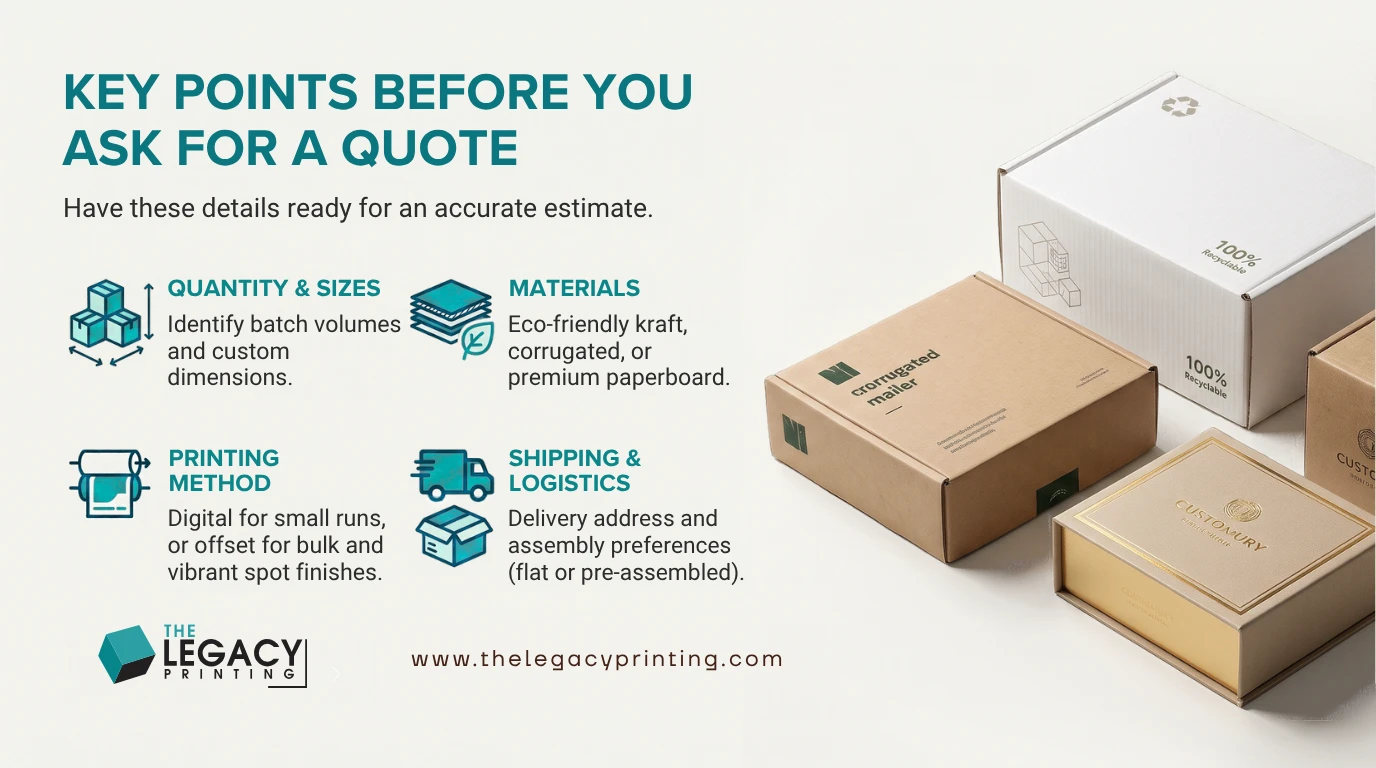
Send complete details the first time. A request with your size and quantity gets a far more accurate quote than "how much for boxes?"
Quote checklist
- Product size (length, width, height) and weight
- Box style (tuck end, mailer, rigid, sleeve and so on)
- Material (kraft, cardboard, corrugated, rigid board)
- Quantity, or a few quantities to compare
- Print colors: 1 color, CMYK or Pantone
- Inside printing: yes or no
- Finish (matte, gloss, spot UV, foil, embossing)
- Insert or window needs
- Delivery ZIP code and deadline
Sample kits
Want to feel the board and check the color before a bulk order? Request a sample kit. You can pick 1 color, 2 colors, 4 colors (CMYK) or custom Pantone. We follow up on sample kit requests within 2 hours, and kits ship within days.
Free 3D rendering before production
We send a digital 3D rendering of your box before printing. You approve the look and fit first. That way, size and artwork problems get caught while they're still free to fix.
Frequently Asked Questions
How much does a custom box cost?
It depends on your quantity, size, style, material, print and finish. Larger orders lower the price per box. Simple styles with one finish keep costs down. Send your specs for an exact quote.
What is the minimum order for custom boxes?
Our minimum order is as low as 50 pieces. That makes it easy to test a new product or design before you buy in bulk.
How do I lower my custom box cost?
Right-size the box, choose kraft or recycled cardboard, and stick to one finish. Use digital printing for small runs and offset printing for big ones. Ordering more boxes at once also lowers the price per box.
How much do custom shipping boxes cost?
Custom shipping boxes usually cost more than folding cartons because they use stronger corrugated board. Your final price depends on size, print and quantity. Oversized shipping boxes can also raise your carrier costs through dimensional weight.
How much do custom subscription (sub) boxes cost?
Most subscription boxes are mailers, which sit in the middle of the price range. Inside printing and inserts add cost. Ordering several months' worth at once brings the price per box down.
Are there die and plate fees?
No. The Legacy Printing charges no die and plate fees. Design support and shipping within the USA are free, too.
Can you print inside the box?
Yes, we can. It adds some cost, so use it where the customer sees it right away, like the inside lid of a mailer.
Next Step: Get a Free Quote
Ready to see what your box will really cost? Send us your product size, style and quantity, and we'll build a quote around your box. Not sure which style or material fits? Ask us. We'd rather help you choose right than sell you the wrong box. Your packaging is the first thing customers touch, so make it count!
- Minimum order as low as 50 boxes
- No die and plate charges
- Free design support and a free 3D rendering
- Free shipping anywhere in the USA
- Save 20% on your first purchase
Get a free quote and free design proof. Prefer to talk? Call 800 719 2780 or email sales@thelegacyprinting.com. Our customer service team is available 24/7.