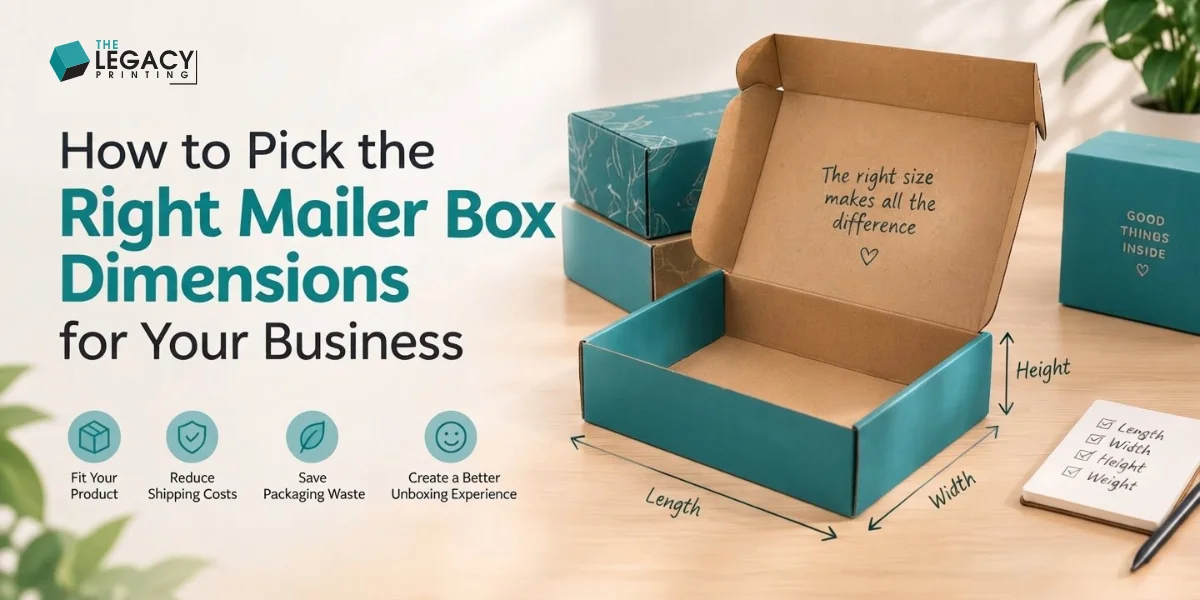
How to Pick the Right Mailer Box Dimensions for Your Business
It is already time to start preparing for the busy peak season and seasonal campaigns & holiday shipping. Nothing will be better than sending out memorable items or corporate gifts by mail. It is unnecessary to make your customers wander around stores looking for the best product when a properly designed package can reach them at their doorsteps.
The important question that may arise in the process of fulfillment is: how big should my mailer box be?
The fine art of balancing product safety, shipping costs & the experience of opening the box all comes down to one thing: picking the right size for the mailer boxes. Not only does using a bigger mailer box than necessary cost you extra in dimensional weight fees and void fill material; it also means that using a smaller box can result in damaged products and annoyed customers.
The Legacy Printing provides a solution to packaging confusion. Whether you choose from our stock list of sizes or work with us to engineer a custom-made package, accurate sizing is key. This comprehensive guide will cover how to measure mailer box dimensions, sizes, flute types & methods of optimizing your packing to reduce shipping expenses.
What Are Mailer Box Dimensions? Length, Width, and Height
In order to determine the correct mailer box for you, it is essential to understand how the packaging industry describes measurements. Mailer box dimensions are always described as internal usable space and are always in a precise, standard order:
Length (L)×Width (W)×Height (H)
Primary Internal Dimensions Diagram
The box drawing below represents the 3D illustration of the 3 interior dimensions:
- Length (L): Horizontal dimension at the base along the longest interior wall.
- Width (W): Side dimension that is measured perpendicular to the length on the interior floor.
- Height (H): Vertical dimension from the interior floor to the top lid.
Secondary Structural Features That Influence Fit
Primary internal dimensions may be obtained from a standard chart. However, the physical construction of the mailer box has some secondary factors that affect overall internal dimensions and must therefore be considered in order to avoid any fit problems:
- Rollover Sidewalls: Rollover types include the roll-end tuck top (RETT) and roll-end tuck front (RETF). These have a double layer of folded sidewalls which makes them strong but reduces internal width by about 1/8 – 1/4 inch.
- Front Lock Panels: Front tuck mailers have lock flaps that fold inside and therefore take up a very small portion of interior depth towards the front panel.
- Dust Flaps: These are small side flaps that fold inwards and under the main top flap. If the product rests flush with the upper edge of the box dust flaps may end up pressing the product when the box is closed.
Tools and Preparation of Irregular Features
Prior to taking any measurements, ensure that you have positioned your item on a flat surface and take all measurements using a caliper or a ruler with millimeter and fractional measurements to get the most accurate result possible. It is important to take the widest measurement of your product including the most irregular features, such as pumps, bottles, handles, sprayers, or caps to calculate the exact clearance needed in the mailer box.
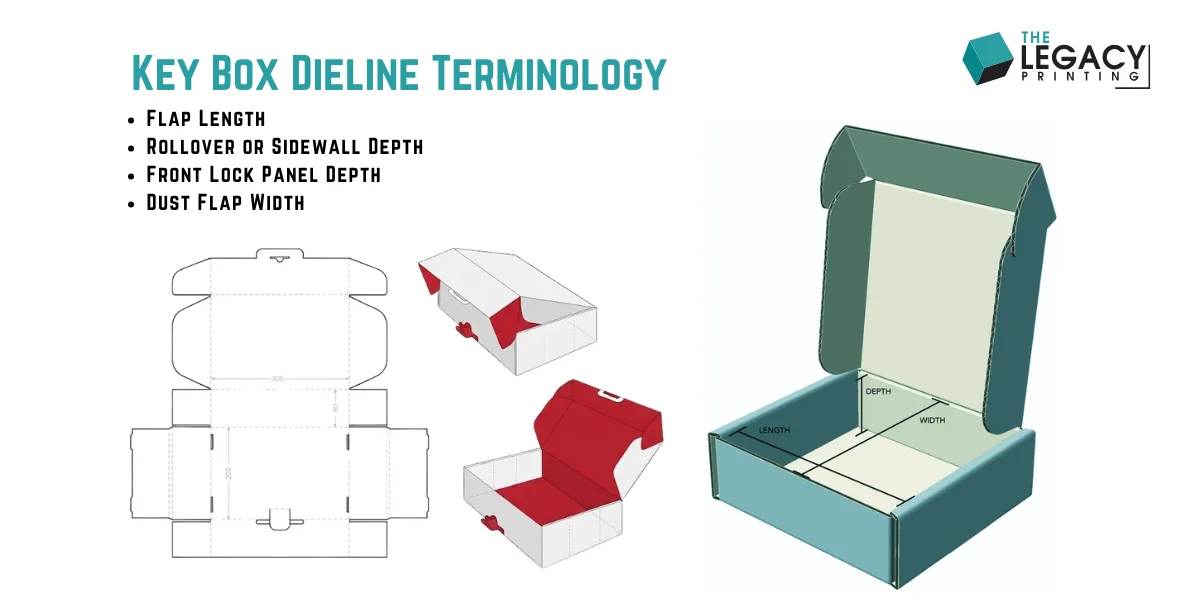
Key Box Dieline Terminology
When selecting or determining the dimensions of your box dieline, consider how the interaction between these auxiliary structural components affect interior clearance in your box:
- Flap Length: Length of the main tuck flap on the lid.
- Rollover or Sidewall Depth: Double wall construction of the sidewalls is created after assembling the box which will take up 1/8" to 1/4" of usable interior width.
- Front Lock Panel Depth: Interior depth of the front wall that locks the tuck lid decreasing the usable interior length.
- Dust Flap Width: Auxiliary side flaps attached to the lid & folded in to keep dust out.
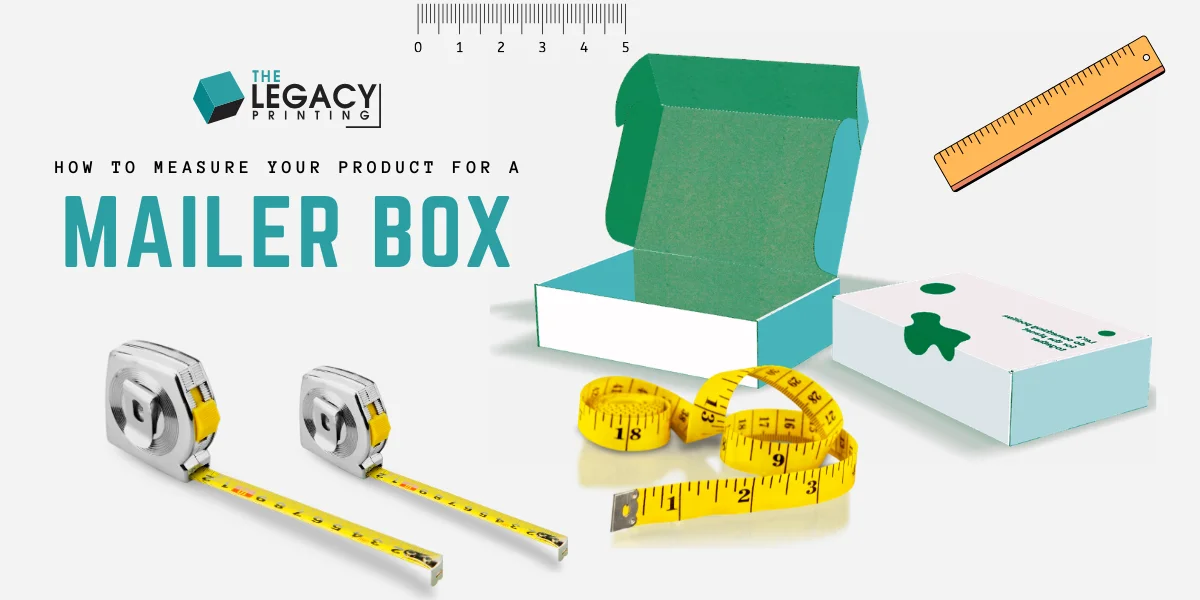
How to Measure Your Product for a Mailer Box
Proper measurement will help you pick a box that will provide a secure fit, yet still have room for protective materials.
- Horizontal process flowchart illustrating the sequence of measurements in detail:
- Measurement of Product: Identify the largest measurements in length x width x height of the product.
- Allow Clearance: Add 0.25 to 0.50 inches per side for a proper fit inside the box.
- Add Inserts: Calculate the space required for custom foam inserts, paperboard trays or bubble wrap
- Pick Box: Select the standard/custom internal box dimensions based on your measurements.
Step 1: Reach a Maximum Footprint
Set your product on a flat surface. Measure its absolute longest, widest & tallest dimensions using an accurate ruler or calipers. Always take in account protrusions such as bottle caps, handles, pump mechanisms or display sleeves.
Step 2: Calculate Required Padding & Clearance
Never select a box that corresponds to your product's outside dimensions. Allocate additional clearance depending on the fragility of your product & the kind of void fill selected
- For non delicate products (fashion items, soft goods): Allocate 0.25 inch on all sides
- For regular products (boxed cosmetics & hard goods): Allocate 0.50 inch in total for tissue paper or light bubble wrap
- For fragile products (glassware & electronics): Allocate 1.00 inch or more for packing foam, molded pulp or corrugated separators
Step 3: Factor for Protective Inserts
When using custom EVA foam, paperboard trays, or bubble wrap, take the measurement of the overall dimensions of the item together with the dimensions of the insert that contains it. The internal dimensions of the box should be equal to the overall dimensions of the insert setup.
Step 4: Convert into Manufacturable Box Dimensions
Compare your measured dimensions (Product + Clearance + Insert) to the available box sizes and choose the most appropriate box dimension.
Standard Mailer Box Sizes That Are Popular in E-Commerce
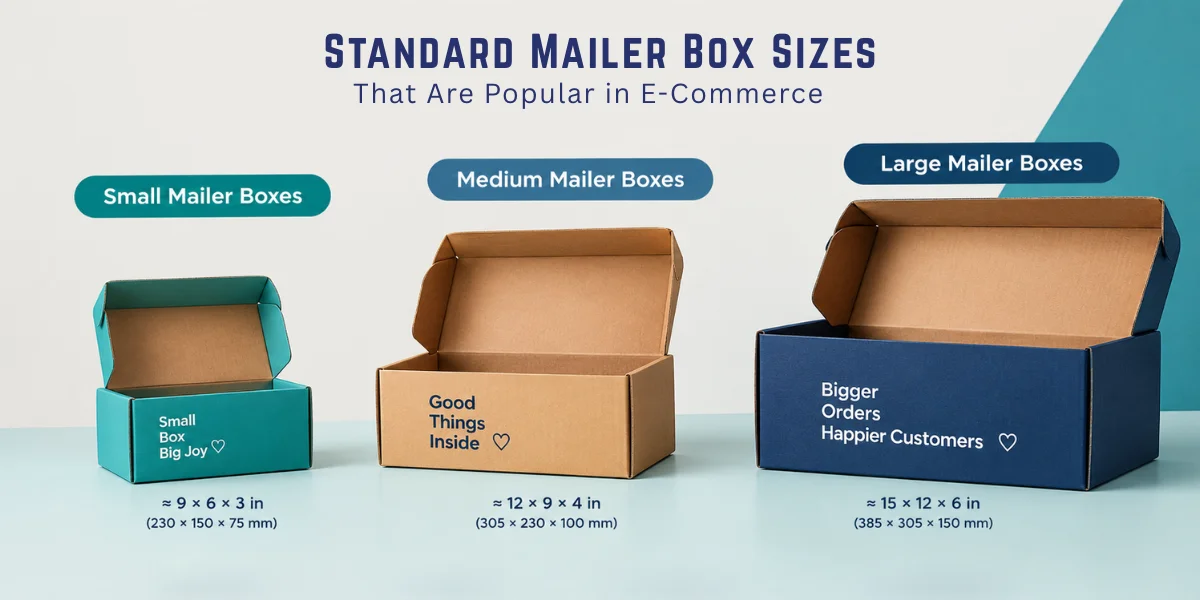
Although custom mailer boxes offer precise fitments, there are standard mailer boxes that are used for most retail and e-commerce purposes. Standardization allows one to make packaging inventory efficient and decrease delivery time.
Small Mailer Boxes
Suitable for light and individual products as well as cosmetics and compact perfume boxes, Helps save on shipping costs because of low dimensional weight.
- Cost Effectiveness: Significantly reduces DIM charges & removes the requirement for additional void fill like bubble wrap or paper.
- Best Applications: Perfect for sending invoices, coupons, gift cards, promotional mail & small products like jewelry and lip balms.
- Security Consideration: Smaller packages have less buffer protection from rough handling during transport; fragile or glass products will need an additional insert in the package or upgrading to a larger sized box.
|
Dimensions (Inches) |
Dimensions (Centimeters) |
Popular Uses in Industries |
|
6×4×3 |
15.2×10.1×7.6 |
Jewelry, lip balms, small individual cosmetics, key chains |
|
7×5×2 |
17.8×12.7×5.1 |
Phone covers, card decks, small skincare jars, accessories |
|
8×6×4 |
20.3×15.2×10.1 |
Perfumes, cosmetics, mugs, small books |
Medium Mailer Boxes
Versatile size class in the e-commerce industry, combining sufficient capacity with economical shipping costs.
- Workhorse Fulfillment: The go to medium box option for many small businesses and e-commerce companies trying to achieve the right balance between interior space and affordable shipping costs.
- Organized Packing Stations: Medium boxes allow for better organization of the packing station because they make it easier to mark the packages and organize products.
- Combining Products in One Box: Helps combine products into one package without having to pay extra money for the oversized package.
|
Size (Inches) |
Size (Centimeters) |
Common Industry Applications |
|
10×8×4 |
25.4×20.3×10.1 |
T-shirts, folded apparel, skincare gift sets & books |
|
12×9×4 |
30.4×22.8×10.1 |
Apparel bundles, dress shirts, subscription boxes & candles |
|
12×12×6 |
30.4×30.4×15.2 |
Footwear, medium board games, bulky apparel 7 multi product kits |
Large Mailer Boxes
Used for sending large items, subscription boxes carrying multiple products, and heavy retail packages.
- Bulk Storage and Capacity: Acts as a high capacity storage container that helps manufacturers and sellers combine several pieces in a single shipment.
- Reduction of Shipping Cost: Packing several items in a single box will help eliminate additional packing costs thereby saving time and reducing shipping costs.
- Maximum Protection: Designed to safely store bulky outerwear, kitchen utensilsor electronic gadgets without box collapse from stacking.
|
Size (Inches) |
Size (Centimeters) |
Common Industry Applications |
|
14×10×5 |
35.5×25.4×12.7 |
Heavy clothing sets, winter jackets, shoeboxes, luxury gift kits |
|
16×12×6 |
40.6×30.4×15.2 |
Large electronics, home decor accessories, multi-item retail sets |
|
18×14×6 |
45.7×35.5×15.2 |
Large outerwear, cookware sets, heavy e-commerce kits |
Industry Recommended Mailer Box Dimensions
Different industries will require different packaging techniques for their products depending on the shape, size, weight, and fragility of products. Choosing the right industry tested dimensions will make the job easier when it comes to packaging your goods.
Fashion and Apparel
Apparel needs special mailer boxes that protect the clothes while maintaining the shape of the clothing.
- Single T shirt or Top: 9×6×2 inches
- Folded Jeans/Sweaters: 12×9×4 inches
- Multiple Item Fashion Clothes: 14×10×4 inches
Tip: Always use inner branded tissue paper or frosted poly bags inside the mailer boxes to ensure that moisture does not affect the clothing.
Beauty & Cosmetics
Cosmetic boxes frequently come in glass jars, pumps & sensitive liquid containers which need tight sealing and sturdy sidewalls.
- Lipstick or Eyeliner Kits 6x4x2 inches
- Skincare Regimen (3 to 4 pieces) 8x6x3 inches
- Complete Beauty/Makeup Bags 10x8x4 inches
Package Design Suggestion: Design custom corrugated or EVA foam inserts for securing sensitive bottles & avoiding any bottle to bottle contact.
Electronics & Accessories
Products in the tech category will need proper cushioning, anti static features & accurate fitting because of delicate internal parts.
- Smartwatches or Earbuds 7x5x2 inches
- Tablets & Other Portable Devices 10x7x3 inches
- Keyboard or Computer Accessories 18x8x3 inches
Package Design Suggestion: Use foam inserts along with tough E flute cardboard packaging to cushion any drop impacts.
Material Selection: Selecting the Correct Flute Thickness
The strength of the corrugated material used in a mailer box relies entirely on the profile of the flute material. The flutes consist of the wavy arches found between the inner and outer linerboards. Selecting the appropriate flute thickness for your mailer box is important in ensuring that the box will be structurally strong but not unnecessarily heavy.
E-Flute (1/16 inch or 1.5 mm Thickness)
- Properties: Densely packed flute structure offering a super smooth surface perfect for HD printing customization
- Perfect For: Small to medium sized mailer boxes, retail boxes, cosmetics, subscription boxes, and light weight materials
- Benefit: Clean folds and reduced cubic volume
B-Flute (1/8 inch or 3.0 mm Thickness)
- Properties: Thick flute structure offering excellent stackability and crush resistance
- Perfect For: Large mailer boxes, heavy items, delicate ceramics, glass packaging & shipping purposes
- Benefit: Shock resistant and rigid structure.
Standard Dimensions vs. Custom Dimensions for Mailer Boxes
Choosing between the use of standard mailer dimensions or custom-engineered dimensions will affect your time to market and efficiency in future fulfillment.
Comparison of Structural Trade Offs in Two Columns
- Standard Dimensions: Provide lower initial cost, quick production lead time & minimal MOQ requirements but result in excess void space and potentially higher carrier dimensional weight charges.
- Custom Dimensions: Guarantee a perfect fit to the product, low dimensional weight & a premium unboxing experience but entail higher initial tooling costs and longer production lead times.
When Standard Sizes Should Be Used
Standard sizes are really economical for businesses expanding their offerings, working under pressure & sending products that will fit a few standard box sizes.
When Custom Dimensions Should Be Used
Custom mailer box dimensions are suitable for high volume deliveries of identical items, fragile products requiring molded inserts & reduced dimensional weight fees.
At Legacy Printing, our specialty is designing custom packages from premium foundation boxes to personlized custom boxes hat fit your needs to perfection. With custom box dimensions calculated down to the millimeter we can help you save on packing materials, minimize damage to goods in transit & boost the unboxing experience.
Custom Branding, Printing Techniques and Box Types
Mailer Box Opening Types
- RETF (Roll-End Tuck Front): Has a lid with side dust flaps and a front flap that tucks straight into the front of the box. Perfect for shipping by e-commerce platforms & subscription box openings.
- RETT (Roll-End Tuck Top): Has tucking flaps that tuck straight into the top of the box, often reinforced with cherry locks along the sides to make sure heavy objects have maximum lock-in.
Printing Techniques and Special Effects
CMYK vs Pantone (PMS): Use CMYK printing techniques for photographs and multi color graphics and gradients; use Pantone Spot Colors (PMS) when a perfect match of colors is necessary for your brand across multiple printing batches.
Spot UV: Adds a glossy & reflective liquid UV coating to particular parts of your design (logos or accent patterns) against the backdrop of a matte background.
Foil Stamping: Embosses metallic foil (gold, silver or rose gold) in the paper board through heat and pressure.
Embossing/Debossing: Creates raised (embossing) or sunken (debossing) images by impressing them in the surface of the corrugated paper board.
Lamination: Go for Matte Lamination to give your design a smooth and non reflective effect Gloss Lamination to make it vivid and moisture resistant or Soft Touch Lamination for a velvet touch sensation.
Be Unique and Measure the Ideal Mailer Box Size
The right measurement will keep your product safe but customization will make your shipping box a good marketing tool. When aiming for maximum effect on your brand consider the dimensions and uniqueness together
Pick Style Compatible with Your Brand
Combine box structures depending on their design like stand up mailers or roll end tuck-tops and fit them to your product design and dimensions.
Make Customizations
Make sure your package opening experience will be unique with custom box insertions, branding colors, printed contact information and personalized thank you messages in the box lid.
Work With Materials Creatively
Make use of durable corrugated board and high quality custom printing. A combination of strong material & creativity builds loyalty and a high end impression of your brand before opening the box.
How Mailer Box Dimensions Impact Shipping Carriers (USPS, UPS, FedEx, DHL)
Shipping companies calculate their freight charges depending on whichever is higher: either physical weight or dimensional weight (DIM weight). The use of oversized mailer boxes directly translates to higher shipping charges.
Formula for Calculating Dimensional Weight
Dimensional Weight (lbs)=DIM Divisor×Length (in)×Width (in)×Height (in)
Standard Divisor USPS, UPS & FedEx – Domestic Commercial Shipment: 139.
International Shipments/Express Divisor: 139-166.
Example: The Cost Savings of 1 Additional Inch in Height
Imagine a company sending a 1.5 pound product in two different mailers boxes via UPS Ground with a 139 divisor:
Box A (10x8x4 in):
Volume: 320 cu in
Dim Weight: 320 / 139 = 2.30 lbs → Charged at 3 lbs
Box B (10x8x6 in - 2 inches taller):
Volume: 480 cu in
Dim Weight: 139480=3.45 lbs→Charged at 4 lbs
Just by decreasing the height of the box by 2 inches, the company has gone down an entire weight tier and will save tens of thousands of dollars.
The Size Balance That Every Merchant Must Avoid
There are two costly size mistakes made by many e-commerce businesses:
- Size Just a Bit Larger: This is a very common mistake, where a larger box is selected "just in case." This results in wastage in terms of additional dimensional weight and more money spent on bubble wrap and void fillers in packaging.
- Size Too Small: When a product is packaged tightly in a smaller sized box, it will take longer to pack and can result in breakage of the contents because of straining of the boxes.
- The Best Solution: Do a sample packing test. Pack around 10 to 20 units physically before going into full production.
Design Perfect Custom Mailers with the Legacy Printing!
In order to avoid guesswork, custom engineered packaging maximizes both protection and cost efficiency in terms of postage:
Custom Structural Engineering
Custom sized mailer boxes reduce extra air space in order to give a perfect fit thus reducing the cost of DIM weight.
Package Systems
Custom mailers can be conveniently used with custom cardboard inserts or custom protective foam to ensure product protection without having large external dimensions.
Sample Testing & Manufacturing
From sample testing through mass manufacturing, custom engineered packaging makes sure that your packages function well across the international freight network as well as maintaining premium brand quality.
FAQs
What is the difference between internal and external dimensions?
Internal dimensions are the actual space available in the box to hold your product. External dimensions are the external space that carriers take into consideration when calculating shipping costs.
How much extra space should be allowed for adding bubble wrap?
Add an extra 1.0 to 1.5 inches to your total product measurements in order to have enough room for adding bubble wrap or paper cushioning.
Which is the most commonly used size for mailer boxes for subscriptions?
The most common size is 10 x 8 x 4 inches (or 12 x 9 x 4 inches for large sets) because it suits a large variety of product combinations while maintaining costs low.
How do corrugated flutes affect interior dimensions?
The thick flutes reduce interior clearance because of the folding in of the panels. The inclusion of wall thickness makes sure that the panel does not bow upon folding the box.
Why am I paying such high shipping fees on an item that is light?
Dimensional weight will be used by carriers when shipping if your box is oversized since this means that you pay for empty space.
Can I obtain custom sized mailer samples prior to placing a large order?
Yes Legacy Printing manufactures customized samples as well as 3D proof models for you to test fit prior to manufacturing.
Conclusion
Boost your mailing experience by the proper utilization of appropriate dimensions of the mailing box. Mailer boxes ensure safety to the contents while mailing. Apart from this they are extremely significant for boosting the number of satisfied customers around the globe. However the confusion of the user is about the selection of the most appropriate size of the box for the specific content. In the aforementioned guideline, different sizes of the mailer boxes were highlighted in order to resolve the user's problem.