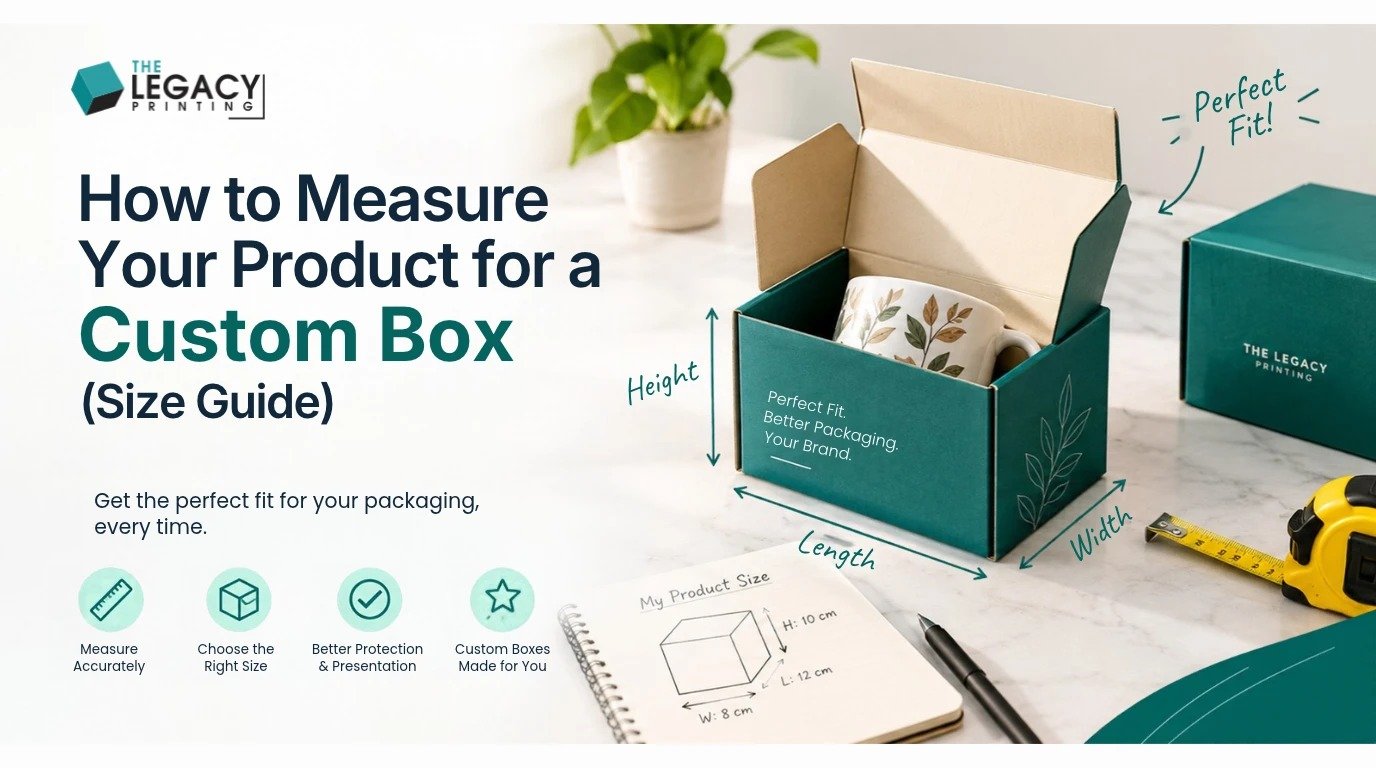
How do you measure your product for a custom box? Measure it the way your customer will receive it, with the cap, pump or sleeve on. Then write the size as length × width × height in one unit, and tell your printer these are the inside dimensions of the box you need.
That's the short version of how to measure a product for a custom box. The details are where people slip. A forgotten pump or two swapped numbers can give you a box that won't close, and nobody wants that surprise after the print run. Below, we take the most common sizing myths one by one, then give you a simple checklist to send with your quote.
Quick answer: how to measure your product for a custom box
You need three numbers: length, width and height. Take them at the widest and tallest points of the finished product, and always say which unit you used.
The 3 numbers every printer needs
- Length: the longer side of the box opening.
- Width: the shorter side of the opening.
- Height (or depth): how tall the box is, from the inside bottom up to the opening.
A one-minute version for busy owners
- Put the product on a flat table, in the position it will sit in the box.
- Measure the longest side, the shorter side and the height.
- Include anything that sticks out, like a cap, pump, handle or bow.
- Measure several units, not just one.
- Send the numbers as L × W × H, with the unit, and say "inside dimensions."
What is the correct order for box dimensions: length, width, height?
The standard box length width height order is L × W × H. Some printers write L × W × D, where D stands for depth. It means the same thing.
Look down at the opening: long side, short side, then depth
Picture the box sitting open on a table, and look straight down into it. The longer edge of the opening is the length, and the shorter edge is the width. The distance from the bottom up to the opening is the height.
Why does the order matter? It tells the printer which side opens. Swap length and height on a tall bottle box, and you could get a box that opens along its long side instead of at the top. Same three numbers, very different box!
Always write the unit and say inside or outside
Watch out for one mix-up. Shipping carriers use the word "length" differently. The USPS parcel size standards define length as the longest side of the package, no matter where it opens. Box makers usually mean the long side of the opening. So label every number clearly, for example: "Inside: 4 x 2 x 6 in (10 x 5 x 15 cm), L × W × H, opens at the top."
In the US, most people work in inches. If your bottle supplier gave you millimeters, that's fine too. Just don't mix units in one measurement, and remember that one inch equals 25.4 mm.
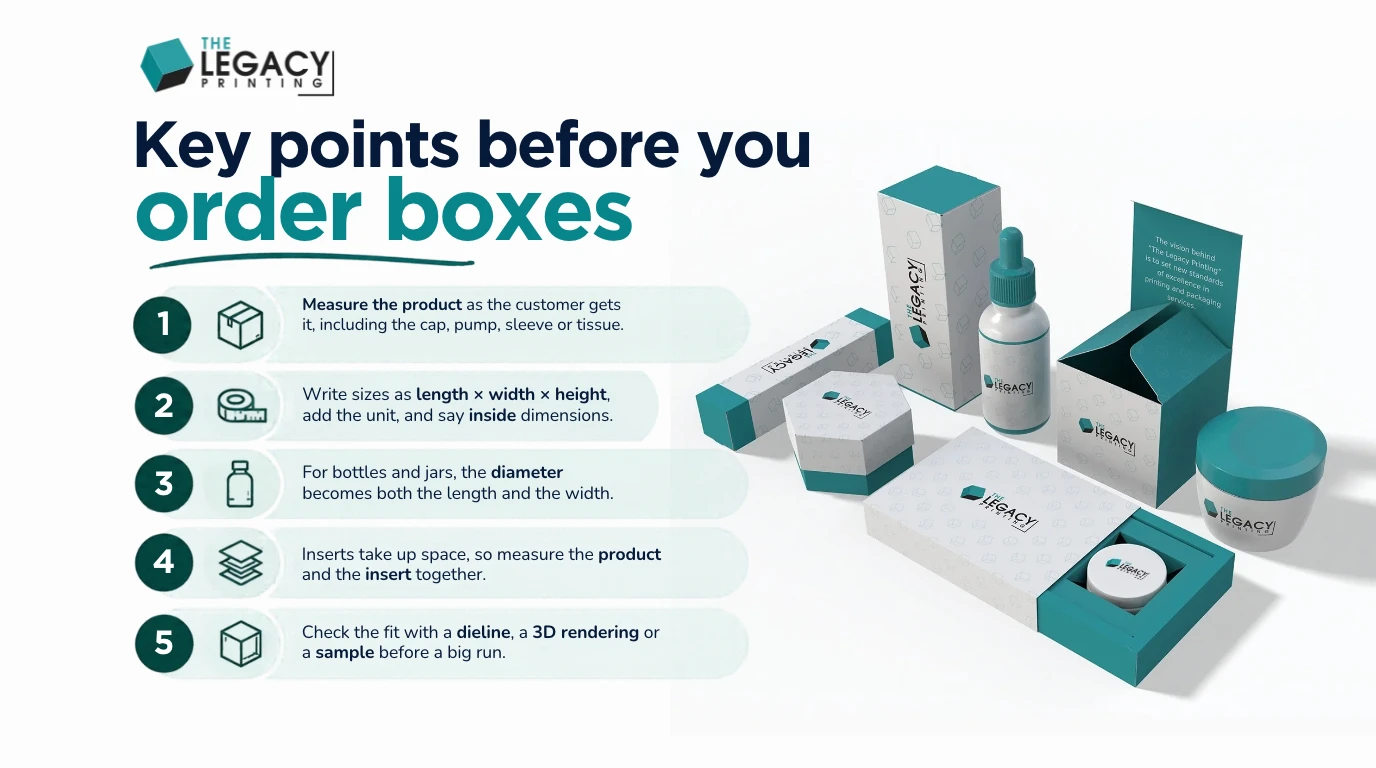
Key points before you order boxes
Step-by-step: measure the product the way your customer gets it
Measure the finished, ready-to-sell product, not the bare item. Pick the right tool, decide how the product will sit, and check more than one unit.
Tools you need
- A ruler or tape measure works for most boxes, mailers and gift sets.
- A caliper is a small tool with two jaws that measures small items very exactly. It's great for lip balm tubes, lipstick and eyeliner.
- A flexible sewing tape lets you measure around a round jar or candle.
- Paper and a pencil help you trace odd shapes.
Choose the orientation: standing or lying
Orientation means how the product sits in the box. A serum bottle standing up gives you a tall height. Lay the same bottle down, and it has a long length and a short height. Decide this first, because it changes which number goes where.
Measure at the widest and tallest points
Products are rarely perfect blocks. A jar may be wider at the shoulder than at the base, and a candle lid may stick out past the glass. Measure at the widest and tallest spots, then measure again. A second pass takes a moment and can save you a reprint.
Odd shapes: find the smallest box that holds it
For an odd shape, like a toy, a bottle with a curved handle or a gift set, lay it on paper and trace around it. Mark the far left, far right, top and bottom points. The rectangle that touches all four marks gives you the length and width. Then measure the tallest point for the height.
Common custom box sizing myths (and the truth)
Most sizing problems start with a belief that sounds right but isn't. Here are the ones we hear most, with the facts that fix them.
Myth: The printer wants the outside size of the box
The truth: Custom packaging makers generally work from inside dimensions. That's the empty space, wall to wall, that your product fits into. Outside dimensions measure the finished box from the outside, so they're a bit bigger because the walls have thickness.
The gap grows with thicker materials. Corrugated board has a wavy middle layer called a flute, which makes its walls thicker than a thin paperboard carton. Rigid board is thick too. For example, if you send the outside size of an old corrugated mailer as your inside size, your product may not fit.
| Inside dimensions | Outside dimensions | |
|---|---|---|
| What it measures | The space inside the box | The whole box, walls included |
| Use it for | Making sure the product fits | Shipping costs, shelf space, carton packing |
| What to send your box maker | Yes, this one | Only if you have a set space to fill |
| Changes with material? | No, you set it | Yes, thicker walls make it bigger |
Myth: Measure the bottle, not the cap
The truth: The cap counts. So do pumps, droppers, spouts, handles and shrink wrap. On cosmetic bottles, the pump is often the tallest part. If the product gets a hang tag, a sleeve, tissue or a thank-you card, measure with those in place too.
Myth: Measuring one unit is enough
The truth: Products vary a little from one unit to the next. That small allowed difference is called tolerance. Measure several units from the same batch and use the largest numbers you get.
It's also smart to ask your supplier if the bottle or jar ever changes between batches. A photo of the product next to a ruler helps our team see exactly what you see.
Myth: A bigger box is the safer choice
The truth: Too much room causes its own problems. The product slides and rattles, and the package feels cheap when your customer opens it. A box that's too tight is no better, because it scuffs the print, bends the flaps and makes the product hard to pull out. Aim for a snug fit with just enough clearance, meaning the extra room around the product. We cover that in the next section.
Myth: Round products are hard to measure
The truth: Here's how to measure a cylindrical product for a box. You need just two numbers: diameter and height. The diameter is the width of the circle, measured straight across the middle. For a square-based box, the diameter becomes both the length and the width. So a jar about 2.75 in (70 mm) across starts with a 2.75 × 2.75 in (70 × 70 mm) base, before any clearance.
No caliper? Wrap a flexible tape around the widest part to get the circumference, which is the distance around the circle. Divide that by π (about 3.14), and you have the diameter. One last check: if the lid or cap is wider than the body, use the lid's diameter instead.
Myth: Inserts don't change the box size
The truth: An insert is a shaped piece inside the box that holds the product in place. Its walls take up inside space, and so does void fill, which is paper or other material that fills empty gaps. So when you plan custom box dimensions for inserts, the box has to fit the product plus the insert. Send us the product size, tell us you want an insert, and our design team will plan both together.
Myth: Box size doesn't affect shipping
The truth: For shipping, the outside size matters a lot. USPS uses girth, which is the distance around the thickest part of the package. For a rectangular box, girth is 2 × height + 2 × width, and for a tube shape it's the circumference. Under the USPS parcel size standards, domestic parcels can't measure more than 108 inches in length plus girth combined. USPS Ground Advantage is the exception, at up to 130 inches.
Carriers can also bill by how much space a box takes up, not just by its weight. This is called dimensional, or DIM, weight. The rules change, so check your carrier's current rate guide before you settle on a size. Our advice: size the inside for fit, then look at the outside size for shipping.
Myth: Length and width are interchangeable
The truth: Swapping them changes the box. On a tuck end box, the tuck flaps close an opening set by the length and width. On a mailer box, the lid hinges along one side. Swap L and W, and the opening or the artwork can land on the wrong side. Label each number, and say where the box should open.
Myth vs fact at a glance
| Myth | Fact |
|---|---|
| Send the outside size | Send the inside size; walls add thickness |
| Skip the cap or pump | Measure the full product as the customer gets it |
| One unit is enough | Measure several units and use the largest numbers |
| Bigger is safer | Loose boxes rattle and look cheap; aim for a snug fit |
| Round items are tricky | Diameter becomes length and width; add height |
| Inserts don't matter | Measure product plus insert |
| Size doesn't affect shipping | Outside size and girth can change the cost |
| L and W can swap | The order decides where the box opens |
How much room should you leave around a product in a box?
Leave enough room for the product to slide in and out easily, plus space for any padding. The right amount depends on the product, how fragile it is and the box style. There's no single number that fits everything.
Advice online ranges from a tiny gap to a generous one. Honestly, we think that's because every product is different. A sturdy soap bar in a sleeve box needs almost nothing, while a glass perfume bottle in a mailer needs room for protection. A rigid box with an insert needs an exact fit, since the insert does the holding. A tuck end box needs just enough space for the flaps to close cleanly.
| Product | What to measure | What to add |
|---|---|---|
| Bottle with pump | Diameter and height with the pump on | Room to slide in; an insert if it's glass |
| Jar or candle | Widest diameter (often the lid) and height | Insert or snug walls so it can't tip |
| Lip balm or lipstick tube | Diameter and height with a caliper | A very small gap, so it doesn't rattle |
| Cookie stack or pastries | Stack length, width and height | Space for liners or dividers |
| Folded apparel | Folded size, with tissue | Space for tissue and a card |
| Subscription kit | All items laid out as packed | Insert walls or void fill between items |
Not sure what your product needs? Tell us what it is and how it ships, and our team will suggest the clearance and box style that suit it. You'll find plenty of shapes on our custom retail boxes page. Beauty brands can also browse our custom cosmetic boxes. If you ship by mail, our post on mailer box dimensions goes deeper.
What to do instead: a checklist before you order
Run through this list before you ask for a quote. It covers every myth above.
- Measure the finished product, with cap, pump, sleeve and tissue.
- Decide whether it stands up or lies down.
- Measure at the widest and tallest points, twice.
- Check several units from the same batch.
- Use one unit only, and label it.
- Write L × W × H and say "inside dimensions."
- Note if you want an insert.
- Check the outside size if shipping cost matters to you.
Copy-and-paste spec block
Fill this in and paste it into your quote request:
Product name:
Orientation (standing / lying):
Product L × W × H (unit):
Widest point / tallest part:
Product weight:
Insert needed (Y/N):
Box style:
Material (kraft, cardboard, rigid, corrugated):
Quantity:
We only need your product's size and shape. Measurements and a few photos are usually enough, so you never have to share your formula or your supplier's name.
Check the fit before you print
The safest move is to see the box before it goes into production. You have three ways to do that.
Free dieline and design support
A dieline is a flat drawing of the box that shows where it gets cut and folded. Your artwork sits on top of it. Our design team helps with the dieline and prepares print-ready artwork and a design proof for free. They also set the bleed, which is art that runs past the cut line so no white edge shows, and the safe zone, which keeps text away from the edges. Learn more in what a dieline is and how it's used.
Digital 3D rendering
Before production, you'll get a digital 3D rendering of your box. It's a quick way to check that the opening, the artwork and the size all look right.
Sample kit and small runs
Want to hold it in your hands? Request a sample kit. We follow up within 2 hours, and kits ship within days.
You can also order as few as 50 boxes to test a size before a bigger run. See how in starting with just 50 pieces. You pay no die and plate charges, and shipping is free anywhere in the USA. Kraft paper and recycled cardboard are available in almost every category at no extra cost, too.
Frequently Asked Questions
What size box do I need for my product?
You need a box whose inside dimensions match your finished product, plus a little clearance. Measure length, width and height at the widest points, with caps or pumps on. Then let our team suggest the right amount of room for your product and box style.
Do I give inside or outside dimensions for a custom box?
Give inside dimensions, because that's the space your product fits into. Outside dimensions are larger due to wall thickness, so they matter mainly for shipping and shelf space.
How much room should I leave around a product in a box?
Leave enough room for the product to slide in and out, plus any padding or insert. Sturdy items need very little, while fragile glass needs more room or an insert. There's no single rule, so we confirm it for each product.
How do I measure a cylindrical product (bottle, jar, tube) for a box?
Measure the diameter and the height. The diameter becomes both the length and the width of the box base. If you only have a flexible tape, measure around the widest part and divide by 3.14.
Should I include the cap or pump when I measure?
Yes, always. Caps, pumps, droppers and handles are often the tallest or widest parts of a product. Leave them out, and the box may not close.
Can I get a sample to test the fit before a bulk order?
Yes. Request a sample kit, and we'll follow up within 2 hours. You'll also see a digital 3D rendering before production, and you can start with as few as 50 boxes.
Can you help me pick the box style and material?
Yes! Tell us what you sell and how it ships. Our team will recommend a style, such as tuck end, mailer, rigid or sleeve, and a material, such as kraft, cardboard, rigid board or corrugated.
Next step: get a free quote and free design proof
Good packaging starts with the right size. A box that fits protects your product and makes the unboxing feel special. Measure the finished product, write it as L × W × H with the unit, and send us your inside dimensions. We'll take care of the dieline, the design proof and the 3D rendering, so you see the box before it's made.
Have questions? Call 800 719 2780 or email sales@thelegacyprinting.com. Our team is available 24/7, and you save 20% on your first order.