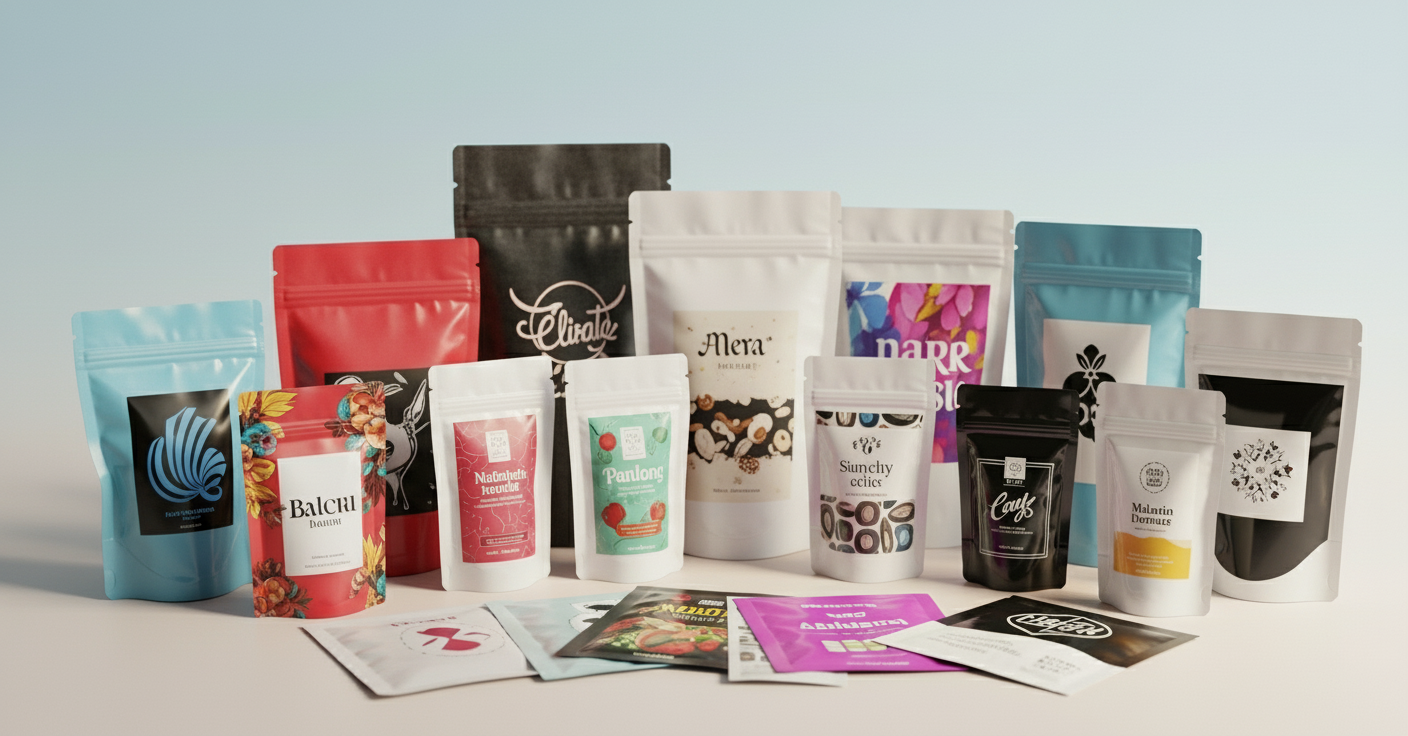
If you’re comparing mylar bags for food, coffee, gummies, supplements, or retail, this guide gives you the exact details buyers ask for—sizes, thickness, materials, barrier, printing, and wholesale options—so you can spec the right pouch the first time.
At-a-glance: Learn what mylar bags are, the difference between clear and white mylar bags, how to choose thickness (mil/microns), the most common stock sizes, when to add valves, zippers, and child-resistant features, and how custom printing and wholesale pricing works.
[caption id="attachment_24210" align="alignnone" width="1408"]
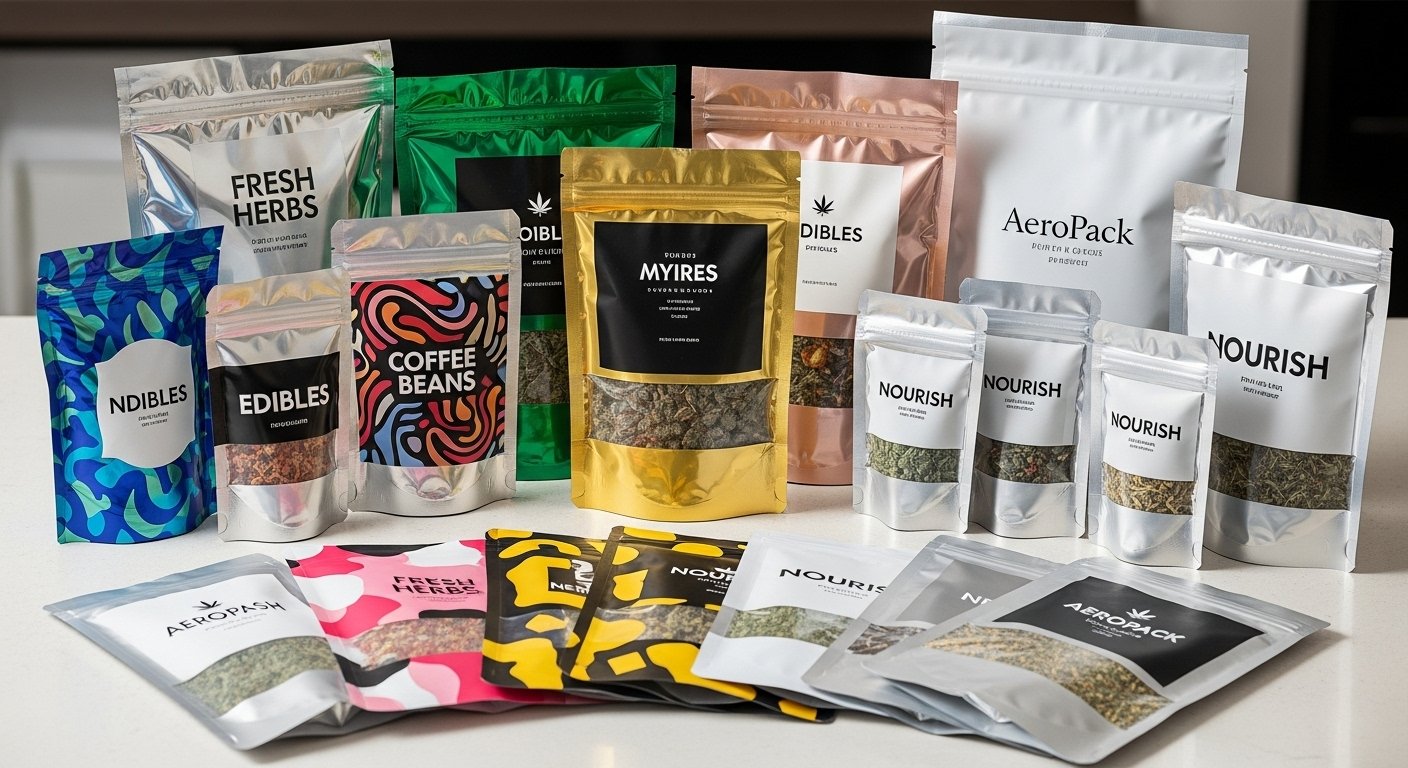 Mylar Bags in different Sizes, Thickness, and Custom Printing by The Legacy Printing[/caption]
What are Mylar Bags?
“Mylar” refers to an oriented polyester film (PET). In packaging, mylar bags usually means a laminated pouch built from layers such as PET / (VMPET or Foil) / PE.
-
PET (outer): print carrier, scratch resistance, shelf appeal
-
Barrier layer: VMPET (metallized PET) or aluminum foil for very low oxygen/moisture transmission
-
PE (inner): heat-seal layer, food contact, soft handfeel
Clear mylar bags use transparent PET + PE (no metal layer), so the product is visible.
White mylar bags use opaque films or white inks for full brand coverage and light protection.
Quick Size & Thickness Guide
[caption id="attachment_24215" align="alignnone" width="1408"]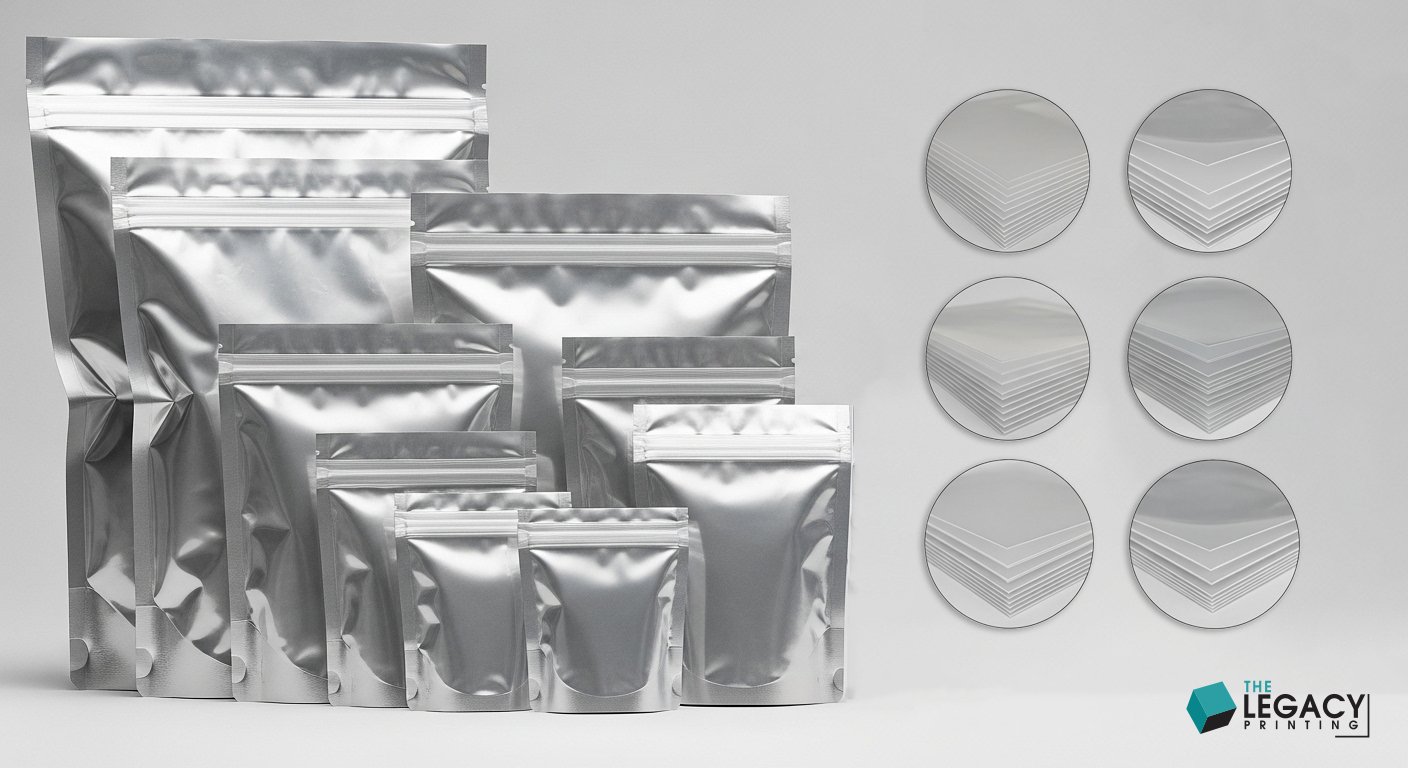 Mylar Bags: Size and Thickness Guide by The Legacy Printing[/caption]
Common Flat & Stand-Up Pouch Sizes (approx.)
| Use case | Flat (W × H) | Stand-Up (W × H × Bottom Gusset) | Notes |
|---|---|---|---|
| Sample / single-serve | 3″ × 4″ | 4″ × 6″ × 2″ | Small portions, testers |
| Gummies / edibles 1–4 oz | 4″ × 6″ | 5″ × 8″ × 2″ | Add reseal zipper + tear notch |
| Snacks 4–8 oz | 5″ × 8″ | 6″ × 9″ × 3″ | Great for nuts, granola |
| Coffee 8–12 oz | – | 6″ × 9.5″ × 3.5″ | Add one-way degassing valve |
| Coffee 1 lb | – | 7″ × 12″ × 4″ | Optional tin-tie, valve |
| Powdered supplements | 5″ × 8″ | 6″ × 9″ × 3″ | Consider matte or soft-touch |
| Pet treats 8–16 oz | – | 7″ × 10″ × 3.5″ | Hang hole for peg display |
Capacity varies by product density and fill height; ask for a filled mockup or sample set before mass order.
Thickness (mil ↔ microns)
-
Light duty: ~2.5–3.0 mil (≈ 64–76 μm) for small, low-stress packs
-
Standard retail: ~4.0 mil (≈ 100 μm) balances feel and durability
-
Premium / bulk: ~5.0–7.0 mil (≈ 127–178 μm) for heavier products or long storage
Conversion: 1 mil = 25.4 microns (μm)
Barrier, Freshness, and Product Safety
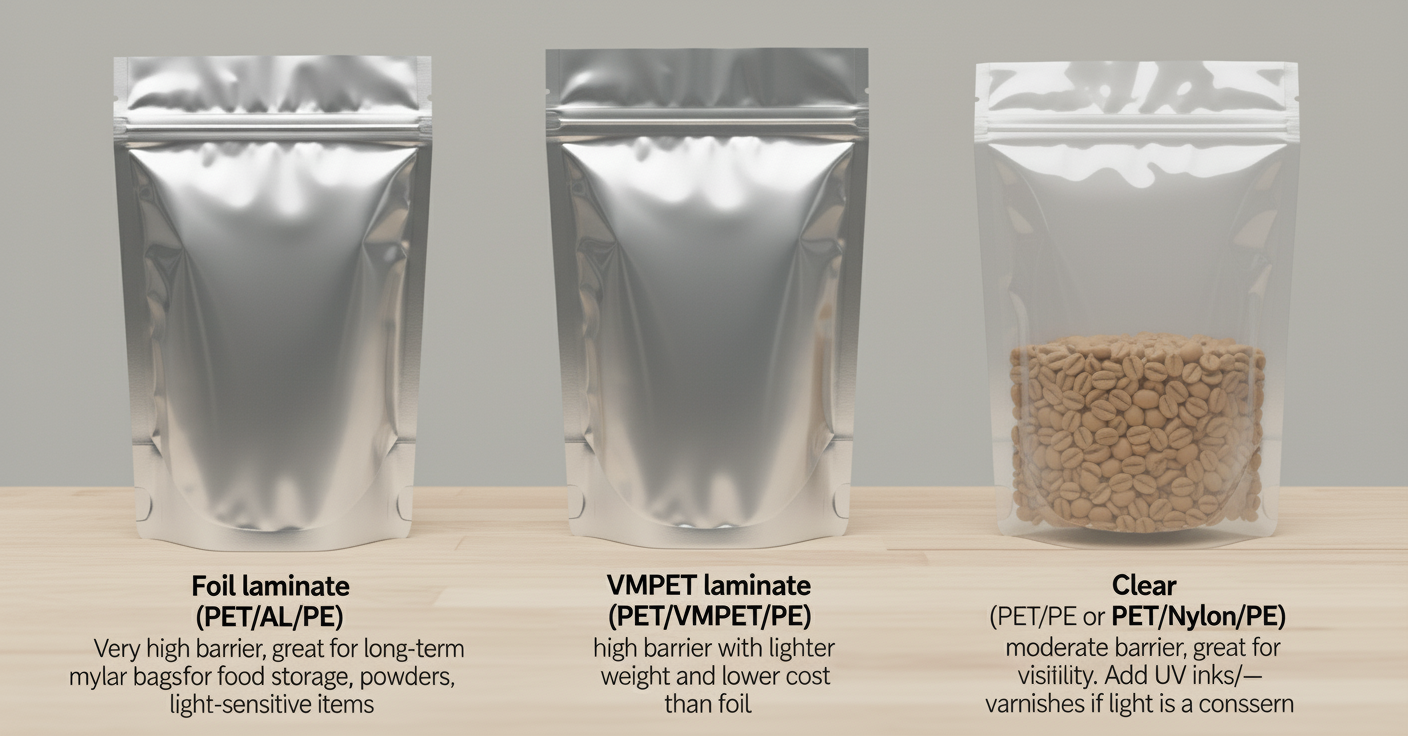
Choose barrier based on shelf life and sensitivity:
-
Foil laminate (PET/AL/PE): very high barrier, great for long-term mylar bags for food storage, coffee, powders, light-sensitive items.
-
VMPET laminate (PET/VMPET/PE): high barrier with lighter weight and lower cost than foil.
-
Clear (PET/PE or PET/Nylon/PE): moderate barrier; great for visibility. Add UV inks/varnishes if light is a concern.
Add-ons that matter
-
Zippers: standard, child-resistant, or double-track for premium reseal
-
Tear notch: clean first-open experience
-
Hang hole: retail displays
-
Rounded corners: pocket safety, premium feel
-
Degassing valve: required for freshly roasted coffee
-
Lot/date window: compliance and traceability
Clear vs White Mylar Bags
[caption id="attachment_24218" align="alignnone" width="1408"]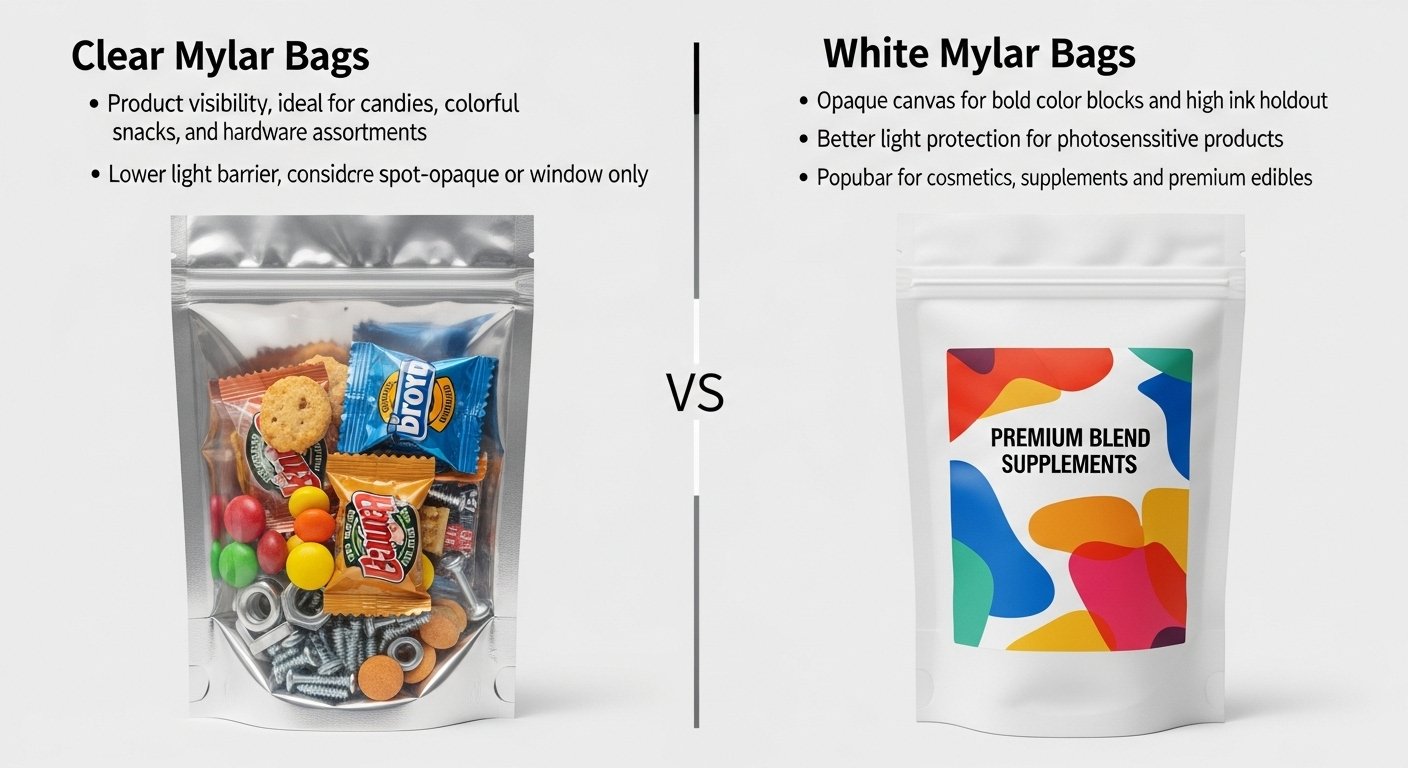 Clear vs White Mylar Bags[/caption]
Clear mylar bags
-
Product visibility, ideal for candies, colorful snacks, hardware assortments
-
Lower light barrier; consider spot-opaque or window only
White mylar bags
-
Opaque canvas for bold color blocks and high ink holdout
-
Better light protection for photosensitive products
-
Popular for cosmetics, supplements, and premium edibles
Pouch Styles (Pick by Use Case)
-
3-side seal (flat): slim, cost-effective for samples and single-serve
-
Stand-up (doypack): great shelf presence, bottom gusset for volume
-
Side-gusset (coffee): classic brick profile, works with tin-tie or valve
-
Child-resistant (CR): certified zippers for regulated markets
-
Spouted / specialty: for liquids, gels, and concentrates
Custom Printing: Digital vs Rotogravure
Digital print
-
Best for short runs, fast turns, frequent design changes
-
Sweet spot starting around 500–1,000 units per SKU (varies by spec)
-
CMYK + white; vivid graphics; variable data and seasonal drops are easy
Rotogravure (cylinder)
-
Best for wholesale and repeat large runs
-
Economical at quantity; supports spot colors, metallics, high ink laydown
-
Typical MOQ begins around 5,000–10,000 units per SKU (can vary)
Finishes & Effects
-
Matte, gloss, soft-touch, retort-resistant varnishes
-
Spot UV, cold foil, holographic layers for premium appeal
-
Registered windows to showcase product while staying brand-first
Food Contact & Regional Notes
-
Use food-contact compliant laminates when needed.
-
Check local labeling rules (nutrition, allergen, batch/expiry).
-
Coffee and edibles often require specific warnings, symbols, CR closures, or opacity by region.
-
For long-term storage, pair barrier pouches with oxygen absorbers and proper heat-seals.
Tip: Ask for 3–5 mm bleed on dielines, 8–10 mm seal width on critical edges, and a tape test for ink/lam adhesion on first article samples.
Experts at The Legacy Printing Can help you with all above in a better way Contact Now
Read what US gov says about Food Ingredients & Packaging
Popular Spec Cheat-Sheet
Best all-round retail spec
-
Stand-up pouch 6″ × 9″ × 3″, 4 mil, PET/VMPET/PE, zip + tear notch, matte or soft-touch
Coffee 12 oz
-
Side-gusset 6.5–7″ × 12″ × 4″ or stand-up 6″ × 9.5″ × 3.5″, valve + tin-tie optional, 4–5 mil
Clear window gummies
-
Stand-up 5″ × 8″ × 2″, mixed white + clear art, 4 mil, CR zipper if required
Long-term storage
-
Flat or stand-up, foil laminate at 5+ mil, labeled for rotation, use absorbers
Wholesale, Lead Times, and Cost Drivers
-
Cost levers: size, laminate stack, thickness, zipper type, finish, print method, quantity
-
Rotogravure: pay cylinder once; unit cost drops significantly at volume
-
Lead time: artwork + proofing + production + freight. Pad time for compliance checks and ship testing.
If you need custom mylar bags wholesale, lock your annual forecast and SKUs early. You’ll reduce per-unit cost and avoid mid-campaign stockouts.
How to Measure and Order Perfectly
-
Choose style: flat, stand-up, side-gusset, CR
-
Match size to fill: request filled mockups using your real product
-
Pick thickness: 3–4 mil for most retail; 5–7 mil for heavy or long storage
-
Select barrier: clear vs VMPET vs foil based on shelf life and light
-
Add features: zipper type, valve, hang hole, easy-open notch
-
Confirm dieline: 1:1 PDF with bleed, zipper/valve positions, barcode quiet zones
-
Approve first article: print + lamination + seal tests before full run
FAQs
Where can I buy mylar bag?
The Legacy Printing offers stock and custom mylar bag options with fast quotes, printable dielines, and retail-ready finishing.
Where to buy mylar bag?
Order directly from The Legacy Printing—choose size, thickness, and features like zippers, valves, or child-resistant closures, then get a press-ready proof.
What are mylar bags?
The Legacy Printing defines mylar bags as laminated polyester-based pouches engineered for barrier performance, heat-sealability, and premium print to protect and present your product.
Do you make clear and white mylar bags?
Yes. The Legacy Printing produces clear and white mylar bags with windows, matte or gloss finishes, and specialty effects.
Can I get custom mylar bags wholesale?
Absolutely. The Legacy Printing supports digital for low MOQ and rotogravure for wholesale scale with aggressive unit pricing.
Why Brands Choose The Legacy Printing
-
Tangible quality: dialed-in laminates for the right barrier and handfeel
-
Design support: free dieline, artwork preflight, color management
-
Reliability at scale: short-run pilots and custom mylar bags wholesale programs
-
Retail-ready details: valves, CR zippers, hang holes, lot/date zones, ship testing
Get a Free Dieline + Fast Quote
Tell us the size, style, thickness, and quantity. We’ll send you a custom dieline, confirm materials, and quote clear or white mylar bags with the exact features you need—for food storage, coffee, gummies, supplements, and more.
Ready to build your perfect mylar bag?
The Legacy Printing is ready when you are. Get a Quote Now