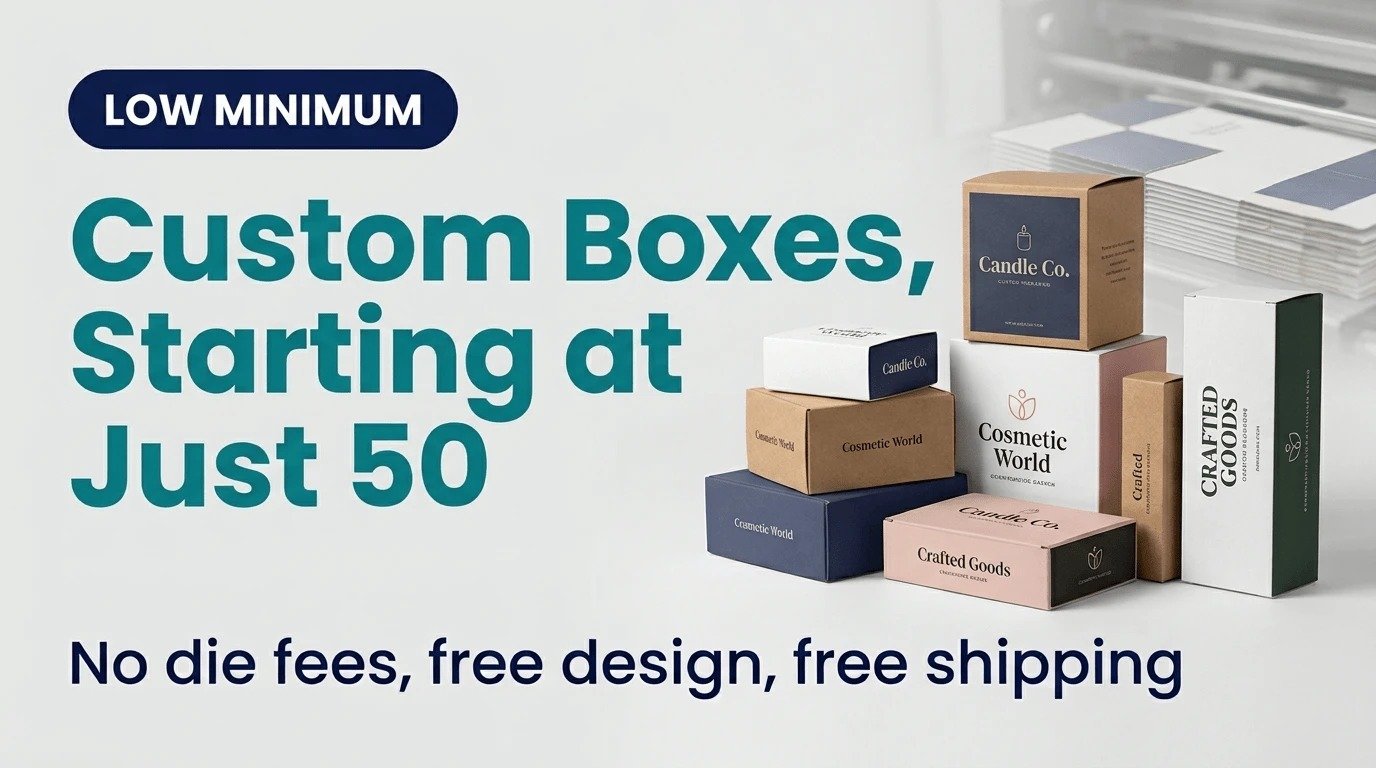
Small Order Custom Boxes: The Short Answer
Yes, you can get small order custom boxes without buying thousands of them. At The Legacy Printing, the minimum order is 50 boxes. There are no die or plate charges, and shipping is free to any address in the USA. That's enough to test a new product, run a holiday set, or try out your packaging before you commit to a bigger run.
Here's a quick look at how a small first order works with us.
| Question | Quick answer |
|---|---|
| What's the minimum order? | 50 boxes |
| Do I pay for dies or plates? | No, there are no die or plate charges |
| Do I need a designer? | No. Our team gives free design support and prepares print-ready artwork |
| Can I see the box before printing? | Yes, you approve a free 3D digital rendering first |
| How long does production take? | 8–12 working days after design approval |
| Is shipping extra? | No. Shipping is free to any US address, with no hidden freight costs |
| Do eco materials cost more? | Kraft and recycled cardboard come at no extra premium |
| Can I test first? | Yes. Ask for a free sample kit, and get 20% off your first order |
What "low minimum" really means
MOQ stands for minimum order quantity. It's the smallest number of boxes a maker will print in one order. Some printers say "no minimum," while others ask for several hundred boxes or more.
A very small order is possible in many places, but it comes with a trade-off. When you print only a handful of boxes, each box costs more, because setup work gets split across fewer pieces. A 50-box minimum sits in a sensible middle spot. It's small enough to protect your cash and storage space, and big enough to give your launch a real test.
Who a 50-box first order suits
A 50-box run works well if you're launching a new product, testing a flavor or shade, or making a limited edition. It also helps e-commerce shops that want branded packaging but don't have room to store thousands of flat boxes. You can browse custom packaging options by industry to see styles made for your type of product.
Why Most Box Makers Ask for Big Minimums
Large minimums aren't random. They come from how boxes are made. Knowing the process helps you understand what you're really paying for.
Dies, plates and setup time explained
Every custom box goes through a few setup steps before the first one comes off the line:
- The die: A die is a metal blade tool that cuts and creases flat board into your box shape. Each new size or shape usually needs its own die.
- Printing plates: In offset printing, a printing plate is a metal sheet that carries your design onto the press. Each color typically needs its own plate.
- Setup time: Someone has to load the board, match the colors and test-run the machine before real production starts.
These costs stay about the same whether you print 50 boxes or many thousands. On a big run, they get spread thin. On a small run, they can make each box very expensive. That's why many printers push you toward a larger order.
What changes when there are no die or plate charges
We don't charge for dies or plates. That removes one of the biggest barriers to a small order. You still pay for the board, the printing and any finishes, but you aren't paying a separate tooling bill just to get started. That makes a 50-box pilot much easier to justify.
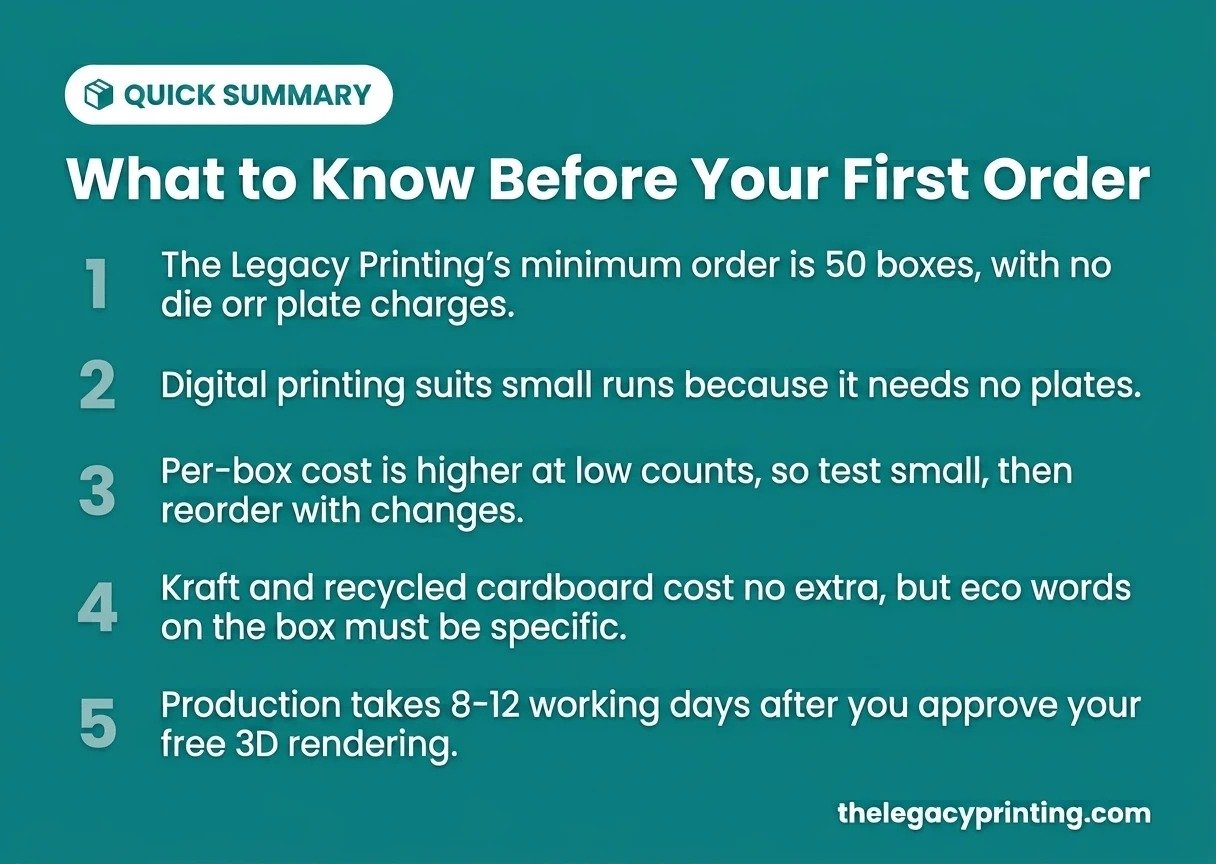
What to Know Before Your First Order
Digital vs Offset Printing for Small Quantities
For small runs, the print method matters a lot. Digital printing prints straight from a computer file, with no metal plates. Offset printing uses plates to press ink onto the board. Here's how they compare.
| Factor | Digital printing | Offset printing |
|---|---|---|
| Setup | No plate setup | Plates and press setup needed |
| Best quantity | Low quantities and short runs | Large runs |
| Cost per box as you order more | Drops a little | Drops more as volume grows |
| Design changes between orders | Easy and cheap to change artwork | New artwork often means new plates |
| Color | Good full-color results | CMYK color, well suited to big jobs |
CMYK means four inks: cyan, magenta, yellow and black. They mix to make most colors you see on a box. For a deeper look, read our guide on offset vs digital printing for custom packaging.
When to switch to offset as you grow
Start with digital while you're still testing. It lets you tweak your design after the first run without paying for new plates. Once your design is settled and you're ordering much larger amounts, offset often becomes the better deal per box. Ask us to quote both when you reach that point, and we'll tell you which one fits.
Quick Decision Table: Pick Your Box by Quantity and Product
This table is general guidance, not a price list. Your best choice depends on your product, budget and goals.
| Quantity | Usual print method | Box styles that fit | Best use |
|---|---|---|---|
| 50 boxes | Digital | Tuck end, mailer, sleeve | Product test, pilot launch, limited edition |
| 100–250 boxes | Digital | Mailer, window, reverse tuck end, rigid | Seasonal sets, small e-commerce shops, gift sets |
| 500+ boxes | Digital or offset (ask for both quotes) | Any style, including die-cut custom shapes | Steady sellers with a final design |
Box styles that work well in small runs
- Tuck end and reverse tuck end: Folding boxes with flaps that tuck in. On a reverse tuck end, the top and bottom flaps open in opposite directions. They're common for cosmetics and small retail items.
- Mailer boxes: Sturdy boxes that fold up and ship products straight to customers. They're great for subscription boxes and online orders.
- Window boxes: These have a die-cut opening so shoppers can see the product inside.
- Sleeve boxes: A printed sleeve slides over a tray. It's a simple way to get a gift-style look.
- Rigid boxes: Thick, firm boxes that don't fold flat. They feel premium but take more storage space.
Materials and board thickness
Board thickness is measured in points, written as "pt" (for example, 18pt or 24pt). A higher number means thicker, stiffer board. Here's what each material does best:
- Cardboard (paperboard): Thin board that folds flat. It's used for folding cartons, like cosmetic and food boxes.
- Kraft paper: Brown, strong paper that is often recycled. It gives a natural look.
- Corrugated board: Board with a wavy middle layer between two flat layers. It's strong and good for shipping.
- Rigid board: Thick board used for premium, gift-style boxes.
What Affects the Price of a Small Order
We won't list dollar amounts here, because every quote depends on the order. These are the main things that move the price up or down:
- Size: Bigger boxes use more board.
- Material and board strength: Rigid and corrugated board usually cost more than thin paperboard.
- Print coverage: Printing the whole box, inside and out, costs more than a logo on one side.
- Finishes: Matte or gloss coating, spot UV (a shiny clear coat on part of the design), foil (a metal-look print) and embossing (a raised design) each add cost.
- Quantity: More boxes usually means a lower price per box.
Why per-box cost is higher at low counts, and how to keep it fair
Setup work still happens on a small job, so each box carries a bigger share of it. To keep your first order reasonable, pick one standout finish instead of three. Use a standard style like a tuck end or mailer before trying a custom die-cut shape. And order the quantity you'll really use in your test period, not what you hope to sell next year.
Custom Packaging for Small Business: Ideas by Industry
Cosmetics
A tuck end box is a classic choice for lipstick, mascara, serums and creams. A 50-box run is a smart way to launch a new shade or scent without filling a storage room. See our custom cosmetic boxes for styles like display, eyelash and perfume boxes.
Food and bakery
Window boxes are great for cookies, cupcakes and seasonal treats, since customers can see what they're buying. Any material that touches food is a "food contact substance" under US rules. It must be allowed for that use. FDA rules for paper and paperboard sit in 21 CFR Part 176, and coatings and adhesives are covered in Part 175. Here's a plain explainer on how FDA food-contact rules work. We use FDA-approved and food-grade materials for food packaging, so ask us to confirm the right material for your product. Browse our food and bakery packaging to get ideas.
Candles, gifts and subscription boxes
Candles and holiday gift sets look great in rigid boxes or sleeve boxes with a structural insert to hold items in place. Subscription and e-commerce brands usually go with mailer boxes, because they protect products in transit and give customers a branded unboxing moment at the door.
CBD and cannabis
Our cannabis packaging includes child-resistant closures and state-specific labeling areas. Child-resistant packaging is designed to be hard for young children to open. Rules differ by state, so check what your state requires before you approve artwork. Keep the box free of health or medical claims, and stick to product facts and required labels.
Eco-Friendly on a Small Run: Kraft and Recycled Board
No extra premium at The Legacy Printing
Kraft paper and recycled cardboard are available in almost every box category, with no extra premium. So going greener doesn't have to cost more, even at 50 boxes. Explore our eco-friendly packaging range.
One tip: brown kraft can change how colors look, since ink sits on a darker base. Bold, high-contrast artwork and larger text tend to read better. A sample kit lets you check this before you print.
Say it right on the box
The Federal Trade Commission (FTC) publishes the Green Guides. They're US government advice on honest eco claims. The main lesson is to be specific. "Made with recycled cardboard" is clearer and safer than a vague "eco-friendly." A "recyclable" claim also has its own rules about whether recycling is really available to buyers. Read the FTC Green Guides summary before you add any green wording.
Your First Order in 4 Steps
Step 1: Choose your style and size
Measure your real product, plus any insert or padding. Then pick a box style. Not sure? Tell us about your product and we'll suggest a structure and material.
Step 2: Send your artwork or get free design
Send print-ready files in PDF, AI or EPS format. Print-ready means the file is set at the right size with the right colors, so it can be printed without fixes. If you don't have files, our team prepares the artwork for free. We'll place it on a dieline, which is a flat outline of the box showing cut and fold lines. Learn more in what a dieline is and how it's used.
Step 3: Approve the free 3D rendering
Before production, you get a digital 3D rendering of your finished box. Check every side, every word and every logo. This is your best chance to catch errors.
Step 4: Production and free shipping
Production takes 8–12 working days after you approve the design. Your boxes are made in-house in Anaheim, California, with no subcontracting, and then shipped free to your US address. Shipping time comes on top of production, so plan your launch with some extra room.
Here's a simple starter plan that works well for first-time buyers:
- Request a free sample kit to feel the materials and see the colors.
- Order a 50-box pilot run, and use the 20% first-order discount.
- Take unboxing photos and ask customers what they think.
- Reorder with any changes to size, color or finish.
7 Mistakes to Avoid on a First Custom Box Order
| Mistake | What goes wrong | How to fix it |
|---|---|---|
| Skipping the sample | The material or color isn't what you pictured | Request a free sample kit first |
| Wrong size | The product rattles around or doesn't fit with its insert | Measure the real product plus insert, and confirm on the 3D render |
| Low-res or RGB files | Blurry images or colors that shift in print | Use high-resolution files in CMYK, or let our team prepare them |
| Too many finishes | Higher cost and a busy look | Pick one standout finish, like foil on the logo |
| Missing legal text or barcodes | The box can't be sold in stores or fails labeling rules | List required text and barcodes before design starts |
| Vague eco claims | Words like "eco-friendly" can mislead buyers | Use specific wording and follow FTC guidance |
| No reorder plan | You run out right as sales pick up | Track stock and reorder before the last box ships |
RGB is the color mode screens use, while printers use CMYK. Files left in RGB can print duller than they look on your monitor.
Best Practices for a Smooth Small Run
- Match brand colors carefully. CMYK covers most colors. If your logo must look exactly the same every time, ask about custom Pantone. Pantone (PMS) is a color-matching system for exact brand colors. Our sample kits come in 1 color, 2 colors, 4 colors (CMYK) and custom Pantone options.
- Keep small text readable. Tiny, thin text can get lost, especially on kraft.
- Use QR codes wisely. Variable data printing puts something different on each box, like a number or QR code. Link QR codes only to pages you control.
- Protect customer privacy. Don't print personal customer details on the box itself. Send logos and artwork through a secure channel.
- Build in a buffer. Plan for 8–12 working days after approval, plus shipping, plus your own launch cushion.
Frequently Asked Questions
What is the minimum order for custom boxes?
Our minimum order is 50 boxes. That keeps your first order small enough to protect your budget and storage space, while still giving you enough boxes to test with real customers.
Do you charge for dies or printing plates?
No. We don't charge die or plate fees on any order, small or large. You pay for the boxes themselves, based on size, material, printing and finishes.
Can I see my box design before printing?
Yes. We send a free digital 3D rendering of your box before production starts. You can request changes until you're happy, and nothing is printed until you approve it.
Can I order a sample first?
Yes, you can request a free sample kit. We follow up on sample kit requests within 2 hours, and kits ship within days. It's the easiest way to check materials and colors before you commit.
Are eco-friendly boxes more expensive in small quantities?
Not with us. Kraft paper and recycled cardboard are available in almost every category at no extra premium. Just keep your eco wording specific and honest on the box.
How long does it take to get custom boxes?
Production takes 8–12 working days after you approve your design. Shipping is free to any US address and comes after production, so plan a little extra time before your launch date.
Can I change my design on the next order?
Yes. Small digital runs make updates easy, since there are no plates to remake. Many brands adjust colors, text or finishes after seeing how the first batch performs.
Next Step: Get a Free Quote
A small first order is the smart way to start. You keep cash in your business, see your packaging in real hands, and improve it before you scale up. With a 50-box minimum, no die or plate charges, free design support, a free 3D proof and free US shipping, there's very little holding you back!
Not sure which style fits? Browse our packaging solutions by industry, or call us at 800 719 2780. You can also email sales@thelegacyprinting.com. Our customer service team is available 24/7, and first orders get 20% off.
Get a free quote for your custom boxes — minimum 50, free shipping in the USA.